

There’s a word that gets thrown around a lot in the U.S. — democracy. The ruling class loves to wrap itself in it, especially when it’s time to attack anyone who refuses to bow to Wall Street, including working-class people here at home. But lately, the target is Cuba again.
With Cuba, the Trump regime is tightening the screws, escalating the decades-long blockade, and ramping up the corporate smear machine. Their message is always the same lie: “Cuba is a dictatorship. We are the beacon of freedom.”
But let’s think for a moment on our democracy in the U.S. Who actually rules? Who decides what happens to our paychecks, our healthcare, our right to organize a union, our children’s future?
If we look at the U.S. and then look at Cuba, we won’t see “democracy” versus “tyranny.” We will see two completely different systems. One is built for billionaires, the other built for the people.
One dollar, one vote
The United States runs on a simple principle: one dollar, one vote. Take for instance the 2024 election cycle where a handful of billionaire families poured more than $2.6 billion into federal races. Dark money groups, the kind where you never see the donor list, spent nearly $2 billion (that we know of). This is not democracy, it’s a sealed-bid auction for the presidency and Congress.
When the Supreme Court made the Citizens United ruling, it kicked down the wall between corporate boardrooms and the halls of power. Now, if you want to run for office, your first job isn’t to listen to voters. It’s to dial for dollars. And who answers? The same capitalists who want massive tax cuts, stock-buy-backs, deregulation, and unions busted in workplaces.
The MAGA assault: trying to burn democracy down
And just when workers, after decades of back-room dealing between the C-suites and Washington, thought U.S. bourgeois democracy couldn’t get any more hollow, along comes the MAGA regime to set what’s left on fire.
Trump isn’t just bending the rules of bourgeois democracy — he’s shredding them.
Let’s consider the record.
Union busting on a historic scale: Over 1.3 million federal workers lost their collective bargaining rights. It was the biggest single attack on organized labor in U.S. history. And don’t think it stops there. The message to every private sector boss is now: “Go ahead, break the unions. The White House has your back.”
Birthright citizenship under attack: Despite the crystal-clear language of the 14th Amendment — “all persons born or naturalized in the U.S. are citizens” — the Trump regime is openly challenging the right of anyone (of color) to be a citizen and participate politically.
Deportation without due process: The Alien Enemies Act of 1798 is being dusted off and used to round up and expel people with no hearing, no lawyer, no nothing. The 5th Amendment guarantees due process. MAGA says: “Not anymore.”
Privacy for sale: Elon Musk’s so-called “Department of Government Efficiency” vacuumed up sensitive data from the Social Security Administration and other agencies. Millions of Americans’ private information is now sitting on servers in violation of privacy laws and respect for human dignity — all in the name of “efficiency.” In reality, it was a billionaire’s data grab with no public, democratic oversight.
Trying to ram through anti-voter bills: the SAVE Act and the MEGA Act would disenfranchise millions of eligible voters from being able to register and cast their ballots — especially women, the LGBTQ community, people of color, and seniors. It is the most sweeping federal attack on voting rights since the Jim Crow era.
This isn’t a “drift” toward fascism by the U.S. ruling class, but a sprint. And it’s being cheered on by the same billionaires that benefit from a weak working class, a terrified civil service, and a public where some feel powerless, alienated, and that mass, popular struggle is “impossible.”
And don’t forget the place where workers spend the majority of our waking hours — on the job. In the U.S. under capitalism, our workplace is also a dictatorship. Our bosses control when and where you work, how much you are paid, what medical insurance you deserve in their eyes, and other aspects of workers’ lives. They can fire us for any reason, or no reason at all, under “at-will employment.” Without a union contract, we have no real say over working conditions, no control over production, and no right to challenge the boss’s bottom line.
Union density in the private sector has fallen to 6% — the lowest ever recorded. When workers do try to organize, we face captive-audience meetings, illegal firings, and endless “legal” delays. The National Labor Relations Board, crippled by Trump appointees, has become a shell of itself for worker grievances.
Cuba’s socialist democracy: power in the hands of the many
Now let’s turn our eyes back to Cuba — a small island that has survived over six decades of the most brutal economic blockade in modern history. We find not a dictatorship, but a democracy of a different kind — one rooted in mass people’s participation, not billionaires buying elections and candidates.
Cuban President Díaz-Canel put it well in a recent interview: “If the Cuban people believed I was unfit to be president, I wouldn’t be here.” His comment is a reflection of a democratic system where leaders don’t buy their way into office, they are elected on merit and popular support.
In Cuba, there are no political TV ads, no billionaire donors, no Super PACs. Candidates are nominated in neighborhood assemblies by the community. Cuba’s 2019 Constitution wasn’t written in a back room, either. It was debated in over 130,000 meetings involving nearly nine million people. Then it went to a referendum, where 87% voted yes.
When a Cuban deputy foreign minister was asked recently about the U.S. demand to “end the one-party system,” he didn’t flinch. He gave the journalist a lesson in real democracy: universal healthcare, free education from kindergarten through university, housing as a right, not a commodity. He noted that Cuba ranks higher than the United States in international comparisons of health and education outcomes.
A country under decades of blockade — a country the U.S. has tried to strangle — still manages to keep its infants alive at rates better than many U.S. states. The same is true for general life expectancy. It still teaches every child to read and still sends doctors to disaster zones around the world, not to profit off of them but to heal those hurt in the events.
The Cuban Revolution was a democratic revolution in the deepest sense — a breaking of the old landlord class, a seizure of land and housing for the people who worked. The 1959 agrarian reform took 70% of the country’s land out of the hands of a few wealthy families and gave it to the farmers who actually tilled the soil. The Urban Reform of 1960 turned renters into owners, slashed rents by up to 50%, and ended the speculation that keeps working people trapped.
Before the revolution, most Cubans were illiterate. Today, Cuba spends a larger share of its GDP on education than almost any country in Latin America.
These gains are the product of a system that puts people’s needs above private profit. Cuba’s constitution guarantees healthcare, education, housing, and food as rights — not as commodities to be bought and sold.
The contradiction imperialism can’t face
So why does the U.S. government hate this system so much? Why spend decades tightening a blockade that the entire world — year after year in the UN General Assembly — votes to condemn?
Because Cuba is a living counterexample. It shows that another way is possible. It shows that you don’t need billionaires and “free markets” to run a country. It shows that democracy doesn’t have to mean “freedom for capital” — it can mean freedom from capital and ultimately who controls it.
The fact is that Cuba has better health outcomes, higher literacy, and is a society where no one starves, where every child goes to school, where the elderly aren’t bankrupted by medical bills.
Cuba has built a democratic system with a socialist character — under very difficult conditions — where money doesn’t buy power, where participation is real, and where the goal of politics is not to enrich the already-rich but to meet human needs.
Does Cuba have contradictions? Of course. It faces enormous economic pressure, and the blockade causes real suffering. However, in Cuba, the national debate is always over how to best serve the people. In the U.S., our national debate is over how to best serve the billionaire class and the interests of imperialism and how to keep the stock market high while the people go hungry.
Fidel Castro once asked: “What kind of democracy is it where the rich decide everything?” That question hangs over every U.S. election, every corporate merger, and every union-busting campaign. And it’s the question that the MAGA regime — and the capitalist system it serves — can never answer.
The U.S. is not the defender of democracy. It’s a defender of billionaires. And Cuba, against all odds, remains a beacon of what working people can build when they take power into their own hands.
The opinions of the author do not necessarily reflect the positions of the CPUSA.
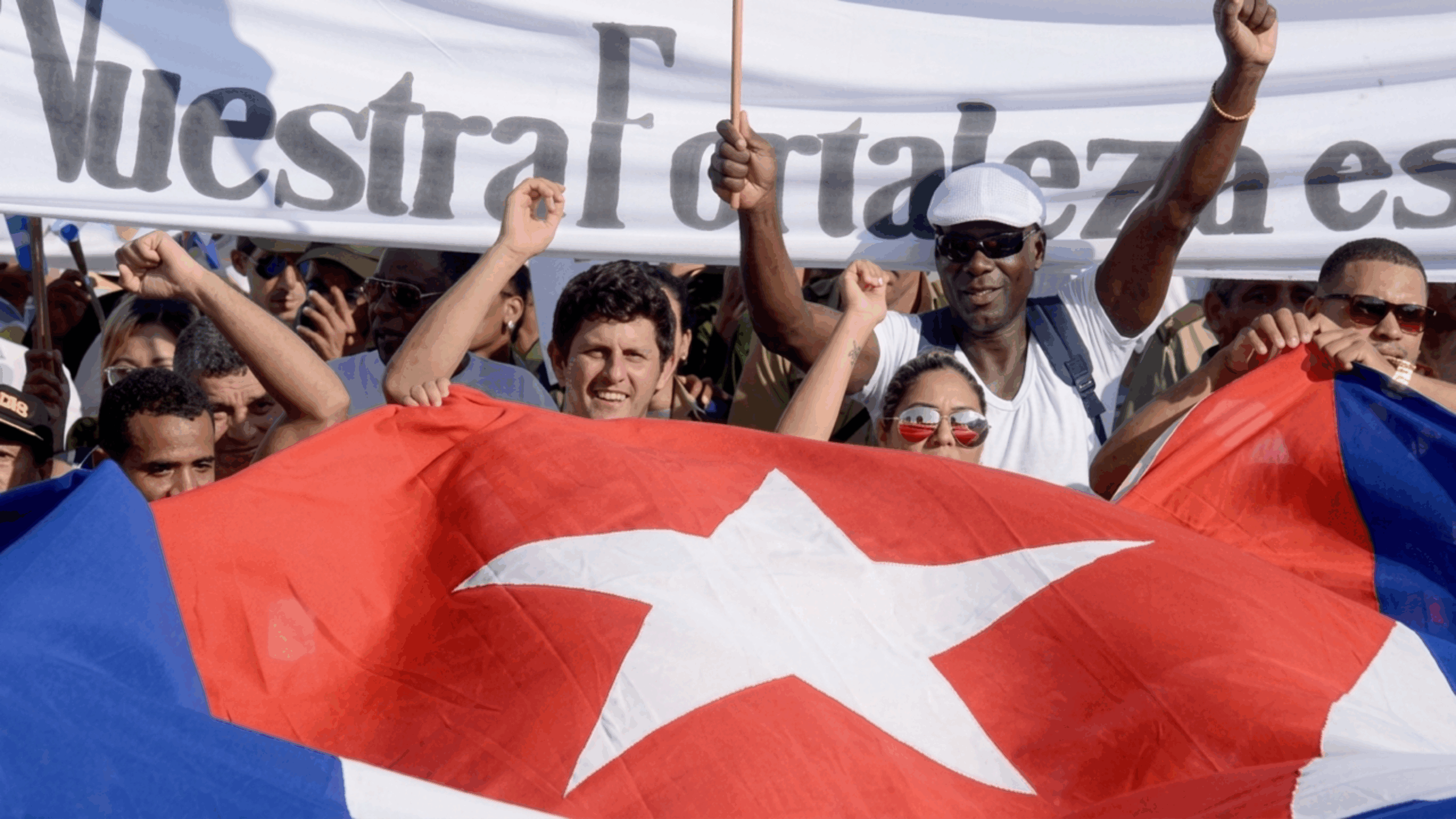
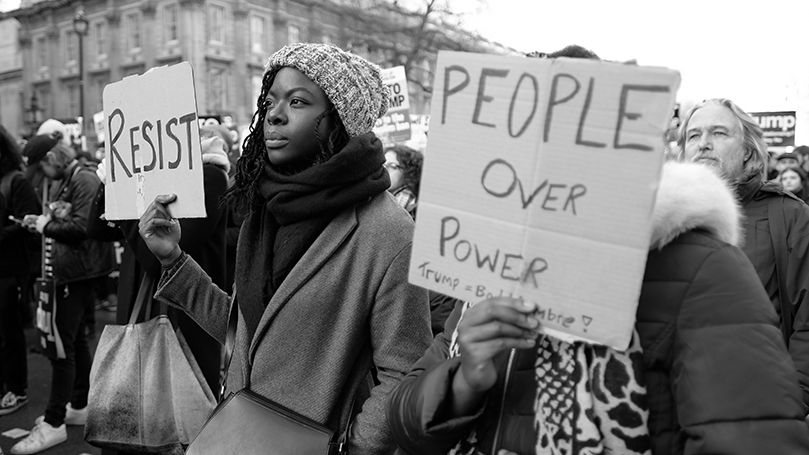
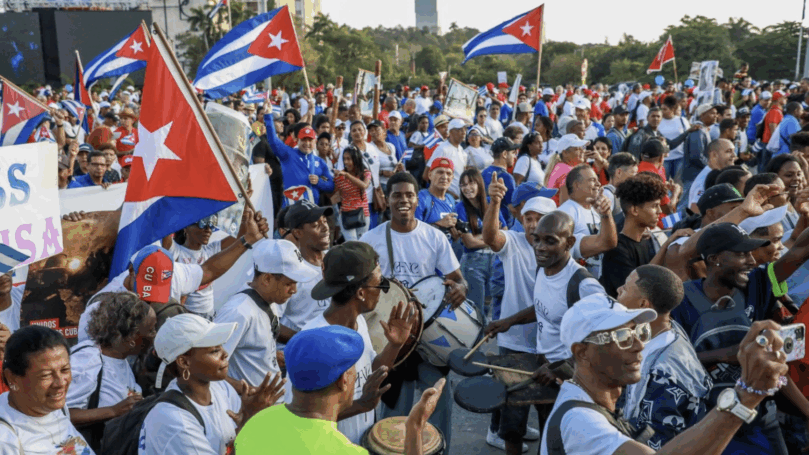
Images: Cuba: Our party is unique because it guarantees the unity of all Cubans intent on building a more democratic, inclusive and just society. Granma; Resist and People over Power. Alisdare Hickson/Wikimedia Commons; Cuban people on May 1 in the Plaza of the Revolution. Miguel Díaz-Canel/X.
Author

-
Cameron Harrison is a trade union activist and organizer for the CPUSA Labor Commission.
 Join Now