

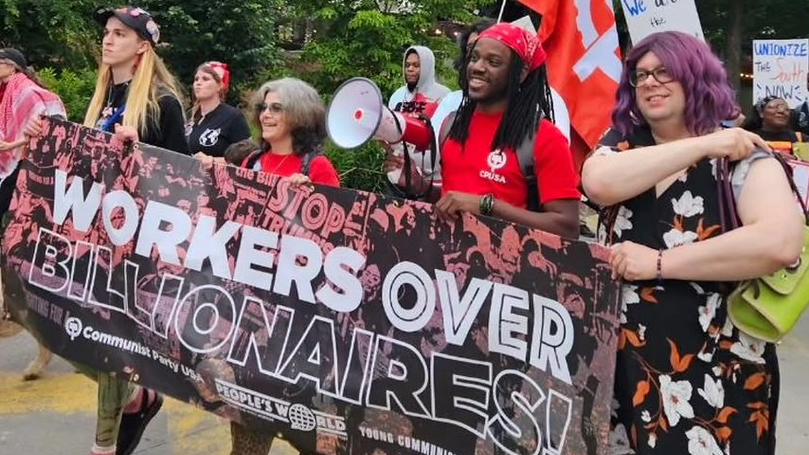
Lenin was not subtle about the relationship between a Communist Party and its newspaper. In What Is to Be Done?, he famously declared that a newspaper is “not only a collective propagandist and collective agitator” but also “a collective organizer.” He compared the party press to the scaffolding erected around a building under construction — connecting the builders, coordinating their labor, and making visible the shape of what they were doing together. The newspaper was not a supplement to the party. It was, in a very real sense, the skeleton around which the party grew.
That idea was not merely theoretical for Lenin. He proposed building the revolutionary organization of the Russian working class around the distribution network of Iskra — the newspaper he helped found and edit in the early 1900s. The agents who moved the paper from city to city, factory to factory, became the connective tissue of what would become the Bolshevik Party. The paper was the organizing tool, and the distribution was the organizing work.
For the Communist Party USA, that tradition has a long and living history. From the Daily Worker to the Daily World to the People’s Daily World to the People’s Weekly World and now to People’s World, our press has always been more than a publication. It has been, at its best, the party’s public face, its educator, its organizer, and its voice in the broader movements of the working class. The press is the link between the party and the movements, bringing Communist analysis to the movements while integrating the movements’ experience into the party’s thinking.
So why has it been so hard to actually build our party around our press?
The print vacuum
When People’s Weekly World ended its print run in 2010 and transitioned to an online-only publication, it created a vacuum that the party was not fully prepared to fill. The decision was understandable on financial grounds — print costs had become punishing, and the internet seemed to offer a cost-effective alternative. The experience of the Obama 2008 presidential campaign left people all across the political and labor worlds with stars in their eyes when it came to the internet. But the transition cost us something that wasn’t immediately obvious: the work of distribution.
For decades, party clubs had organized themselves in large part around the paper. Members had routes — neighborhoods they walked, workplaces they visited, picket lines they covered. Distributing the People’s Weekly World was not just a task; it was a discipline. It gave members a regular, tangible connection to the party’s political life. It forced conversations. A paper handed to a co-worker on a lunch break opens a door that a web page could not replicate at that time. The physical act of distribution was itself a form of organizing.
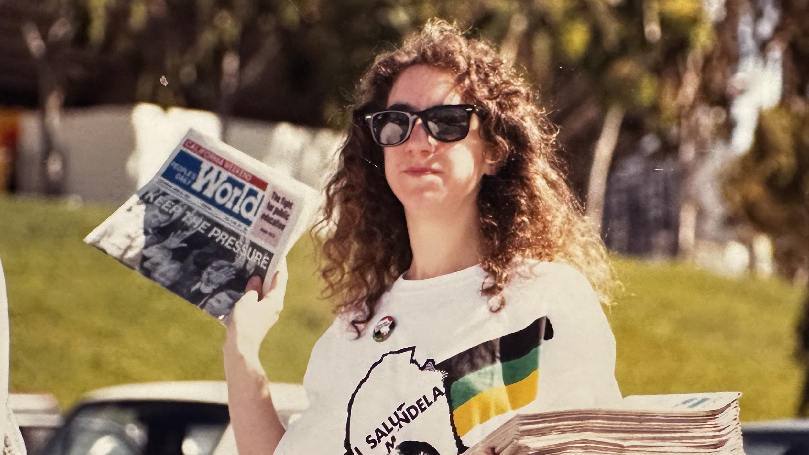
For new and younger members, distributing the paper was often their very first assignment. It was an early and practical education in what it meant to build the party around the press. You showed up, you took your stack of papers, you learned which shops and union halls would display them, and in the process you learned something fundamental: The press was not a passive product to be consumed. It was an active tool. When the print paper disappeared, that initiation disappeared with it. Newer members joining in the 2010s and after often had no lived experience of what it even meant to “build the party around the press.” The phrase was an abstraction.
The transition to online-only presented challenges that were genuinely new. Posting an article to Facebook or forwarding it via email is not the same as putting a paper in someone’s hands, and for many members, coming up with a way to recreate that experience has not been easy. And there is the fact that all the various digital channels come with their own structural obstacles: algorithm updates throttle our reach with little notice, junk-mail filters intercept our e-blasts, and social media platforms increasingly deprioritize political content from smaller organizations.
The fund drive fades, and with it, the culture
Compounding the loss of the print edition was an organizational retreat that happened around the same time: the suspension of the annual People’s World Fund Drives. These drives had always served a dual purpose. Obviously, they raised money. But they also regularly placed the press at the center of club life. Members who participated in fund drives were members who were thinking about the press, talking about it, and making the case for it to their neighbors, co-workers, and comrades.
The suspension of the fund drives coincided with a broader period of organizational decline, including a move away from the local club structures that had long been the basic unit of party life. The cumulative effect was to push People’s World further and further to the margins of what members thought of as their primary work. The press became something the party had rather than something the party was organized around.
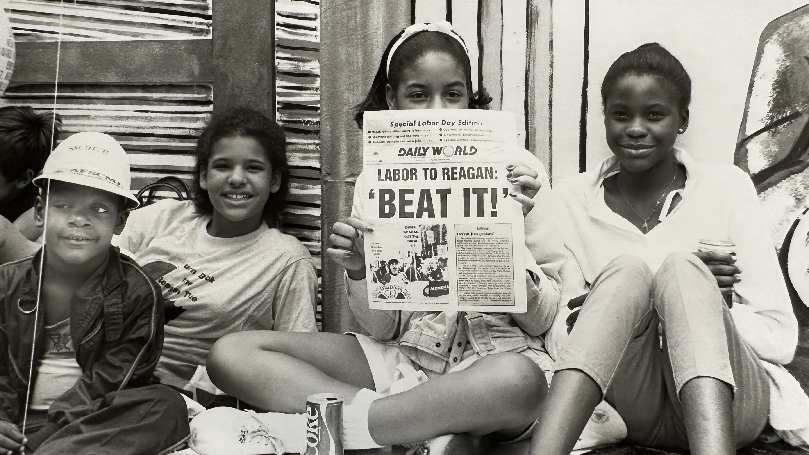
The fund drives have returned, thankfully. But neglect accumulated over years does not dissolve quickly, and habits that have lapsed do not snap back into place so fast, either. After a prolonged period of treating fundraising for the press as a secondary or optional concern, rebuilding that culture requires sustained effort and deliberate reeducation.
Some of the most successful means of fundraising — just like any other political task — are collective ones. Banquets, award luncheons, and movement solidarity events have always been among the most significant contributors to the People’s World fund drive. In the districts that hold them regularly, these gatherings have become premier party-building events on the annual calendar — occasions not just to raise money but to bring together our partners, allies, and friends from labor and the broader movements in a setting that reminds everyone why People’s World — and by extension, the Communist Party — matters. They are a demonstration, in miniature, of the united front in action.
Rebuilding the fund drive culture does not have to mean starting from scratch; it can start with a small event, expanding outward and learning from bigger districts what it takes to put on something that not only we in the party but our allies also look forward to.
Learning from what works
The honest accounting of these difficulties is not a cause for despair but rather for clarity. Alongside all the challenges discussed so far, there are also real and instructive experiments underway that get us started toward finding some answers.
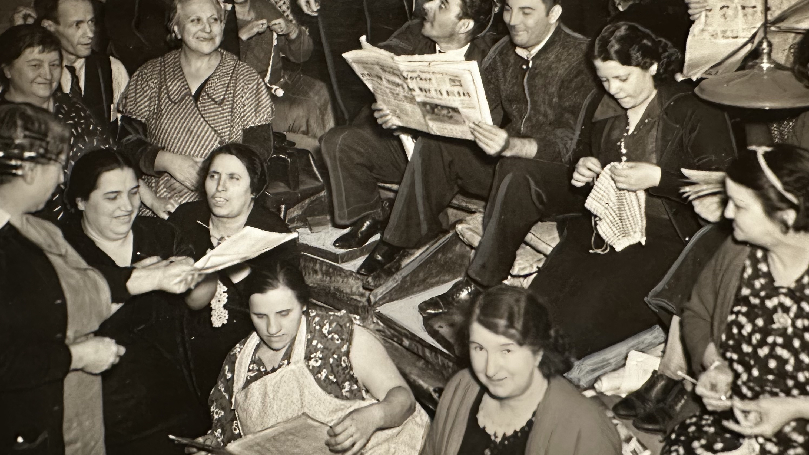
Connecticut stands out. The Connecticut district never abandoned the practice of regular neighborhood and workplace outreach with People’s World material. Their sustained commitment to distribution — week after week, route after route — helped them build a sprawling network of local party clubs that stands as evidence that the Leninist instinct was right: The organizing work of press distribution is party-building work.
In recent years, we have begun encouraging other clubs to experiment with local print editions — weekly digests in some places, monthly editions in others, depending on what capacity they have. The results have been encouraging, and many clubs and districts across the country have experience that we need to find ways of collecting and exchanging: Ohio, Michigan, Philadelphia, the Southern Workers Voice edition, and several more.
A local print edition gives members a dedicated collective task: meet together, discuss the content, plan out whose hands you want to put it into, print it out, fold it, and then go out to distribute it together. It provides a reason to gather that is also a reason to engage politically. It functions simultaneously as an internal organizing tool, an opportunity for political discussion and strategizing — and as an outward-facing one, building coalition through the stories chosen for local coverage while directing readers toward the main website.
Hand cards and flyers built around specific struggles — with QR codes linking to PeoplesWorld.org — have also proven effective at demonstrations and rallies. They are inexpensive, flexible, and easy to produce quickly. Special four-page print editions for significant events like May Day, Juneteenth, or No Kings Day, designed centrally and printed locally, have given clubs another way to show up at major moments with something concrete in their hands.
These approaches are yielding results. More people are contacting us wanting to write for People’s World. The diversity of contributors is growing. The connection between club activity and press activity is being rebuilt, piece by piece. For a lot of members, People’s World is back on their radar in a way that it wasn’t a few years ago.
Local People’s World social media accounts have become another meaningful form of focused “distribution.” The @DCpeoplesworld account on Instagram stands out in this regard, having built a following of over 5,000 — and put it to work. Whenever there is a coalition event or a story worth amplifying in the District, they get it out immediately to the allies, activists, and movement organizations who follow them. Chicago and other clubs are actively building their own followings along similar lines, including on X. This work, too, is distributing the press. It is an extension of the same logic that used to motivate people to stand outside plant gates with stacks of papers: getting People’s World content into the hands, feeds, and conversations of the people we need to reach, where they already are.
Lenin wrote that the party newspaper requires as many people “as possible to contribute their ideas and experiences.” That remains the standard. Every writer recruited, every club that takes up distribution, every fund drive participant is a step toward meeting it.
The website question
All of the print and distribution work described above is ultimately in service of directing people to PeoplesWorld.org as a daily source of news and a tool for organizing work. That makes the quality and functionality of the website a matter of real organizational urgency.
The current People’s World website was built in 2015–16 and is now over a decade old. It increasingly presents technical problems, struggles with mobile compatibility, and is expensive to update without relying on the original developers.
A redesign would make People’s World more flexible in the kinds of content it can feature and more accessible to the readers we need to reach. Given the financial constraints facing both the party and Long View Publishing, however, the timeline for such a redesign is uncertain — but it is a need that will only grow more pressing. It may be worth a special campaign at some point once we can get an idea of the cost involved.
Toward a People’s World Conference
All of this points toward the need for a broader, more systematic conversation — one that goes beyond what I’ve put down here as a single individual. The suggestion has been floated that it is time to convene a National People’s World Readers Conference. It is an excellent idea and worth serious planning, perhaps with 2027 as a target.
The old Daily Worker and Daily World used to hold periodic conferences that brought together readers, distributors, supporters, and contributors — from inside and outside the party — to assess how the press was doing and strategize about how to do it better. That kind of periodic gathering, rooted in practical experience and oriented toward practical improvement, is exactly the kind of collective thinking we need now. Questions of digital distribution, local print editions, fund drive culture, the website, and the recruitment of new writers and contributors all deserve more sustained collective discussion than they typically receive.
Building the press is building the party
Lenin understood something that the history of our own movement confirms: a Communist Party that is not organized around its press is a party that has lost one of its most essential instruments. The press is not a vanity; it is not only the concern of the comrades whose daily responsibility it is to produce; it is not just another item in our budget. It is the voice of the party and a voice for the movements — simultaneously an expression of what we stand for and a tool for building the forces that can fight for it.
That Leninist principle is one we need to do more to revive and inculcate among our members new and old. We can no longer allow People’s World to be just another task on a long list of things members have to do — especially not a task that is far down that list!
Luckily, we are not starting from zero. Connecticut has shown a model of local club building focused on the press. Local print experiments are showing that it can be adapted. Writers’ groups and new contributor classes are showing that the pipeline of voices can be widened. The fund drive can once again become a regular feature of club life. Smart and constantly evolving use of social media is opening new channels for distribution and coalition-building.
The challenge before us is to take these scattered experiments and successes and make them standard practice — to rebuild, consciously and collectively, the culture of a party that understands its press as the scaffolding around which it builds itself.
When you build the press, you are building the party. That was true in Lenin’s time. It was true in the era of the Daily Worker. It is true now, in the era of PeoplesWorld.org. The medium changes, and the methods of distribution are updated, but the core principle remains valid.
In many respects, the work of building the party around the press is just beginning again. Let’s get to it.
The opinions of the author do not necessarily reflect the positions of the CPUSA.
Images: Atlanta CPUSA at march. CC BY-NC 2.0. 1990s by People’s World. CC BY-NC 4.0. Labor to Reagan: beat it by People’s World. CC BY-NC 4.0. Flint sit-down strikers read Daily World by People’s World. CC BY-NC 4.0.

 Join Now