

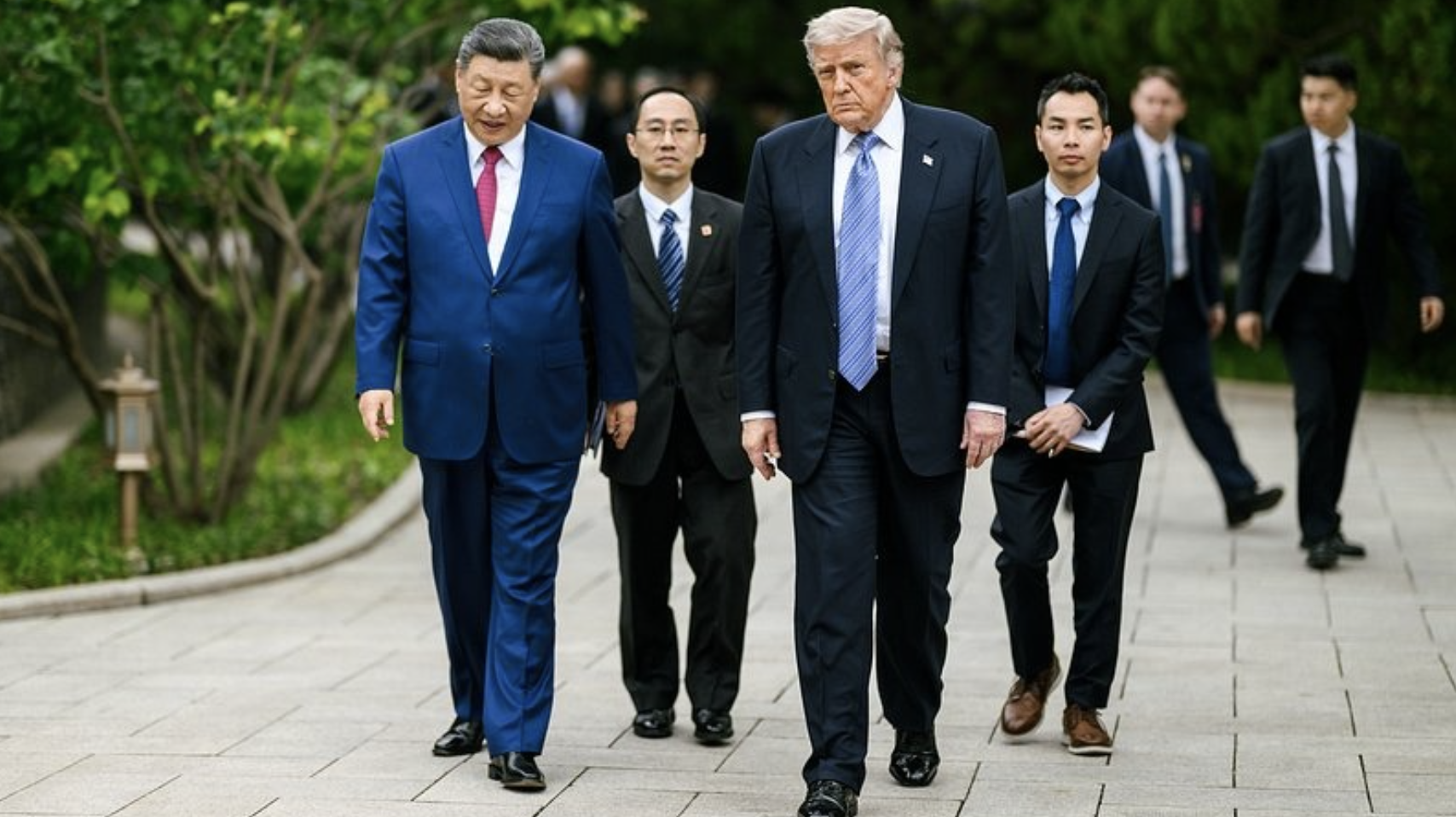
The summit between Presidents Donald Trump and Xi Jinping, overall, was modestly positive and constructive, even if no major deals or decisions were made. The U.S. struck a positive mood with red-carpet treatment, and China loaned two giant pandas to the Atlanta Zoo. These symbolic gestures helped set a friendly tone for the summit. In the U.S.-China relationship, talking is better than not talking, and any form of diplomacy should be supported, especially at a time of many wars.
The world will welcome the extension of the temporary tariff truce and the dialing down of tensions. The last summit in Beijing concluded with a commitment to “strategic stability,” and this meeting seemed to fulfill that commitment. While there was some improvement in tone and transactional relations, deeper contradictions and possible long-term problems were not addressed and remain. The contradiction between the socialist and capitalist systems also remains.
China stressed that the principles of “respect, fairness, and reciprocity” are the basis for sound, productive bilateral relations. This formulation was part of the consensus, appearing in both countries’ official readouts and summaries. How it is actually implemented will disclose the policy behind the statement. Meanwhile, the U.S. continues to uphold its position supporting Taiwan, yet withholds final approval of the current $14 billion arms package.
The May 2026 summit in Beijing established two U.S.-China bilateral boards, which are beginning to function. The new Board of Trade had some accomplishments, with $30 billion in mutual tariff reductions. Some trade adjustments were made on both sides. The U.S. complained about China’s slow pace in releasing rare earths and its lack of soybean purchases. China rejected the U.S. policy of not selling advanced high technology to China, calling it an attempt to hinder or contain China’s development.
There were no major changes in tariffs. The volume of trade is smaller because of the tariffs, but total trade is still huge, with the balance still favoring China. The new Board of Investment raises interesting possibilities, such as the prospect of significant Chinese investment in US industries. This, of course, was met with strong opposition from anti-China politicians.
Xi announced that China would grant an additional 100,000 student visas over five years to American students and youth. The initial allotment of 50,000 from the last meeting is already filled; this shows the enthusiasm of students in the U.S. who want to learn about the huge, colorful, and increasingly modern China, which is becoming a big part of young people’s future world. U.S. youth are less likely to hold the dated anti-communist, anti-Soviet dogmas of the past. The overall impact of these and other people-to-people exchanges can be substantial towards peace and an end to the new Cold War on China.
China’s first lady and Xi’s wife, Peng Liyuan, received some favorable treatment in the mainstream media. Peng had a career as a well-known popular singer in China and has been a public figure for some time. At the big banquet, stories were exchanged about gung-ho Marines and the US and China as allies in World War II.
In the U.S., cooperation with China is now rated higher in public opinion polls than approaching China as a hostile adversary. Successful U.S.-China collaboration on international law enforcement has led to the arrests of many figures in international illegal drug and fentanyl networks.
There was also an important agreement to schedule ongoing dialogue on AI issues and direct communication on AI in case of an emergency. These are productive examples of cooperation. Xi said, as always, that U.S.-China relations should be governed by cooperation first, competition second.
China’s view contrasts with the “fierce competition” focus that was first introduced by Obama’s “Pivot to Asia” and supported by both sections of the U.S. ruling class since.
Both the Democratic and Republican parties have had an anti-China consensus and have supported imperialist foreign policy, with some exceptions among progressives. Among the capitalist class in general, there is exists a split between the capitalists who favor friendly relations with China in the interests of practical moneymaking, whereas there also those — such as MAGA Rep. John Moolenaar of Michigan, who chairs the so-called “House Select Committee on the CCP” — who represent the most rabidly anti-China and anti-communist section.
The military-industrial complex also favors an increased bellicose attitude towards China, particularly in the military build-up of the whole Asian Pacific, including weapons sales to Australia, Taiwan, South Korea, and Japan, for the sake of profit making. This adversarial position is held by the Trump administration’s National Security Strategy, which asserts that China is the principal, long-term rival.
Some Democrats criticized Trump for treating Xi to a top-level diplomatic reception, even meeting Xi’s plane as it arrived at the airport. For example, Elizabeth Warren joined other Senate Democrats in writing a statement saying that China “presents a greater threat to American security and prosperity than ever before.”
China proposed cooperation in creating international AI governance, supporting UN initiatives, and launching the World AI Cooperation Organization in Shanghai. Trump, however, refused any international regulations, saying the U.S. will defend its supposed one- to two-year lead by keeping AI regulation as a voluntary program for private companies.
As is common lately, the two countries issued no joint declaration. However, the official readouts and summaries from both sides were positive in their assessment of the summit. The Chinese emphasized the positive, hoping that a good new start for the two countries had arrived. There was consensus wording on Iran: that Iran should not have nuclear weapons and that international waterways should be open for commerce. Nothing was said about the frequent U.S. charge that China is sharing satellite data, thereby assisting the Iranian military. For its part, China described the equipment sale as fulfilling long-standing commercial contracts.
Nonetheless, it is favorable that the countries are now arranging two further Xi-Trump meetings this year, one in Shenzhen at the APEC summit and another in Miami for the G20. Dialogue is better than confrontation and conflict.
The opinions of the author do not necessarily reflect the positions of the CPUSA.
Image: U.S. President Donald J. Trump and President Xi Jinping of the People’s Republic of China. The White House on Flickr.

 Join Now