

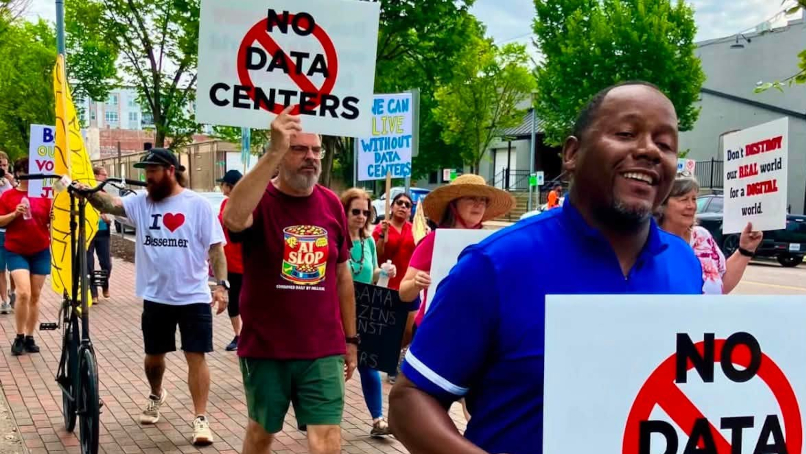
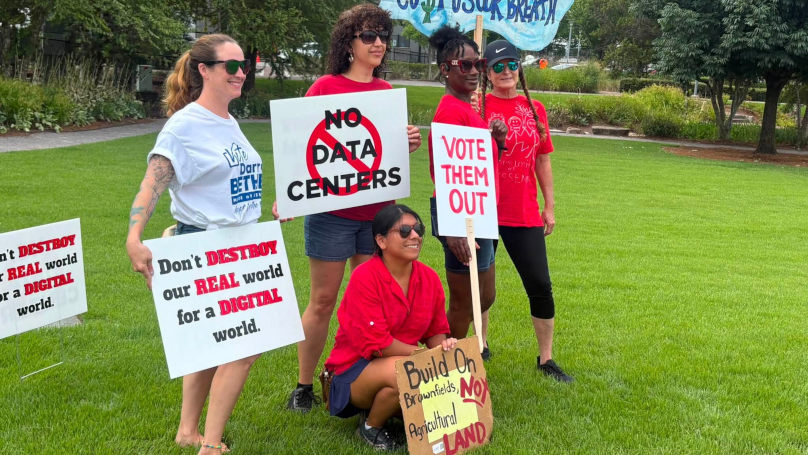
The room is quiet, filled with about 200 people, heads bowed in prayer of gratitude. Their candidates unseated the mayor and several city council members in an election in Bessemer, Ala. Activists, frustrated by unsuccessful attempts to get answers from their local government about the data center, dubbed Project Marvel, decided the only way to express their dissatisfaction was to vote them out. And they did.
Across town, in Birmingham, residents protesting the 75-acre Nebius Project data center say they don’t like the shady way that the city has done business so far. They filed a class action lawsuit against project developer Nebius and the city, claiming the city allowed the project to progress without proper zoning approvals or public hearings. They asked the judge to stop all construction at the site and grant damages for falling property values and reduced quality of life. The lawsuit failed due to a legal technicality.
Data center defenders say the resistance is an irrational aversion to technology dating back to the 19th century when “Luddites,” workers in the English textile industry, waged war against new, automated machinery that threatened their jobs. They complain about the intellectual naïveté of activists who, they say, are driven by absurd conspiracy theories. The activists, meanwhile, are deeply skeptical about promises of hundreds of high paying local jobs, more tax revenue for the city, a bonanza for schools and more economic development. Their biggest gripe? Government overreach and lack of transparency.
In Bessemer (population under 26,000 and declining), the resistance sprang up over just a few months, cutting across party lines to challenge what many consider stealth efforts to avoid public scrutiny. Residents claim the NDAs (non-disclosure agreements) the mayor, city council, and crucial city employees signed were designed not only to shield developers from competition, but to stave off questions from concerned citizens.
The NDAs in particular angered residents who say there is something fishy about the deal. The suspicions only got worse as their efforts for information were met with disdain. One city council member, faced with questions from residents, told them it was none of their business. The then-current mayor called protesting citizens “crazies,” and Alabama senator and gubernatorial candidate Tommy Tuberville called their concerns “bull crap.”
Disputes like Bessemer’s have attracted the attention of news media as well as regional and national legislators who appear to be listening. In Alabama, Tuberville began to backtrack on his “bull crap” statement, saying he wants local governments to be able to reject plans for data centers. But then he further confused the conversation by announcing he is fully behind data center development.
Running for re-election, Jefferson County Commission chair Jimmie Stephens, just a week after the Bessemer election upset, sent out mailers to his constituents claiming to “renew” his opposition to data centers. But he previously said there is little the commission can do about the development. (Commission opposition has no impact on Marvel or Nebius projects.)
Both Bessemer and Birmingham hope to either pause or suspend projects until there are more definite strategies for addressing concerns about noise, air and water pollution; issues around power grid sustainability; costs to power and water consumers; and the incentives offered to developers such as tax abatements and promises of support for local schools. The misgivings are plenty.
Project Marvel
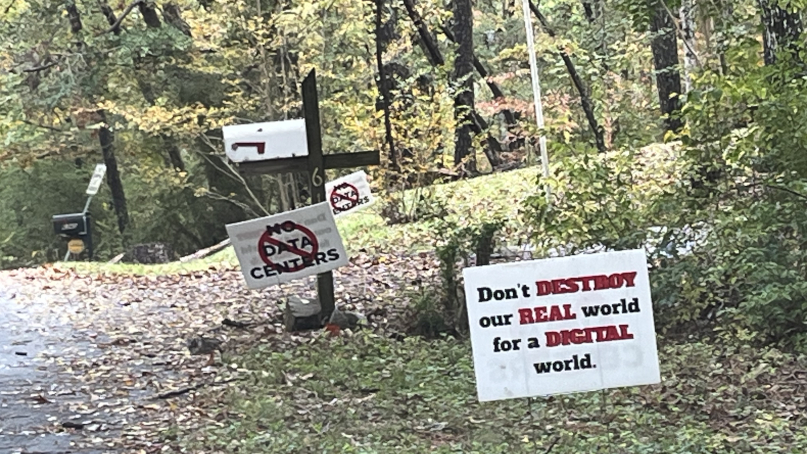
The developer in Bessemer is Virginia-based QTS Data Centers, a major developer of data centers across North America. Project Marvel started out as a 700-acre project but very quickly grew to 1600 acres after the city council zoning committee approved the developer’s request to rezone the property from agricultural green space to industrial. That’s when residents began to hear of a “hyperscaled” data center that would consume enormous amounts of electricity and water for cooling. They heard of other projects, like those in Virginia, where utility bills soared after data centers became operational. And they wondered about the impact on the water supply and the potential strain on the power grid.
Many residents already experience occasional power outages from seasonal storms. In addition, there is the environment. The 1600 acres is a heavily wooded home to a wide variety of wildlife — deer, bald eagles, and a little-known species of fish dubbed the Birmingham Darter. Scientists are in the process of acquiring endangered species designation for the darter through the U.S. Fish and Wildlife Service. But the process is slow.
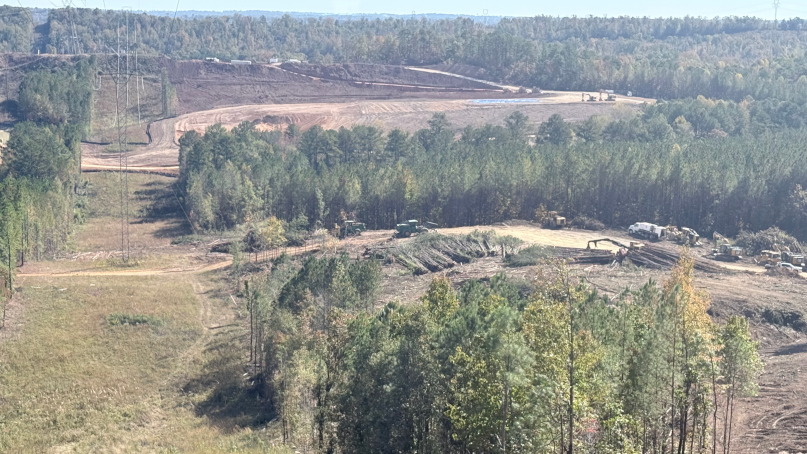
The plans are to raze the acreage and place 18 buildings — each one the size of a Super Walmart — on the property. Each building will have diesel generators that will kick in during power outages and other moments of need. The generators are one more point of contention. They not only generate power for the giant computers, but also air pollution that will likely infect the homes and schools of the community. And there is noise pollution. People who have experience living near data centers say it’s not just the generators that make the noise. There is the constant whirring from cooling systems and humming from fans. Together they produce a chorus of noise that residents say data center developers make no effort to muffle or limit.
High noise levels, particularly at night, can cause sleep deprivation and decreased cognitive performance, which shows up in poor school or work performance. The elderly, children, shift workers, the less affluent, and people with chronic illnesses are most likely to be impacted by noise pollution.
Data centers have a voracious appetite for electricity, and there are a variety of claims about how this affects utility bills. But the story of whether bills go up is complicated, so an across-the-board answer to the question is not a yes or no. Data centers do increase demand which means states have to address grid and delivery cost increases which may be passed on the consumers. This is where consumers may see the higher utility bill. But this isn’t always the case. In states where consumers have a choice of electricity providers, they can shop around for the portion of the bill these companies provide.
Having the ability to shop around helps, but most states don’t have that option, so consumers have less opportunity to lower their bills. Additionally, states with more dense data center build out — like Virginia and Texas — will experience higher rate increases than those with less data center activity. That simply means that figuring a national average results in a number that doesn’t accurately reflect the picture state-by-state. The true answer to the question — “Do data centers increase residential electricity bills?” — is “It depends.”
Still, the potential for water scarcity and electric grid strain is enough to cause concern. And increased health problems plus likely damage to the environment all contribute to what may be serious damage to quality of life for communities that house data centers. Those communities are often already oppressed. In Memphis, Tenn., Musk’s xAI — touted as the biggest supercomputer in the world (for now), is surrounded by working-class Black communities. Residents have faced air pollution problems for decades and now, with xAI and its dozens of methane gas turbines, they say it’s getting much worse.
Exploiting oppressed communities
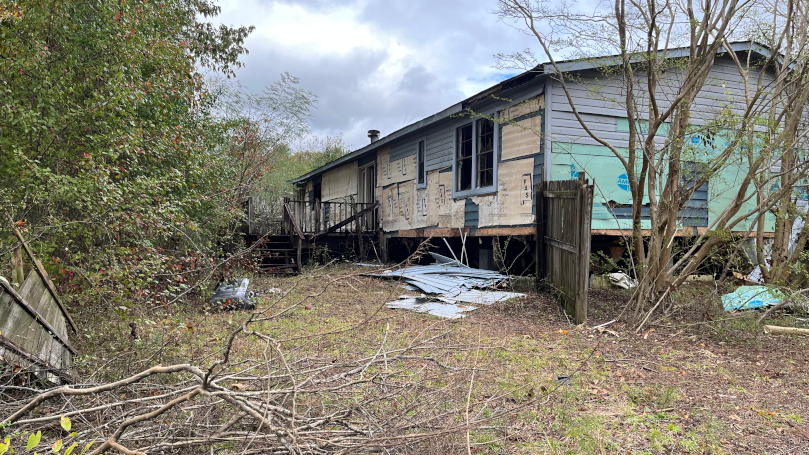
Bessemer is a majority-minority community — 66.6% Black residents and has a poverty rate of 29.7%. Household income is 38% below the state average. Twenty-eight percent of Bessemer residents live below the poverty level (the national average is 12.4%), and the unemployment rate is 8.6% (more than twice the national average).
In 2024 the state of Alabama placed the Bessemer City School System under state intervention because, they said, the school system had so many problems that student learning fell short of standards.
These numbers, plus an eager city administration and low property values, made Bessemer easy pickings for developers. QTS has pledged to invest millions in Bessemer schools, and right before the election, the then mayor announced a higher education scholarship program (funded by QTS) that will award every Bessemer City High School graduate a scholarship of at least $10,000 toward tuition. The scholarship is only for high school graduates through the graduating class of 2030 — just four years — and they must attend one of two HBCU private colleges or a specific community college.
This is QTS public relations. It remains to be seen how much they’ll pay in actual regular taxes, electrical, and water use. This has been said in other communities with no money actually showing up.
Regarding the promise of more jobs, the contract for clearing Project Marvel’s 1600 acres went to a company in Georgia, not Bessemer or Alabama. Once construction is completed, no matter who gets the contract, the number of jobs will shrink. During the construction phase, there is a possibility of an increase in local spending, but once construction is complete, only about 100 permanent jobs will remain and those will go to workers with specialized skills.
Whether there will be a boost to the economy is unknown. The increase of construction workers will likely boost sales in nearby businesses, but the long-term effect is uncertain. There is sketchy information about how much tax abatement QTS receives and whether the company will pay for the electricity it uses or whether it gets a break there, too. There are promises that taxpayers will not bear any of the costs QTS incurs, but those are promises. Bottom line, pledges of full transparency for the community have yielded little clarity on several important questions.
The bigger story
Data centers exist as infrastructure, supplying hardware and energy to the production and maintenance of AI processing and cloud storage services. They also serve as mechanisms for surveillance, oppression, and war such as processing input from FLOCK cameras, U.S. military guidance for drone surveillance and weapons of warfare, and powering various facial and other forms of recognition.
The swell in data center construction is due to the surge in research and deployment of artificial intelligence (AI).
The movement has captured the imagination of those who are fascinated with the potential of the future. The idea that machines can improve humanity by “thinking” for us is often proposed by the tech moguls who are working feverishly to advance the technology — moguls like Elon Musk, Mark Zuckerberg, Jeff Bezos along with OpenAI CEO Sam Altman and President Greg Brockman. Marketers would say it’s a “sexy” pitch — improving humanity with machines that “think.”
In fact, the label “artificial intelligence” is not a scientific term; it’s a “flashy” marketing term coined by scientists to entice investors to their research. Without the term and the idea that AI will improve humanity, AI is just another type of software technology like Word or Excel. So, much of the fascination with AI comes from the marketing of the technology — marketing designed to reach investors with deep pockets.
Dr. Abeba Birhane is a cognitive scientist at Dublin’s Trinity College’s School of Computer Science and Statistics. Her interest is in AI accountability research which involves “. . . challenging and dismantling societal and historical inequalities and power asymmetries [and] holding responsible bodies accountable. . .”
On AI and the tech moguls, she says we are living in an era of peak AI hype. “There’s too much money flying around desperate for a home. Because we don’t tax these people,” Dr. Birhane continued, “until the pips rattle, they have too much money, and they use it to cause damage. And these guys are literally only interested in lottery-level returns. They desperately want returns without actually funding an economy that’s healthy. This means there’s no sane things to invest in that give returns. So, they invest in insane things.”
This scorched-earth strategy knows no boundaries. Communities in Africa also feel the heat. Africa could attract $876 billion in data-center investment by 2031, even as more than one-third of African countries already face water insecurity.
In Nairobi, Kenya, where potable water is scarce, Kenyans are now competing with data centers for fresh water. Things are so dire, many Kenyans in urban areas are having to purchase drinkable water because their taps only run with salty water. Kenyans across the country are asking questions about how long it will take before their freshwater stocks are depleted.
There is no shortage of young unemployed workers in Nairobi and companies like OpenAI are eager to take advantage. Companies like Sama Source out of San Francisco go into the slums of Nairobi and lure young people to sign onto the perceived romance of working in the tech industry. They promise them a chance to pull themselves out of poverty, but in the end, pay less than a dollar an hour for jobs in areas like training AI models to identify inappropriate content.
The documentary Ghost in the Machine (2026) tells the story of workers who suffer mental disturbances because of constant exposure to intensely graphic pornography. Workers report waking up screaming or not being able to sleep at all. Others report the onset of paranoia that intrudes on their personal relationships. One member of TechWorker Community Africa, an NGO tasked with advocating for tech workers exploited by the system, says the effects of doing the work he did “tears at the veil of what makes you to be human.” But when they asked for help from their bosses they were told there was no time for counseling.
Some Nairobians recognize a familiar pattern. In colonial days, slave masters cut a deal with African chiefs — guns for slaves — a shameless betrayal. Today, Dr. Matt Mahmoudi says AI companies construct their software technology with exploitation and data theft. Mahmoudi, a sociologist who researches and advises Amnesty International on AI and human rights, calls it “digital colonialism.”
“AI is just a repackaging of our data to produce some pretense that, you know, this thing can do things magically,” he said. “It’s just the ability to obfuscate new colonial logics mapped onto similar patterns of colonialism.”
A note on eugenics, AI and data centers
Eugenics is generally described as a proscribed theory that a human population can be improved by selectively breeding for “superior” traits. It was the idea favored by the Nazis during the Holocaust and cited as the reason for forced sterilization of women who were deemed to be of lower intelligence. It involved classifying and categorizing people by IQ, facial characteristics, head shape, and skin color.
While normally thought of as debunked science, the base idea turns up in AI applications such as facial recognition. It’s an example of the systemic racism that exists in the U.S. today. Recent studies show that AI training sets — the part of a data set that can be used to teach a machine to make predictions based on the construction of algorithms — are skewed by the biases of the white male supremacist culture providing the data.
Simply, the training set, in this example, is a set of examples — dark skin, light skin, gender, etc. If the set offers fewer examples of one trait — say, dark skin — the machine will not be as accurate in recognizing a dark-skinned face. Depending on the study, facial recognition is 99-percent accurate when it comes to identifying white males but only 65-percent accurate in identifying dark-skinned females. So, as the New York Times headline put it, “Facial Recognition Is Accurate, if You’re a White Guy.”
The point here is that using facial recognition, for instance, in law enforcement can result in false arrests, and has. There are documented cases of people of color being arrested for serious crimes they did not commit. They are proof of the racism baked into AI that can also interfere with efforts to get insurance, home mortgages, and a job. From the development of data centers in oppressed communities to the development of AI used in a variety of ways that touch our lives, racism becomes even more ingrained in our institutions. There are scientists dedicated to making AI systems accountable, but their numbers and resources pale in comparison to the trillion-dollar investment daily in the quest for artificial intelligence.
Back in Bessemer
It’s been about 10 days since the new mayor took office, and she is wasting no time. A city attorney spent 90 minutes with residents answering their questions and offering guidance. He is charged with figuring out what commitments the previous administration made and where they can be “un-committed.” He’s sent a cease-and-desist letter to the developers until they meet with city officials.
The project is moving very fast. Acreage has already been cleared, temporary stations for earthmovers and other large equipment have been set up, and a broker has already met with citizens nearest the site about purchasing their property. They were told to accept the developer’s offers or suffer the consequences — it’s a done deal, and the bum’s rush follows.
It all sounds too familiar. The capitalists (QTS) make a sweetheart deal with the corrupt leaders (the former city administration) and the wage slaves (residents) pay the price of a betrayal that could leave this community even more oppressed and exploited than before. All is driven by a big-money marketing scam designed to line the already gilded pockets of the very, very rich no matter the impact on the working and oppressed peoples impacted by their plans.
The opinions of the author do not necessarily reflect the positions of the CPUSA.
Images: Bessemer, Ala. rally against data centers by Darral Bethel/Bessemer Data Center – We Say No! Facebook. Images of data center construction around Bessemer, Ala. and of the general area by Rena Weaver. CC BY-NC 4.0. No data centers by Darral Bethel/Bessemer Data Center – We Say No! Facebook.
- Tags:
- AI
- Data center

 Join Now
