

The Trump administration’s return to power on January 20, 2025, marked the beginning of an anti-people, systematic dismantling of civil rights and worker protections established over decades of struggle, especially during what the Civil Rights movement calls the “Second Reconstruction” the political, legal and legislative wins that occurred between 1950 and 1970.
By implementing Project 2025 and in particular its targeting of Diversity, Equity and Inclusion (DEI) programs, the MAGA right has imposed a legal counter revolution by dismantling the entire civil enforcement infrastructure of the federal government.
While he campaigned on economic policies, Trump’s immediate actions upon taking office were to attack the wins of the civil rights period. They are “targeting organizations and institutions in this country,” Nikole Hannah-Jones, author of the 1619 Project, observes, “for trying to integrate and comply with the affirmative action mandates of the civil rights law,” on the basis that “these efforts are anti-white; that they are racially discriminatory against white Americans.”
Indeed, on his first day in office, Trump signed Executive Order 14151, “Ending Radical And Wasteful Government DEI Programs And Preferencing” which labeled DEI as “illegal and immoral discrimination programs.” The White House framed this order as protecting civil rights and advancing “colorblind equality” but it was really the curtain behind which the counter revolution was unfolding.
The second day of his administration saw Trump repeal President Lyndon B. Johnson’s 1965 Executive Order 11246, which had prohibited employment discrimination based on race, color, religion, and national origin by organizations receiving federal contracts. This order had been progressively strengthened over the decades to include protections for sex, sexual orientation, and gender identity.
DEI was a smokescreen that hid a broader assault on Civil Rights.
Since then the federal government’s entire civil rights mechanism has been dismantled and closed, with workers fired or reassigned. Federal websites were purged of content about African American and Latino contributions to U.S. history. Every federal DEI office was shuttered, and all employees working on DEI projects were furloughed or terminated. The Defense Intelligence Agency stopped all events related to Martin Luther King Day, Black History Month, Juneteenth, Pride Month, Women’s History Month, and Holocaust Remembrance Day. Historical figures like Harriet Tubman were erased from official White House pages. Military websites removed references to the Tuskegee Airmen and the Navajo Code Talkers. As journalist Nikole Hannah-Jones observed, this represented “a lot of erasure” happening in a “blitzkrieg” fashion. Some of these “erasures” have been restored by people’s fightback.
The Trump administration’s assault extended beyond symbolic erasures to material attacks on workers’ rights. A March 2025 executive order excluded agencies with “national security missions” from the Civil Service Reform Act of 1978, stripping collective bargaining rights from approximately one million federal workers — representing 84% of the unionized federal workforce across more than 30 federal agencies. This move effectively ended union representation for workers at agencies including Defense, Justice, State, and Veterans Affairs.
The federal government’s entire civil rights mechanism has been dismantled.
The administration simultaneously pursued massive workforce reductions under the anti-DEI banner. More than 4,000 federal workers were directly fired during government shutdown periods, and the Office of Personnel Management reported that approximately 317,000 federal employees left government service in 2025 through various means including layoffs, firings, resignations, retirements, and buyouts. While federal workers were being terminated en masse, the administration dramatically expanded Immigration and Customs Enforcement (ICE), making approximately 18,000 tentative job offers and aiming to hire 10,000 new enforcement officers.
Where civil rights were once protected by the full weight and power of the federal government those protections are now gone. The Department of Education, which existed primarily to enforce civil rights protections for students (such as access to special services for disabled students) was shuttered, leaving parents to rely on states that may not want to provide those expensive services. The Justice Department Civil Rights Division was created by the Civil Rights Act of 1957 to protect the voting rights of Black citizens and to prosecute crimes being committed against civil rights workers. Now, the Civil Rights Division has moved to dismiss voting rights cases and civil rights cases involving police departments.
It’s important to note that Trump’s actions were implemented through executive orders rather than legislative changes, operating outside normal constitutional checks and balances. The ultra-right dominated Supreme Court facilitated this approach by abrogating its responsibility to maintain constitutional balance of power. Thus, while many civil rights laws technically remained on the books, their enforcement has been fundamentally undermined.
Unity trends are strengthening.
As a result, the fightback has grown increasingly complicated. However, some responses are beginning to take shape. Spontaneous protests and uprisings are starting to coalesce. For example, in a statement, the NAACP recognized “that the rollback of DEI initiatives is a direct attack on Black economic progress, civil rights and the principles of equity and fairness.” The storied civil rights organization’s president Derrick Johnson said “It is outrageous that the President is rolling back critical Diversity, Equity, and Inclusion (DEI) programs.” “His appalling executive order,” Johnson continued, “will only worsen America’s racial hierarchy and benefit the oligarch class. This executive order threatens public services that benefit all Americans; it’s an attempt to consolidate power and money to a few wealthy individuals. And poor and working-class people will pay the price.”
In a similar vein, the Congressional Hispanic Caucus stated it “strongly condemns President Trump’s Executive Order dismantling federal diversity, equity, and inclusion (DEI) initiatives and affirmative action in contracting. This harmful action seeks to undo decades of progress toward creating a more equitable and inclusive society.”
Frankie Miranda, President and CEO of Hispanic Federation, responded “It is alarming to see how much President Trump’s day one executive actions ignore the rule of law and threaten the livelihood of all Americans. These actions, especially several executive orders, disregard the core pillars of governance.”
Responding to the pointed attacks on the LGBTQ community Lambda Legal said: “These executive orders include direct attacks on LGBTQ+ communities, particularly transgender people, youth, and families whose lives, dignity, and safety would be further jeopardized in this fraught moment when over two dozen states have already passed anti-LGBTQ+ laws since 2022.”
The ACLU argues the administration is weaponizing civil rights laws that address discrimination to bully both private and government entities into abandoning legal efforts to promote equity.
Asian Americans are fighting back as well. One group, Asian Americans Advancing Justice—Asian American Justice Center (AAJC) specifically condemned Trump’s rescission of Executive Order 14031, “Advancing Equity, Justice, and Opportunity for Asian Americans, Native Hawaiians, and Pacific Islanders,” calling it “a direct denial of our communities.”
The Coalition of Black Trade Unionists (CBTU) immediately spoke out in defense of DEI. Lew Moye, CBTU’s Second National Vice President, argued: “There’s a reason in the 1960s and ’70s, the Civil Rights Movement and labor movement came together. It was because we knew being divided did not serve us.”
We’re nearing an inflection point.
Labor leaders at the CBTU Convention “made it clear that DEI must be cemented into union contracts in the first place” because “when Big Business and far-right politicians wage war on Diversity, Equity, and Inclusion (DEI), workers need more than vague assurances from corporations — they need enforceable protections codified in federal law and in collective bargaining agreements.”
CBTU has called on the AFL-CIO to organize a national day of union solidarity in Washington and around the country in response. And that’s important because bereft of any means of enforcement, women’s, students, children and disabled rights are all on the chopping block. Even birthright citizenship is under attack.
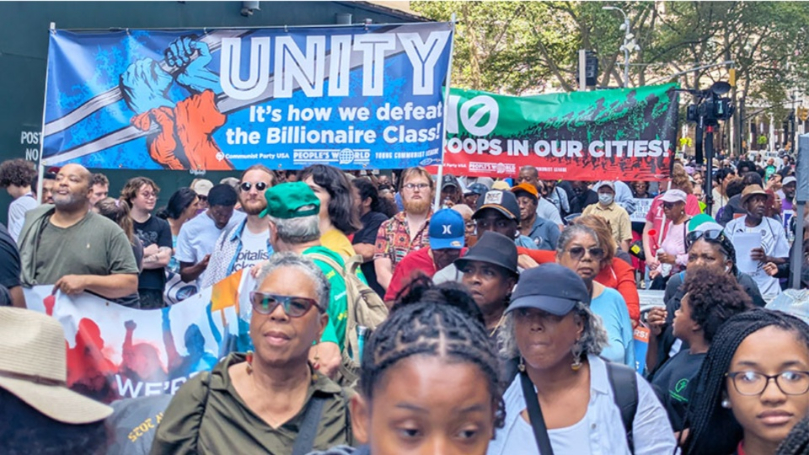
Yes, the anti-MAGA struggle is at an inflexion point today and the direction of struggle may be fundamentally changed by strengthening or weakening of this or that side in the battle. Class, race and nationality are intersecting in dramatic ways and much depends on the level of unity that can be achieved. Will white trade unionists heed the call of their black union siblings for national protests in defense of collective bargaining and other rights? While that question remains unanswered one thing is clear: the working class and national trade union movement needs to be brought directly into the fight. And it’s in the interests of all workers that the battle be joined as soon as possible.
The direction of anti-capitalist struggle may be fundamentally changed by a victory in what needs to become a pro-DEI, pro-democracy, anti-MAGA struggle of a democratic, labor-led, united front of workers, oppressed peoples, and women, fundamentally changing the balance of forces.
Workers and oppressed people, unite and resist. We can win.
The opinions of the author do not necessarily reflect the positions of the CPUSA.
Images: Unity is how we defeat the Billionaire class by cpusa.org.
Author

-
Eric Brooks was born in Brooklyn, New York, and currently lives in Indiana. He is a life-long organizer in the struggle for working class power and socialism.
 Join Now