

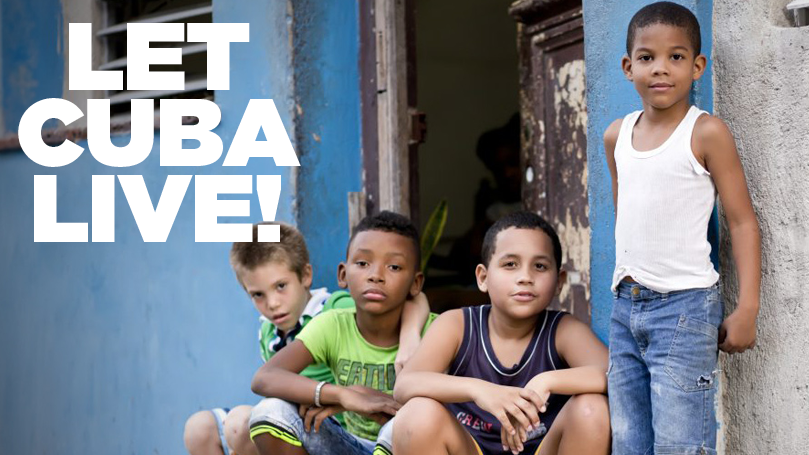
For over six decades, the United States has maintained a comprehensive economic blockade against socialist Cuba. What began as a Cold War aggression in the 1960s continues today. The blockade harms Cuban citizens solely due to anti-communism; attacking the Cuban people’s ability to live healthy lives. The United States is isolated from the overwhelming consensus of the international community.
In the United Nations, every year for the last 30 years, a resolution on the “Necessity of ending the economic, commercial and financial embargo imposed by the United States of America against Cuba” has passed overwhelmingly, only to be vetoed by the U.S. Today, two bills in the U.S. legislature, HR 7251 and S. 136 — the Freedom to Export to Cuba Act — represent a long-overdue legislative challenge to the inhumane, imperialist, violence of the U.S. blockade against Cuba. Working people worldwide, and especially in the U.S., are called on to stand with the people of Cuba in their right to build a society according to their own collective, democratically expressed, desires and needs, to build socialism.
What the bills do
HR 7251, introduced in the House, and its Senate companion bill, S. 136, would lift the statutory prohibitions on trade with Cuba that have been codified into law over decades, most notably through the Helms-Burton Act of 1996 and the so-called Cuban Democracy Act of 1992. These laws entrenched the embargo in statute, removing executive flexibility and cementing a failed policy regardless of changing circumstances. The Freedom to Export to Cuba Act would restore normal commercial relations, allow American businesses to sell goods and services to Cuba freely, and remove the legislative architecture that has strangled economic exchange between two nations separated by only ninety miles of ocean.
The blockade is an attack on the people of Cuba
The blockade, and baseless inclusion in the U.S. State Sponsors of Terrorism List (SSOT), has inflicted a serious lack of resources on Cuban people. Shortages of oil, medicine, food, and basic consumer goods are direct consequences of trade restrictions. The Cuban healthcare system, once celebrated internationally for its outcomes despite limited resources, has been repeatedly undermined by difficulties in importing medical equipment and pharmaceuticals. Children, elderly citizens, and working families bear the daily burden of a policy designed to punish a government. This is not principled foreign policy — it is collective punishment, and it is wrong.
The international community has spoken
Year after year, the United Nations General Assembly votes overwhelmingly to condemn the United States blockade against Cuba. In recent years, these votes have been lopsided to the point of embarrassment — often 185 or more nations against just a handful of U.S. allies, including Israel. Even close American partners in Europe and Latin America routinely vote against the blockade and maintain robust trade and diplomatic relationships with Havana. The United States stands nearly alone in its posture, and that isolation is not a sign of moral clarity — it is a sign of a policy that has become disconnected from reality and from global norms.
Passing HR 7251 and S. 136 would end the U.S. attempt to strangle Cuba and deny the Cuban people their right to self-determination.
U.S. businesses and farmers benefit from access to Cuba
The blockade doesn’t just hurt Cubans — it hurts U.S. agricultural exporters, manufacturers, pharmaceutical companies, and technology firms. These sectors of the economy are locked out of a market ninety miles from Florida while European, Canadian, and Chinese competitors fill the void. U.S. farmers in the Midwest who could be selling grain, poultry, and soybeans to Cuba are instead watching foreign competitors take that business. U.S. entrepreneurs who could be building tourism infrastructure, telecommunications networks, or clean energy projects in Cuba are legally prohibited from doing so.
The Freedom to Export to Cuba Act would open a market of over eleven million consumers to American goods and services. It would create jobs in export-dependent industries, strengthen agricultural communities, and generate economic activity that benefits both nations. Most importantly, it would allow Cuba to thrive and to continue to build its socialist society unfettered by U.S. imperialist sabotage, at least as far as the blockade and the SSOT list are concerned.
All working and oppressed peoples in the United States are asked to support HR 7251 and S. 136, to call their representatives in the House and Senate to express their support and demand passage of these bills. Call (202) 224-3121 to speak to your representatives. Click here to send them a letter.
The opinions of the author do not necessarily reflect the positions of the CPUSA.
Image: Let Cuba Live! Fred Barr. CPUSA.
Author

-
Eric Brooks was born in Brooklyn, New York, and currently lives in Indiana. He is a life-long organizer in the struggle for working class power and socialism.
 Join Now