

Review of Aymeric Monville, Gabriel Rockhill, Jennifer Ponce De León, Requiem for French Theory: Transatlantic Funeral Dirge in a Marxist Key. New York: Monthly Review Press, 2026.
As a brief on the contradictions within French Theory (FT) and the material forces that sustained and circulated it in U.S. academic circles, this little book is worth reading. It is organized as an edited transcription of an interview featuring Jennifer Ponce de León as interviewer and philosophers Gabriel Rockhill and Aymeric Monville as interviewees. In this discussion, FT refers to the generally cohesive body of writings French academics developed during the Cold War as an “antidote” to Marxism, known in the U.S. as postmodernism and poststructuralism.
Its major adherents included Michel Foucault, Jacques Derrida, Roland Barthes, Jacques Lacan, Jean-François Lyotard, Gilles Deleuze, Alain Badiou, among others, who sold thousands of books to American graduate students in philosophy and literature in the 1980s and 1990s. Around its edges lie other French Marxists: Louis Althusser, Étienne Balibar, Pierre Bourdieu, and (for Rockhill) the postwar Frankfurt School (not French but assumed to be in the same ideological field).
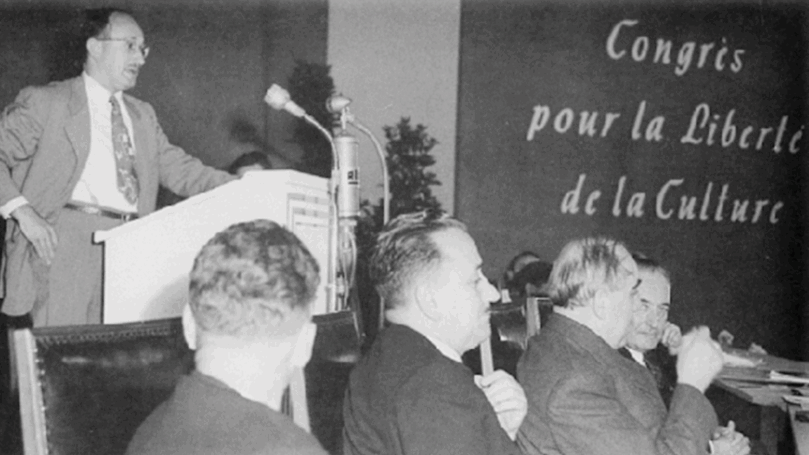
On a sensationalistic register, Rockhill highlights the role of U.S. intelligence apparatuses in financing, promoting, and analyzing FT as a Cold War ideological formation that it saw as an ally in the anti-communist battle. Some of his statements about this development come from his research for his 2025 book Who Paid the Pipers of Western Marxism? The evidence he unearths shows that CIA agents funneled money through the Congress of Cultural Freedom to finance a 1966 conference at Johns Hopkins University that hosted several of the named individuals, who presented their work on American soil for the first time.
Oddly, this academic, erudite conference drew media attention and circulated widely in academic and media circles, launching decades of deep influence on U.S. academic thought. (The Congress of Cultural Freedom had, since 1950, financed American academic and political work aimed at fostering hostility toward and distortions of communism and Marxism. Famously, it financed the otherwise failing Partisan Review to attract literary types to the cause.)

Both Rockhill and Monville received their graduate training at some of France’s top universities, studying under some of the famous philosophers closely associated with FT. Rockhill admits that his experience had put him on track for professional success but at a cost. “[A]fter years of arduous elite training, I was incapable of understanding fundamental aspects of the material world (such as imperialism).” He had found himself trained in “imperial ignorance.”
As the source of his realization of FT’s contradictions, Monville cites his reading of Michel Glouscard’s Neoliberalism and the Ideology of Desire (1998), along with Monville’s self-directed study of Foucault’s break with fact-based historical research. Glouscard’s book traces the anti-humanist influence of Nietzsche and the former Nazi philosopher Martin Heidegger on postwar French philosophy. Monville argues that this philosophical stream saw itself as supporting French imperialism, opposing Gallist national-independence forces (inclined to resist subordinating France to U.S. imperialism), and openly hostile to French communists. FT advocates ultimately sided with the neoliberal parties that submitted to U.S. hegemony.
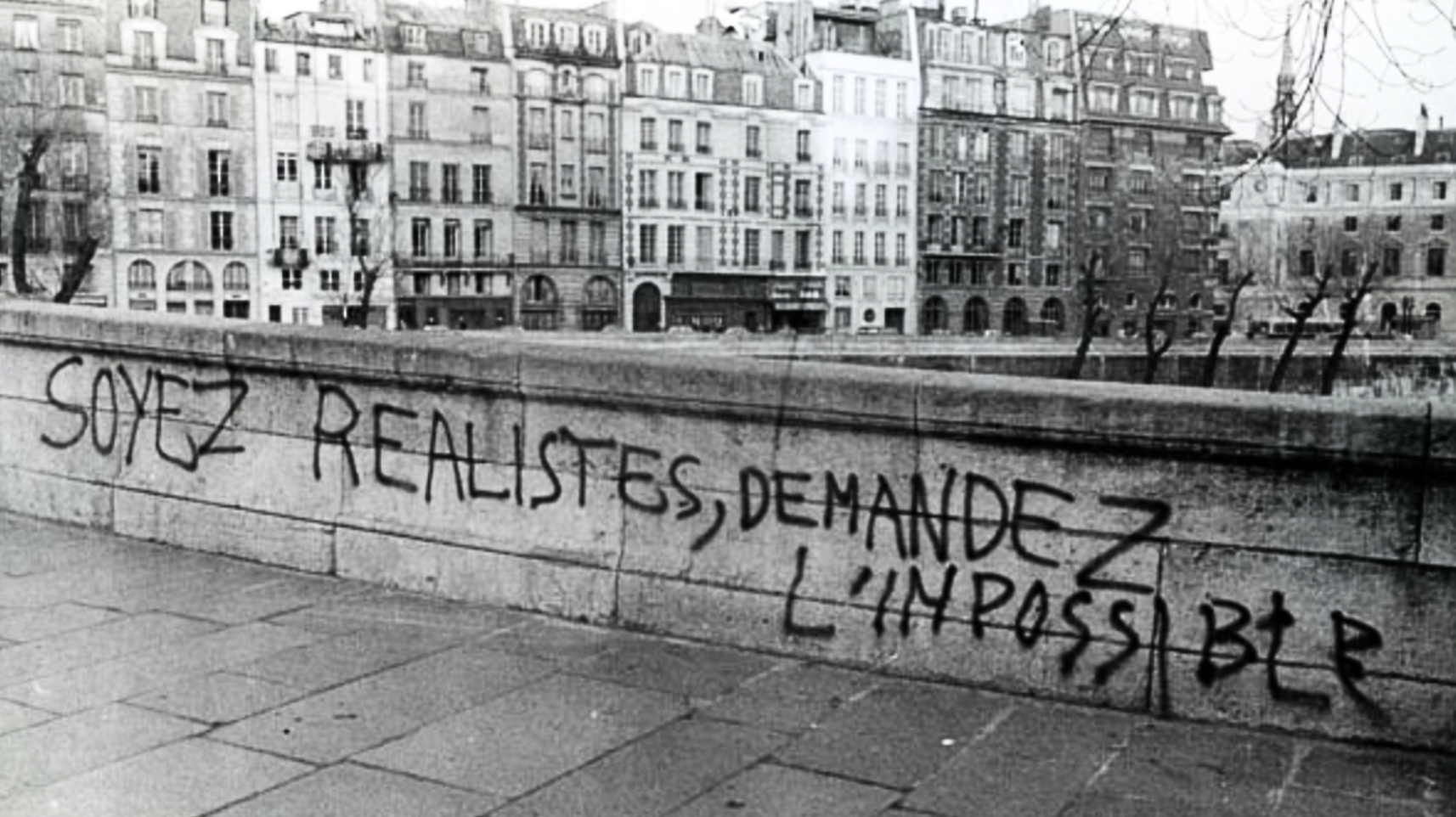
After the failed landmark 1968 uprising, FT proponents proclaimed their affiliation with the defeated radicals. FT academics had not participated in, agitated for, or organized in support of the uprisings, but they strove to repackage FT as a “model of radical recuperation” to chip away at a renewed interest in Marxist thought and communist politics. At the same time, the U.S. intelligence apparatus’s interest in, and material support for, FT academic conferences and the circulation of its ideas reflected a similar desire to disrupt a concurrent American-centered rehabilitation of Marxist thought and politics.
How did this FT operate as an ideological field (notwithstanding internal debates and debates among its proponents)? John Bellamy Foster’s introduction to the book is useful for a summary of the major ideas and trends in FT as well as for a periodization (following the more detailed story given in the Marxist critic Fredric Jameson’s The Years of Theory: Postwar French Thought to the Present).
Rockhill believes the main ideological work is not creative, innovative political or social practice. Instead, its primary goal is to oppose Marxism and communism. FT’s consistent internal logic misrepresents Marxism “by depicting it as class reductionist, deterministic, economistic, Eurocentric, teleological, and uninterested in liberation struggles related to race, colonialism, gender, sexuality, the environment, etc.” Both Rockhill and Monville observed that such depictions depend almost entirely on failing to study Marxist thought with rigor, acknowledge its anti-colonial streams, and honestly research existing socialisms.
FT dissociated the objects of its study from their concrete historical context and from class struggle, tried to eliminate historical and dialectical materialism from serious studies of philosophy (ironically as the source of totalitarian systems), and encouraged a “fetishization of fragmentation.” According to Rockhill, it relied on reactionary philosophical systems (Nietzsche and Heidegger) to “rehabilitate” right-wing thought and re-package it as a “radical” alternative to Marxism. It is essentially an idealistic philosophy of radical individualism that aligned with neoliberal and free-market theories.
Powerful state actors and pro-capitalist networks orchestrated its circulation during the Cold War. Monville explores the specific French context of FT’s rise in the decline of French imperialism (especially after the Algerian independence victory in the early 1960s). FT became grist for every graduate school mill, to name my own academic experience with it, perhaps until it gave no answers or roadmaps forward when U.S. imperialism hit a roadblock in Fallujah, Iraq, in 2004, and the capitalist breakdown in 2007.
FT’s intellectual target was the Marxist concept of dialectics: the study of a system’s internal-external contradictions, which inevitably structure it as something in motion and in a process of transformation, but also as an “interrelated totality.” FT philosophers and students took issue with the notion of a mediated social totality, claiming it was the source of totalitarian thinking. They were no longer interested in the communist analysis of fascist totalitarianism as a product of the contradictions and breakdowns of monopoly capitalism and imperialist contests for world domination. In rejecting socialism as an alternative to capitalism, FT prepared the groundwork for the “there is no alternative” or “end of history” ideological fields.
The central goal of FT political ethics was purely “symbolic change” and anti-communist activism (à la Derrida). For the Marxist analysis of the totality of social relations of production that constitutes a mode of production, FT (without recognizing the irony) substituted language and discourse as the monocausal determinant of social reality. By denying the real accumulation of power in the form of social classes and pretending power was distributed throughout society, FT denied the need for, and the empowerment of, exploited and oppressed people to collectively struggle to free themselves from capitalism’s chains.
This otherwise valuable little book has two major weaknesses in its analysis. First, it has a pervasive conspiratorial element closely associated with Rockhill’s contributions. This posture may stem from his ongoing research project on the specific role of intelligence apparatuses in promoting anti-Marxist thought and political groupings after World War II.
The problem is that it sees “dupes” of “propaganda” everywhere and, unfortunately, narrows the concept of ideology to the conspiratorial inner workings of CIA outposts. It subtly positions, for example, proponents of queer theory, such as the philosopher Judith Butler, as agents of a propaganda machine, not as thinkers who have made any valuable contribution to socially progressive thought or praxis.
Conspiratorial thinking, prominent in Rockhill’s mode of explanation, encourages the view that the ruling class can make strategic compromises and retreats but always keeps the upper hand, and that political parties, social movements, or aggrieved communities occasionally embrace liberal ideas only under the condition of being propaganda dupes or class traitors.
This framework favors dismissal over engagement (at the risk of insult); indeed, Rockhill defines engagement as “eclecticism” that weakens Marxism and amounts to capitulation. Ironically, at one point in the exchange, Monville warns against “systematically conspiratorial” thinking to avoid what is essentially an anti-intellectual gesture, but his colleague ignores the warning, at least in this book.
A second feature, developed nearly exclusively by Rockhill, is the diatribe on identity politics (IP). In fact, this aspect of his thought almost appears to be the primary motive behind his approach to the topic. The contradictions in his analysis of IP warrant closer examination.
While John Bellamy Foster’s introduction attempts to mitigate Rockhill’s hostility to identity politics by historicizing the term’s origin among radical queer, feminist women of color activists in the 1970s (who were not “dupes” of propaganda), Rockhill associates IP solely with FT and its CIA handlers.
He describes it as a “counter-insurgency,” a “weapon of war,” and a “counter-revolutionary enterprise,” leaving no doubt about his stance. Unfortunately, his engagement with identity politics as an ideological field is abstract and de-historicized (ironically, a technical weakness at odds with his deep knowledge of FT).
Despite foregrounding militaristic and conspiratorial language, Rockhill tempers his rhetoric and acknowledges that movements (that advance analysis and praxis against racism, male supremacy, homophobia, etc., rather than more explicitly revolutionary analysis) associated with IP and what he calls the “veritable diversity industry” forced the U.S. ruling class to “walk back some of the overt forms of racial, gendered, and sexual oppression.”
Rockhill even accepts that Trump’s intense reaction to DEI indicates the importance of those cultural changes. At this point, his claims become more measured, temporarily shifting from militaristic metaphors to a normative Marxian analysis of the limits of reformism and corporate or institutional performativity.
Still, he acknowledges that identity politics reflects, at a fundamental level, struggles over and analysis of “the specific problems of particular groups.” His sudden shift from warlike rhetoric to hints of progress reveals a contradiction in his thought that is problematic across the entire front of left-wing hostility to IP.
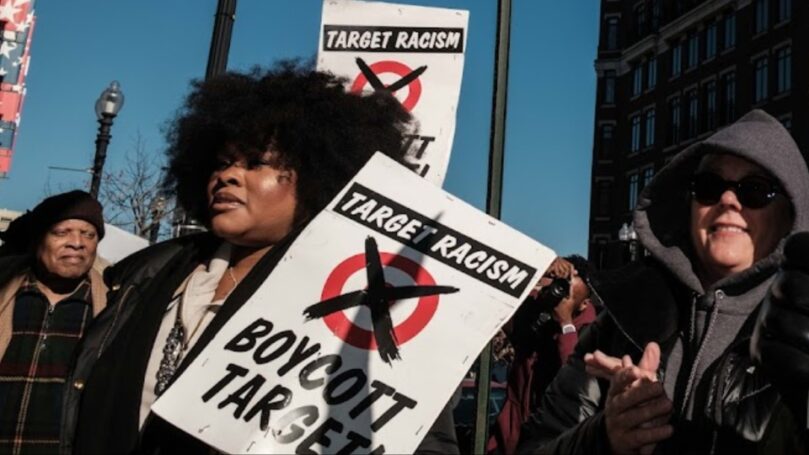
IP is an ideological field produced historically by key political struggles for democratic rights and freedoms denied to various communities because of their identities. Rockhill fails to acknowledge that these identities also represent a refusal to assimilate to the genocidal demands of racial capitalism.
The demand to erase identity politics, even from a left stance, unfortunately aids in erasing historically developed modes of being crafted by oppressed peoples in their struggles to exist, survive, and resist. The specificity of historical circumstances and locations within social relations of production (not just false ideologies) gives rise to subjective/collective forms of identity formation. This helps build a culture of solidarity and political struggle for self-defense and liberation; such expressions are not always anti-capitalist or revolutionary. But Marxist thought gives us tools to understand the possibility of a through line between reforms and revolutions.
Reading these assessments, I detect some unfamiliarity with decades of research that explores, documents, and historicizes how oppressed and exploited people defined their cultural identities not as dupes of capitalist ideology, but as part of a collective struggle for survival and freedom. Rockhill does not acknowledge (or may be unaware) that a general liberal-progressive-radical consensus currently sees social identities as socially and historically constructed rather than as essentialist categories, as he implies.
Instead, his claim that IP relies on essentialist categories names no writings or authors who argue that. And most of the academics in this camp will not approach “the superficial politics of recognition” uncritically. Rockhill’s offhand dismissal of IP as “woke,” in an apparently non-ironic echo of Trumpian terminology, was alarming. These contradictions reveal Rockhill’s one-sided approach to IP and reformism (and the potential openings each creates).
The movement to restore Marxist thought’s explanatory and political power need not fully assimilate this political tendency. Indeed, the struggle against white supremacy (and other -isms that function materially — not just discursively — in capitalist relations of production) will involve the passage — in struggle — from reformist measures to revolutionary ones.
The authors are correct. FT is no longer relevant, but heed Monville’s injunction against “systematically conspiratorial” thinking and assess IP using a more dialectical, historically grounded analysis.
The opinions of the author do not necessarily reflect the positions of the CPUSA.
Images: “Be realistic, demand the impossible” slogan graffiti in France, 1968. Public domain; Requiem for French Theory: Transatlantic Funeral Dirge in a Marxist Key. New York: Monthly Review Press, 2026; Congress of Cultural Freedom conference in Germany, 1950. CIA. Public domain; Picketers outside a Target store in Washington, D.C. Photo courtesy of Bill Lee Photography.
Author

-
Joel Wendland-Liu teaches in higher education. He uses critical race theory and Marxism in his research and award-winning teaching. He is the author of The Collectivity of Life and numerous scholarly articles. He is a member of the AAUP and is deemed “dangerous” by Campus Watch, a right-wing, pro-white supremacy blog that is funded almost completely by right-wing billionaires and millionaires who control the Republican Party.
 Join Now