

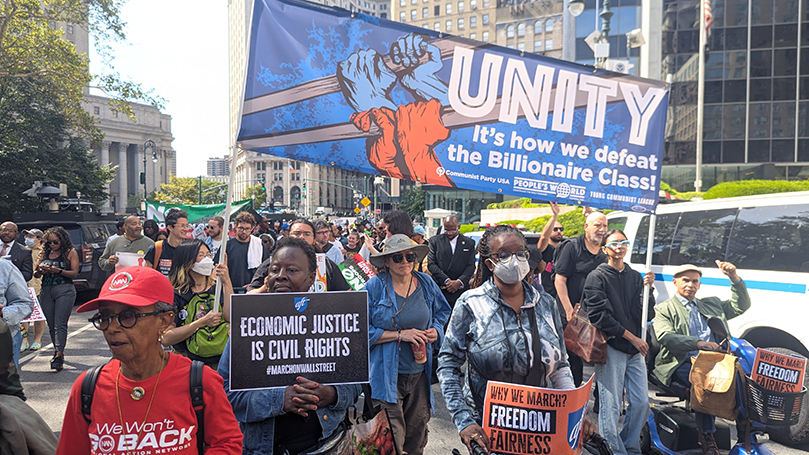
In What Constitutes the Communist Party? CPUSA, May Day, and the Communist Plus, P. K. Gandakin and J. Ryder argues that American communists suffer from an inability to respond to the absence of political form in today’s mass democratic movement. By “absence of political form,” we understand them to mean the lack of a political vehicle capable of moving broad and diffuse mass movements like ‘No Kings’ in a transformative direction.
In this regard, Gandakin and Ryder identify two main political currents among the left that have a single ideological source, namely, economism. The two trends presently are abstentionist sectarianism on the one side, and on the other, attempts to engage with mass movements. The CPUSA, they identify correctly, is in the second line of movement, which rejects abstentionism.
While acknowledging that the party is formally critical of economism, they assert that in practice it ends up producing economism anyway through the way in which it participates in labor struggles, activist campaigns, and broad coalitions. What is their problem with the CPUSA’s style of participation? That it does not distinguish itself enough from liberal progressivism, trade union reformism, or social justice activism. Here, they single out the party’s implementation of the communist plus: “…it should be noted that in understanding the ‘communist plus’ as equal to a program of taxing the rich, boycotting corporations, and perhaps most vitally ‘showing up’, they have, in effect, ceded the ability to imprint a unique political stamp on present events and have succumbed to the very ‘economism’ they are attempting to extinguish.”
They assert the Party remains on the margins and has failed to place its stamp on unfolding mass movements due to its apparently narrow focus on taxing wealth and corporate boycotts — a telling critique if true.
Misreading the communist plus
But here the authors commit errors of both fact and analysis that severely undermine their argument. The first factual error lies in a misquote of CPUSA co-chair Joe Sims. They write:
“What is the content of the communist critique? Sims clarifies: “Taxing the rich, breaking up the big monopolies, fighting racism, sexism, and homophobia. Add to that boycotting Target and other corporations that have backed away from equal opportunity. And let’s not forget cutting the military budget and ending the forever wars in the Middle East. U.S. imperialism must be defeated!”
The quote attributed to Sims is from a photo essay summarizing the CPUSA’s participation in No Kings. The accompanying explanatory text was taken from a heavily edited extemporaneous Instagram video by Sims in which he, following Lenin’s Two Tactics, calls for a working-class stamp and leadership of the broad democratic movement. This social media video was never intended as a definitive statement. In fact, that paragraph does not appear in the Instagram post. For this reason, it’s signed by CPUSA.org, suggesting the work of many editorial hands.
Setting aside Gandakin and Ryder’s editorial mistake, the second error stems from their selective and one-sided quoting of the actual text in question. Rather than equating the communist plus with taxing the rich and boycotting corporations as the authors suggest, the actual text articulates a much wider range of issues, among them fighting racism, sexism, imperialist wars, etc. Indeed, the article goes on to highlight Palestine, Cuba, the fight for civil rights, statehood for D.C., ending plant closings, and concludes by highlighting the need for working-class leadership in the fight for democracy and the coming midterms — hardly an exclusive focus on economic issues, which we most emphatically agree would be a mark of economism or vulgar Marxism.
What economism actually means
We ask the authors to clarify exactly what they mean by economism. “What Constitutes the Communist Party?” devotes considerable space to quoting Lenin on the subject, but have the writers grasped the essence of the matter?
For Lenin, economism consisted in an exclusive focus on trade union and economic issues, an eschewing of politics, a reliance on spontaneity, along with an emphasis on collaborating tactics in tune with the issues of the day (tactics-as-process) absent and in opposition to a general plan. Lenin insisted on addressing not only economic struggles, but each and every issue that might be of concern to the people of Russia.
The emerging party must be a “tribune of the people.” Moreover, in the course of struggle, the party must continually expose the capitalist roots of the crisis, intervening ideologically and raising class and socialist consciousness, so that the fights for reforms are not mere ends in themselves but the means to the socialist goal. This point is central to Lenin’s thesis because, in his view, left to themselves, economic struggles will only take the movement so far. It will not encroach on the rule of big capital. Why? Because trade unionist and other forms of democratic thought remain in the realm of bourgeois consciousness and ultimately capitalism.
The party in mass struggle
Is the CPUSA guilty of these mistakes as the writers insist? Does its identification with the present goals of the democratic and trade union movement make it culpable in inadvertently spreading economism? The charge might be true were it merely to repeat the slogans of current protests and leave it there. However, that hardly seems to be the case.
We must sharply disagree with Gandakin and Ryder, who assert with no evidence, or ‘evidence’ taken out of context, that the party’s concept of the communist plus is to equate it with taxing the rich and boycotts. Rather, party members in our day-to-day struggles, along with our schools and written materials, continually use the demands of the day as points of engagement. We attempt to use these demands to deepen people’s understanding of how current crises are rooted in capitalism, and that truly resolving these problems requires a revolutionary change of the system.
The demands of the working class are the immediate things we fight for — our minimum program — but Communists should be and will be the ones to deepen these struggles into one coherent political movement. The “communist plus” is an effort to intervene ideologically in mass struggles with a political emphasis that criticizes not only the conditions which have been catapulted from the capitalist system (unaffordability, lack of jobs, discrimination) but identifies the problem as the system itself. We say that Target is wrong for capitulating to the Trump administration, but we also say that this is the nature of corporations — not only that they prioritize profit over people, but that racist and discriminatory practices are essential for their success. Indeed, they are a source of super-profits.
It’s disappointing that Gandakin and Ryder chose to single out the CPUSA’s support for the Target boycott as an expression of faulty ideology and politics. It’s a campaign that’s resonated broadly in the African American community and that has won some recognition for our comrades’ outstanding coalition work. Far from being a narrow economic demand, the Target campaign struck a wide chord through the body politic, raising advanced democratic demands before the country, as the African American national question is bound to do given its centrality to class and democratic struggles generally. Target’s support for Trump and its decision to allow ICE to use its facilities to round up immigrant workers only accentuates the relevance of these issues.
Taxing the rich or participating in campaigns like the Target boycott, we know, are not the end of our struggle, but are the very point at which we begin our struggle. This is certainly not to diminish the struggle for these reforms. It’s through participating in these struggles that the CPUSA is practicing organization, building capacity, training cadres, and directing the movement of the working class to its most powerful tool: unity.
Geese are well aware, it’s through fighting for reforms and the failure of these reforms to satisfy the needs of the working class that we’ll be able to advance and deepen our struggle toward a socialist future. It is through participation in mass struggle that we will develop a strong political form, and the form that is currently developing must include the participation of the working class and the demands they put forward.
United Front politics in practice
The United Front policy is premised on the idea that communists align with workers and movements on issues of mutual concern as the basis for unity. This does not preclude, while working together, deep, probing debates on differing issues at hand or over a broad array of questions. Not having these conversations would be a glaring symptom of the economism our comrades are attempting to combat. For example, in the New York District, our participation in New York’s Mayoral contest did not mean we stayed silent on issues like public housing. We distributed electoral guides that advocated for the top ranking of the mayor, but also rejected his support for Props 2-4 which have given way for corporate owned luxury developments. We’ve also been a part of the coalition that is pushing the mayor to keep his campaign promise in supporting the No More 24 campaign — a drive led by working-class women of color in Manhattan’s Chinatown.
The CPUSA takes strategic inspiration from the ‘Peace, Bread and Land’ party of the Bolsheviks. They educated the party and the broader public in the spirit and letter of Marxism, building a revolutionary party in the process. In 2026, the CPUSA is committed to building a People’s Front that’s united in breaking the billionaire grip on the U.S. political process. This unity is a precondition to advancing a multi-racial democracy, an anti-monopoly coalition government, and revolutionary socialism. The CPUSA’s strategy is clear: united fronts built around the burning issues of the day are the way forward.
Is this enough? Or should a revolutionary vanguard do more than articulate the mass movement’s current talking points and slogans? It’s an important question that should not be evaded, and it’s here that, though misformulated, Geese’s critique touches on something.
Leadership means going further
Here, leadership necessitates providing an additional “plus,” that is, next steps to move the democratic revolution and class struggle forward. Without such steps, we might not only risk getting stuck in the present but also might face a legitimate question: “If the Communists are offering no more than ordinary democratic movements, why join them?” The task at hand then is finding the balance between current demands and stretching them further, but not so far as to narrow the scope of action and lose contact with key sections of working people.
For example, instead of limiting ourselves to calling for an end to plant closings or AI-induced unemployment, Communists in addition advocate shortening the workday and/or week, e.g., a 6-hour day with no cut in pay. Or instead of simply aligning with the call to abolish the electoral college or eliminate the Senate, a radical reform of the voting system like proportional representation is required. The CPUSA and YCL must do much more in bringing forward our platform and solutions. Former chairman Gus Hall put forward that, “We must be the same but different. We must be differently the same.”
But why then, the authors might counter, if you have all of this figured out, does the CPUSA remain on the fringe of political developments? A major part of the answer lies in understanding the impact of the party’s long-term struggle with right opportunism, revisionism, and reformism: Jay Lovestone, Earl Browder, and Sam Webb’s tenures in leadership continue to weigh on the party today. These tendencies expressed themselves after the turn of the century in a renouncing of the communist plus, in a steady downplaying of left and communist candidacies, and in a stiff opposition to taking initiative as a party unless others had done so first.
Bowing to spontaneity, economism, and tailism: these criticisms once had merit but we are aggressively attempting to correct the errors of the past while dealing with all the problems that have developed from it. Keep in mind that alongside these revisions there were attempts to change the party’s name, dissolve its press including its theoretical journal, and even liquidate the organization itself — which was successful in the case of the YCL. The result was the shedding of generations of leadership, splits, losses of revenue, and isolation from general developments. It cannot be overlooked that decades of errors can’t be resolved overnight.
Why the CPUSA remains on the margins — and what’s changing
While the party’s experience with McCarthyism, right opportunism, and revisionism remain weights, we are not so naive to think we are simply victims of our history. A major task lies before us that we are at work trying to solve. How do we make ourselves known and trusted political leaders? Several efforts are already underway: we are running candidates for office, we’re in the process of re-launching Political Affairs, and we are developing a new generation of leaders.
Another major area of work that needs to be done is our presence in popular culture. One example is the reformation of our Social Media Collective, who are slowly but surely navigating the online world and learning how we can become more relevant to everyday political discourse. How do we get to a place where we have our own influencers, artists, and spokespeople who can represent us in the mainstream?
Finally, we must also acknowledge the YCL, which Geese references and makes another error by claiming it is entrenched in ultra-left politics. While the newly formed YCL, that the authors were familiar with, may have expectedly encountered the ultra-left tendencies of some young Marxists, today YCL chapters reflect the development that has come with organizational discipline.
In NY, Philadelphia, D.C., New Haven, and Michigan, to mention only a few, YCLs are deeply involved in electoral and coalition politics. Though they never came to see the results of their efforts, the authors were a part of this process that has taken the YCL to become a respected organization in communities throughout the country. Through party-led and YCL educational activities, Lenin’s Left-Wing Communism: An Infantile Disorder has now become a favorite among the YCL that is revisited formally multiple times a year. YCLs across the country are involved politically at every level. Some YCL leaders have worked on multiple city council campaigns, the fight to protect public housing, the years-long No More 24 campaign, and community campaigns demanding police accountability. What about this activity could be deemed “ultra-left”?
Finally, we urge our authors to address their critiques to official party documents: the CPUSA program, National Committee reports, etc. We also welcome the discussion that Geese has prompted and look forward to continuing the debate as we work to take the CPUSA into its next stage of development. If the criticism from Geese is that we are not yet the political force that is needed, we can agree. But we put forward confidently that though we are not yet where we ought to be, we are surely on our way.
Images: CPUSA at the 2025 Aug. 28 March on Wall Street by Cameron Orr.

 Join Now