

This article was originally published in People’s World.
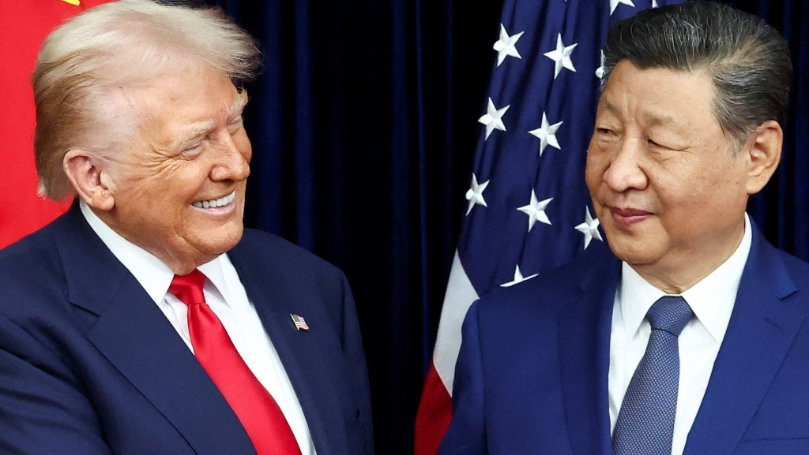
Fresh off his meeting with Chinese President Xi Jinping, President Donald Trump hailed the summit as “amazing,” a “12” on a scale of 1 to 10. Xi’s assessment was also positive but more measured in tone. “In the face of winds, waves, and challenges,” he said, “we should stay the right course, navigate through the complex landscape, and ensure the steady sailing forward of the giant ship of China-U.S. relations.”
Headlines in the media, meanwhile, rattled off details of the agreements reached in Busan: A delay of Chinese rare earth export controls, the lowering of the U.S.’ supposedly fentanyl-linked tariff rates, the resumption of Chinese purchases of American soybeans, U.S. approval for the sale of some advanced microchips to Chinese firms, the mutual lowering of port fees, further talks about the future of TikTok, and more.
While these steps back from the precipice of damaging economic confrontation are welcome news, the fact is that the summit in South Korea represents a truce, not a treaty. The ambitions of the U.S. corporate oligarchy to derail China’s growth and hobble their competition have not been set aside. Nor have China’s desires to continue developing its economy and raising living standards for its 1.4 billion people.
So, there is still a contest underway between the world’s biggest capitalist power and the world’s biggest socialist country, and the leaders of the two nations are following very different strategies as they seek to bring the rest of the globe onside.
Gramsci’s strategic insight
To better understand the meaning of not just the Busan summit but the U.S.-China relationship in general—especially since the beginning of the second Trump term—the work of Italian Communist Antonio Gramsci is instructive.
Locked in the bowels of Mussolini’s prisons in the 1920s and ’30s, Gramsci had a lot of time to think about what had gone wrong for Marxists. Why, he wanted to know, was capitalism and its more extreme variant, fascism — despite revolutionary predictions of collapse — more entrenched than ever?
The result of his investigations was The Prison Notebooks, a long-neglected masterpiece of Marxist strategy and tactics. Applying insights from military science to politics, Gramsci wrote that there are essentially two strategic orientations that the working-class movement could take: the “war of maneuver” or the “war of position.”
A war of maneuver was the model of the Russian Revolution: a frontal, rapid assault on power structures. He contrasted it with the war of position, which he described as a long-term, gradual building up of influence and embedding of support among the population and within the institutions of society.
A war of maneuver is feasible when one’s opponent is vulnerable and a direct attack is likely to change the balance of forces or overthrow them quickly. That was the situation Lenin and the Bolsheviks faced in war-torn Czarist Russia in 1917.
The war of position, however, recognizes that the existing order shields its power through not only sheer force but also via ideological and institutional hegemony — by harnessing the widespread support and consensus of the population. Winning change requires the political forces of the working-class movement to put in the long and grueling effort of building up their own hegemony among the people to counter the ideological “common sense” of the ruling class.
Neither strategy was inherently right or wrong, Gramsci said; it was a matter of surveying the battlefield, so to speak, and determining which was appropriate given the political situation at the time. “To fix one’s mind” on one model, he argued, “is the mark of a fool.”
Dueling strategies
The trade war that Trump has waged against China, and the meeting in Busan, can be understood not simply as a matter of diplomatic haggling but rather as a battle of two competing strategic logics. Trump is fighting a war of maneuver, while Xi and China are engaged in a war of position.
Back in his first term and especially since his second inauguration this year, Trump has focused on disrupting the status quo of world economic relations. He’s executed rapid shifts in trade policy — slapping one tariff and then another on China, imposing bans on the sale of advanced computing chips, and strong-arming other countries into cutting their trade with China.
It reflects a belief in the value of moving fast, striking hard, and instigating turmoil while claiming gains along the way.
While press coverage of the Busan meeting was characterized by the kinds of things that fit Trump’s style — immediate “deals,” dramatic numbers for the folks back home, and big announcements about the grand bargains supposedly reached — the truth is that China’s longer-term efforts to shape a more cooperative and consensus-driven global trade environment may have actually carried the day.
In a number of statements and communiques over the past several months, and even years, Xi has been playing a longer game rooted in cultivating stronger ties with other countries (rather than endlessly attacking them), building institutional strength (instead of demolishing bodies that don’t conform to demands), and solidifying ideological leadership in the global trade system (as opposed to relying on threats to extract concessions).
Compared to the reactive and adversary U.S. state under Trump, China projects the image of a stable and responsible power. Reinforcing that message even during his summit with Trump, Xi said that even if the U.S. leadership and China “do not always see eye to eye… China’s development goes hand in hand” with that of the U.S. and the rest of the world.

China is not after a simple transactional win; nor does it seek to cripple the U.S. economy and people over the long term. The country’s leaders know that such an approach is a formula for self-destruction. “Blocking someone’s path will only end up blocking your own,” as Xi is fond of saying.
Repeatedly, China has answered Trump’s hostility with calls for building consensus for shared prosperity and inclusive economic globalization. Even when it has responded in kind to U.S. trade aggression, it has always emphasized that cooperation, multi-lateralism, and fair trade are its preference. As its leaders repeat, “China’s door is open” to foreign investment and mutually beneficial exchange.
It’s the opposite of the policy of haphazard division, unilateral tariff wars, and splitting the world into adversarial blocs and spheres of influence.
Xi’s war of position is yielding results. This week, China and the Association of Southeast Asian Nations (ASEAN) agreed on an updated version of their regional free trade agreement. It is also strengthening cooperation within the Asia Pacific Economic Cooperation forum (APEC), whose member states collectively account for over 60% of global GDP.
Canada — the U.S.’ largest trading partner and target of many of Trump’s tariffs — is now looking to reorient its trade toward Asia and China and away from over-reliance on the U.S. market. This is a sharp reversal of past practice, which saw Ottawa’s approach to Beijing move in tune with Washington’s.
What has Trump’s trade war really achieved?
Looking at Trump’s trade war from this dual-logic lens, the strategies of the world’s two big powers become clearer. The U.S. president goes for the highly visible maneuvers: signal to the domestic MAGA base that he can extract concessions, score wins, and aggressively shape China’s behavior.
The problem with that narrative, however, is that China’s claim to be a more reliable partner is gaining broader buy-in from the nations of the world. China comes off looking like it can lead responsibly, shape a more cooperative international order, and build relationships that go beyond the deal-of-the-day.
For all the bluff and bluster of these past six months, the Busan summit has basically reset U.S.-China trade relations back to their previous status quo. The U.S. president has had to learn that China is not as easy to push around as he thought.
His trade war has in many ways backfired. He’s actually achieved very little for the anti-China faction of the U.S. ruling class which backs him, those elements who most feel the pressure of China’s advance, and he’s brought no “wins” whatsoever for the American working class.
Some predicted that Trump’s tariffs would send China into a tailspin. The fact that its main stock index in Shanghai has risen by 34% in 2025 in dollar terms, double the rate of the U.S.’ S&P 500 index, must be sobering.
As for China’s trade surplus with the U.S., it will probably end up higher this year than it was in 2024, contrary to Trump’s promises. And while his tariffs have certainly harmed China and other nations, they’ve also driven up prices for consumers at home, pushing U.S. inflation higher, to 3% by the latest count.
The Chinese restrictions on soybeans that Trump triggered have obliterated a $12.6 billion market that U.S. farmers rely on to earn a living while China simply found other suppliers. And the sanctions that his Commerce Department put on Chinese companies resulted in closing the door on the rare earth metals that China possesses and which U.S. tech companies need for their electric vehicles, smartphones, and AI wonder devices.
As The Guardian’s diplomatic editor Patrick Wintour put it, Trump “discovered that bullies can be bullied back.”
Turning again to Gramsci, it’s possible to see that the net effect of all this drama has been a further undermining of U.S. capitalism’s hegemony in the global economic system. By trying to enforce subservience to his demands, Trump’s strategy has actually generated further legitimacy for China’s model of multilateral cooperation in the eyes of much of the world.
The old infrastructure of U.S. predominance which animated all economic organizations and free trade treaties is breaking down as China becomes the nation more and more countries want to do business with.
Trump’s war of maneuver has depended on flashy claims and regular assurances of victories that are yet to materialize. But as China is showing in practice, and as Gramsci concluded in his Prison Notebooks, “In politics, the ‘war of position,’ once won, is decisive definitively.”
Images: Xi Jinping and Donald Trump from Nikkei Asia (Facebook) (also here); Gramsci from rivoluzione.red (CC BY-SA 4.0).

 Join Now
