

Consumer-and community-led boycotts have long been a tradition in the fight against racism in the United States. The “Don’t Buy Where You Can’t Work” campaigns of the 1930s, which took hold across the country, were led by African American organizations fighting workplace discrimination and segregation. Organizations like the New Negro Alliance in Washington, D.C., picketed retail and drug stores that refused to hire Black clerks or shops that barred Black people from sitting at lunch counters. These boycotts against retail giants led to Supreme Court victories affirming the right to boycott and picket businesses with discriminatory practices.
In the 1940s, organizations like the National Negro Congress took up the fight against transportation companies that refused to hire Black workers. In 1941, alongside Rev. Adam Clayton Powell and the Abyssinian Baptist Church in Harlem, New York, a boycott was launched against two private bus companies for their refusal to hire Black workers and for relegating those who were hired to the worst jobs. The boycott led to one of the first affirmative action policies at a private bus company, calling for 17 percent of the workforce to be African American. This effort also contributed to Rev. Powell’s election to the New York City Council and, shortly thereafter, to Congress.
In the 1950s, the more widely known Montgomery Bus Boycott took place after Rosa Parks refused to give up her seat. A year-long campaign led by Rev. Martin Luther King Jr. ensued, lasting 381 days. Community organizations, along with the Black church, coordinated the effort, including organizing carpools and convincing Black taxi drivers to charge fares equivalent to bus fares. Eventually, a Supreme Court ruling declared bus segregation unconstitutional, delivering a major blow to Jim Crow.
On the international level, the Free South Africa movement organized a global boycott of the fascist apartheid government’s products. This also included cultural boycotts led by figures like Harry Belafonte, along with Ruby Dee, and Ossie Davis. Students urged their universities to divest from businesses investing in the apartheid regime. Over 200 U.S. businesses cut ties with South Africa, and the U.S. government eventually imposed sanctions. The movement in the United States was largely African American–led, reflecting the parallels between apartheid and Jim Crow. The apartheid government was ultimately defeated in the early 1990s.
Rev. Jesse Jackson’s Operation PUSH in the 1970s and 1980s also played a significant role in securing affirmative action programs in private industry. Jackson led boycotts against corporations such as CBS, demanding the hiring of more Black writers and producers, and against Coca-Cola for discriminatory hiring practices. These efforts helped establish hiring quotas in industries that had historically excluded Black workers.
Regarding labor-led boycotts, the Filipino- and Latino-led United Farm Workers (UFW) launched a boycott of California grapes in 1965 alongside their strike against grape vineyards in Delano, California. Picket lines were organized in front of grocery stores in major cities, urging shoppers not to buy grapes. Over 14 million people boycotted grapes, and grape sales dropped 30–40 percent by 1969. This strike and boycott eventually forced growers to the bargaining table in 1970 to meet farm workers’ demands for better wages and working conditions.
This was followed by the lettuce strike and boycott led by the UFW during the “Salad Bowl” strike, a labor dispute between the UFW and the Teamsters, the latter of whom were accused of signing sweetheart deals with growers. This dispute, along with a renewed grape boycott, contributed to the passage of the California Agricultural Labor Relations Act in 1975, a major victory for migrant workers. Most recently, the UFW launched its first vegetable boycott in over two decades, targeting mushrooms grown by Windmill Farms in Washington State.
Major corporations like Target donated $1 million to the Trump inauguration fund.
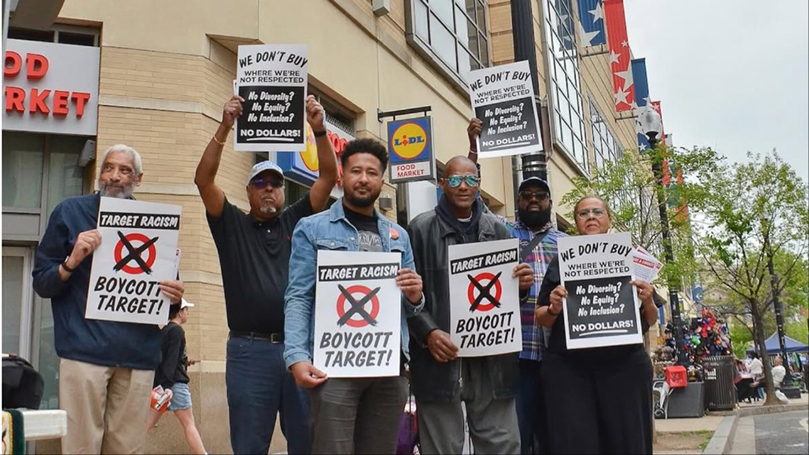
Today, in 2025, sections of the billionaire class and corporate America are attempting to assert full control over social and political life by backing the presidency of Donald Trump. Major corporations like Target donated $1 million to the Trump inauguration fund, hoping to curry favor with the new administration. Many of these corporations also began rolling back their diversity initiatives. African Americans, who felt betrayed by the election result, initiated a historic boycott of Target, a company headquartered in Minneapolis, where George Floyd was murdered in 2020. This represented a strategic effort by the Black community to resist the administration’s racist agenda.
The boycott, led by local Black women–led grassroots coalitions in Minneapolis and national leaders such as former Sen. Nina Turner, Tamika Mallory, and Rev. Jamal Bryant, has significantly damaged the retail giant’s bottom line. A most effective component was the Black church, which organized a 40-day “Target fast” from Ash Wednesday through Easter Sunday. Since the boycott began, Target’s stock value has dropped by 57 percent, and its market capitalization has plummeted by more than $2 billion. Foot traffic and online engagement continue to decline.
On the five-year anniversary of George Floyd’s murder in May, hundreds of churches and organizations nationwide gathered in front of local Target stores for prayer vigils, calling on the company to meet the movement’s demands: a $2 billion commitment to Black businesses, $250 million invested in Black banks, and partnerships with HBCU business programs to cultivate Black entrepreneurs. Boycott leaders also demanded that Target restore its diversity, equity, and inclusion (DEI) commitments. Target CEO Brian Cornell resigned in August 2025.
In Washington, D.C., a coalition of Black clergy, community members, and organizations—including the CPUSA’s local club—has picketed the busiest Target store in the Columbia Heights neighborhood for over eight months. The coalition engages the community directly, encouraging consumers not to spend money at Target. This pressure contributed to the closure of the Target store in Cleveland Park, a predominantly white neighborhood, over the summer. Target has also announced a nationwide layoff of 1,800 workers, likely tied to the boycott and management’s failure to respond to the demands.
Corporate America’s retreat from DEI has produced broader civil rights rollbacks.
Corporate America’s MAGA-initiated retreat from DEI has produced broader civil rights rollbacks, including renewed attacks on Washington, D.C.’s right to self-governance. Until recently, D.C., a federal enclave, lacked the ability to elect a local government. “Home Rule”—a limited form of self-government without full congressional representation—has again come under assault by the Trump White House and Congress. After the murder of George Floyd, D.C.’s City Council, under intense community pressure, passed police accountability laws banning chokeholds and mandating body cameras. MAGA Republicans in Congress, joined by several moderate Democrats, repealed these measures. Cash bail, abolished in 1992, and the death penalty, have since been reinstated.
Trump’s “Big Lie” alleging a crime crisis in D.C. has also justified a military-style occupation of the city and an intensified federal law enforcement presence that disproportionately targets Black and Brown youth. Earlier this year, D.C.’s mayor, in an attempt to appease Trump’s anti-DEI crusade, bulldozed the nation’s first Black Lives Matter Plaza and mural. Trump has also targeted Black mayors nationwide with ICE raids and military deployments.
Despite these repressive efforts, boycotts and other anti-MAGA initiatives have continued to grow. The labor movement has begun to respond. The American Federation of Teachers (AFT), representing 1.8 million members, passed a resolution endorsing the boycott, becoming the first major union to do so. The Coalition of Labor Union Women (CLUW) passed a similar resolution at its national conference, and the Coalition of Black Trade Unionists (CBTU) endorsed the “We Ain’t Buying It” holiday shopping freeze, focused on Target. Taken together, these actions may signal the reemergence of the historic Black–labor alliance.
One could argue that the MAGA anti-DEI drive is aimed primarily at Black workers—not only to remove them from the workforce but also to dismantle civil rights protections, beginning with the federal government. Historically, the federal government has been the nation’s largest employer of African Americans and a source of relative economic stability. This has contributed to the comparatively high Black per capita wealth in the D.C. suburbs, particularly in Prince George’s County.
Under Trump, however, African Americans have been driven out of both government and private-sector jobs, largely due to Department of Government Efficiency (DOGE)–led attacks on DEI and federal employment. More than 300,000 Black women have been pushed out of the workforce, while over 300,000 white men have been added—a trend some have described as affirmative action for white men. Meanwhile, national unemployment has reached eight million, with Black women comprising over 800,000 of the unemployed. In the District of Columbia and surrounding metropolitan areas, the unemployment crisis is nearly ten times worse than the national average.
It should be noted that white men, too, face unemployment and declining job prospects under the Trump administration. Additionally, more than 1.3 million federal workers have had their collective bargaining agreements illegally canceled in a sweeping union-busting campaign. This dismantling of the federal workforce and purging of Black workers echoes the early 20th century under Woodrow Wilson, when federal agencies were resegregated, reinforcing elite support for Jim Crow.
Trump has also illegally fired—or attempted to fire—Black women in senior government positions, including Gwynne Wilcox of the National Labor Relations Board and Lisa Cook of the Federal Reserve Board. He has pursued Black women in elected office as well, including New York Attorney General Letitia James and New Jersey Congresswoman LaMonica McIver. Black history institutions have come under attack, with Vice President JD Vance tasked with purging so-called “illegal DEI” from Smithsonian museums. Budget cuts threaten closures, including the Smithsonian Anacostia Museum in Washington, D.C. Universities such as George Mason University face sanctions for maintaining DEI policies.
In response, the Coalition of Black Trade Unionists (CBTU) has called for a national day of action led by the AFL-CIO, reminiscent of the Solidarity Day mobilizations of the 1980s following the Reagan administration’s union-busting assault of PATCO.
MAGA’s goal is to roll back the democratic gains of the Civil Rights Movement entirely.
Moreover, the ultimate goal of Trump and MAGA is to roll back the democratic gains of the Civil Rights Movement entirely. Assaults on the 14th Amendment and efforts to dismantle the Department of Education—a product of Reconstruction—seem to signal an attempt to resurrect the Confederacy politically. Civil rights offices across the federal government have been shuttered, leaving little recourse for cases involving environmental racism, medical neglect, fair housing, or LGBTQ rights. The attack on DEI functions as both wedge and smokescreen for the broader project of dismantling bourgeois democracy in favor of a fascist dictatorship. Black workers are the first targets, but all workers—women, immigrants, LGBTQ+ people, and others—are under assault.
While large demonstrations such as the No Kings protests, led by the 50501 movement, Indivisible, MoveOn, and sections of organized labor, have taken place nationwide, these efforts have often remained disconnected from the broader Black freedom movement. Is this due to a lack of concrete anti-racist demands? Or an unwillingness to address the attack on DEI within their own ranks in favor of a liberal “back to normal” politics? Rev. Al Sharpton’s March on Wall Street focused on DEI drew thousands, but was it sufficient? Could the CBTU’s call for a Solidarity Day provide the missing link to unite these movements and mobilize millions in Washington?
The March on Washington movement of the 1940s, led by A. Philip Randolph, demanded that the Roosevelt administration desegregate war industries and federal jobs. Randolph threatened to bring 200,000 Black workers to the capital. Roosevelt ultimately conceded, issuing an executive order banning discrimination in defense industries. Though the march was called off, it laid the groundwork for the 1963 March on Washington for Jobs and Freedom, organized by Randolph in coalition with Rev. Martin Luther King Jr., the United Auto Workers, and others. When 250,000 marched in 1963, concrete demands helped win historic gains such as the Civil Rights Act of 1964. The CBTU’s initiative stands firmly within this tradition.
Any renewed march must advance clear demands: reinstating DEI across government and private industry; restoring and expanding union contracts for federal workers; ending ICE raids and attacks on immigrants; and removing military forces from U.S. cities. These demands can broaden the movement and center the struggle for equality as essential to defeating MAGA fascism.
The growing centrality of the fight against racism is evident, with Black organized labor and the Black church leading the charge through demands for DEI, workers’ rights, and the Target boycott. As the midterm elections approach, more union locals must pass resolutions supporting the boycott, DEI, and a national Day of Solidarity. The path forward points toward a Third Reconstruction: a multiracial democracy with a working-class “stamp,” that is, where worker’s issues are placed at the top of the governing agenda.

 Join Now