

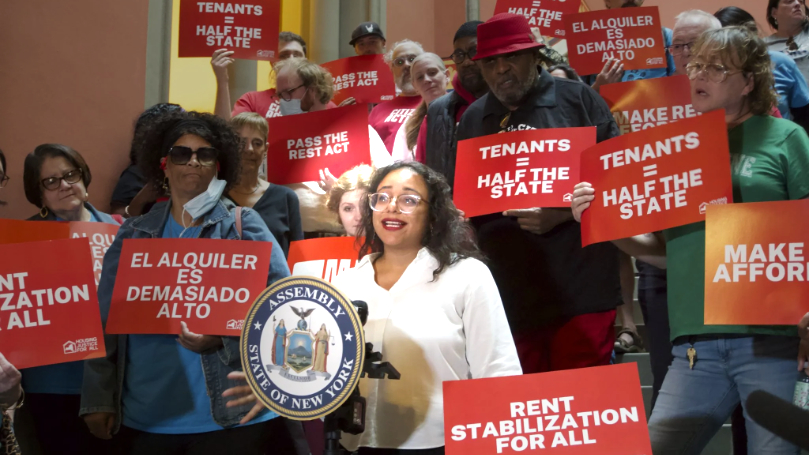
A specter is haunting the United States — the specter of the Housing Crisis!
Over the past few decades, and especially after the 2008 Great Recession and the Covid-19 Pandemic, the skyrocketing cost of housing has become a central political concern. Both Republican and Democratic administrations have acknowledged the growing crisis and both have put forward purported solutions to resolve it. Yet such solutions have, at best, only managed to slow the developing crisis rather than dissolve it; a study from the U.S. Treasury shows that 90% of families live in counties where median rent and home prices grew faster than median income between 2000 and 2020. (1) It seems an established truth that housing is too expensive today, but rarely is it asked why that is the case.
The failure of liberal and conservative solutions to the crisis is underpinned by the incorrect view that the housing crisis is a contingency within the capitalist mode of production. That is, the crisis is viewed as a result of a temporary mismatch between supply and demand that can be remedied without any deep changes to the functioning of capitalism. Thus, the mainstream discussion moves to contingent causes of that mismatch, be it government underinvestment, too stringent zoning regulations, or — more fascistic — immigration. It is no wonder that such solutions have missed their mark; they are grounded in a fundamental misunderstanding of the housing crisis.
This paper hopes to present a more accurate account of the housing crisis by appealing to the laws of capitalist production and exchange. As such, the analysis begins with an examination of the housing commodity through use- and exchange-value. We will find that ground rent explains how the price of housing is inextricably linked to the exploitation of workers. Then, it turns to crisis formation under capitalism where we will see how the housing crisis forms and in what ways mainstream solutions (whether through loosening zoning laws or producing more housing) fail to address the roots of the crisis. In the final determination, the housing crisis is intrinsic to how private property and capitalism function.
Under capitalism, the housing crisis is impossible to resolve. As such, we must recognize the housing struggle as an important theater of the broader working-class struggle. The only way to end the housing crisis is to end capitalism and move into socialism.
I. The value of housing
Capitalism is a mode of production dominated by the production and exchange of commodities. As commodities, objects can be viewed from the perspective of use-values and exchange-values. The use-value of a commodity is its utility, its ability to satisfy some need or want, while the exchange-value of a commodity is its worth, its value in relation to other commodities. (2) What, then, are the use-values and exchange-values of housing? (3)
Use-Value and Exchange-Value
We’ll begin with the former. There are innumerable uses for housing, many of which are outside of the scope of this investigation, but deserve attention nonetheless. (4) The class of use-values of housing that we are interested in are those such as a place to rest and relax, raise a family, escape from the private sphere, etc.; broadly, the production and reproduction of labor power. Put strongly, housing is necessary for the full production and reproduction of labor power.
And recall that under capitalism the working class is composed of people who must rely on selling their labor power in exchange for money or other goods. As a “means of production” of labor power, housing plays a crucial role in perpetuating the capitalist system through the threat of homelessness and unemployment: a failure to obtain housing leads to a failure to reproduce one’s labor power, which prevents one from selling one’s labor power for money, and thereby prevents one from buying housing. The vital role of housing in the production of labor power thereby becomes a point of exploitation for capitalism — which only worsens under crisis.
Cost components of housing’s price
Now we move to examine the exchange-value of housing or, roughly put, its price. (5) Marx states that the exchange-value of a commodity is determined by the amount of social (or average) human labor power expressed in the commodity. (6) That is, the more average labor used to create a commodity, the higher will be its exchange-value. How, then, is social human labor power expressed in the housing commodity?
The first and most obvious place we can look for social human labor power is in the material and labor costs of a house. Annual surveys by the National Association of Home Builders (NAHB) estimate that construction costs (labor and materials) and finished lot costs (utility and street preparations for the new construction) contribute about 78% of housing’s sales price. (7) Labor — the physical construction — directly imparts value into the house. And the materials for that labor are themselves commodities already filled with value from past production processes. The transformation of standing trees into planks on the job site is replete with social labor power.
Aside from the costs of physical construction, there are several smaller expenses that contribute to a house’s price such as financial and marketing costs, among others. Marx considered these costs as faux frais — costs for the circulation of capital as commodities and money which do not add to the exchange-value of a commodity. (8) Although they do not contribute to the value of housing, the developer must still recoup the cost of these faux frais expenses in the final price. According to the NAHB survey, faux frais expenses amounts to around 10% of a house’s sales price.
The last segment of a house’s exchange-value and price is the profit margin of the builder. This contributes the remaining 9-12% of a house’s sales price, according to the NAHB Survey. (9) Profit, according to Marx, is the form in which surplus value — the value over and above the value put into the commodity — appears to the capitalist. (10) Marx spends a great deal of time, especially in the first volume of Capital, showing how surplus value can be derived from a capitalist’s exploitation of their workers: the worker produces a greater value than they are paid. Yet it would be too hasty to conclude that the profit in housing commodification is entirely derived from the exploitation of construction workers (although this too undoubtedly happens). Rather, we should look at ground rent as the deeper source of housing’s profit.
Ground rent: Marx’s theory
Marx spends a great deal of the latter chapters in Capital Vol. 3 explaining his theory of ground rent to reconcile a seeming contradiction in his economic system: if social human labor power is the source of value, how and in what sense can land be said to have value? Much of Marx’s discussion is couched in the context of agriculture, which was the dominant use of land in his time, and Marx spends considerable time discussing land fertility and how it factors into capital circulation. We can recontextualize much of Marx’s discussion of agricultural land fertility in terms of housing; after all, whereas farmland’s use-value is in growing crops, housing’s use-value is in growing people and their labor power. (11)
In analyzing ground rent, Marx categorizes four types of rent that work opaquely and in tandem: absolute, differential I, differential II, and monopoly. First, absolute rents arise from the fact that ultimately capital must have the permission of a landowner to use land. Landowners are not under the same pressures to use their land as capitalists are to expand and produce. Therefore, landowners can demand a rent for the use of land, even the worst land, so long as that rental cut does not prevent the capitalist from obtaining the average profits in their industry. Differential rent arises from comparing some land to the worst usable land. Land that is more productive (for example because it is more fertile) will require less capital to produce surplus value than the worst usable land. As such, the landowner can demand a rent from the profit of using better land.
Lastly, differential rent II occurs as differing capital investments are made on similarly productive pieces of land. Even if the two pieces of land are originally identical in terms of productivity, one tract of land may attract more capital investment and thus become more productive than the other tract of land over time. Therefore, landowners can also extract rent based on the productiveness of capital already invested in the land compared to others. Lastly, monopoly rent arises in unique locations that can easily be monopolized (e.g. vineyards that produce one-of-a-kind wines, homes in New York City which are unique in their proximity to the heart of global capitalism, L.A’s proximity to Hollywood, etc.). (12)
Here is the crux of the matter underlying ground rent: the value of land is not tied to some innate property in the ground; rather, the value of land is instead tied to the potential profit that can be extracted by using the land as a means of production. (13)
We can now translate the discussion of ground rents from talk of land to talk of housing and thereby understand the price of housing. Housing’s price is determined in part by its ability to be used in the production of labor power. How, then, is that price determined?
Applying ground rent to housing
First, we must determine what kind of value can be extracted from the worst kind of housing (absolute rent). Housing is a paramount example of an ‘inelastic good’ — a commodity whose demand remains stable despite fluctuating or rising price — because it is so essential to the reproduction of human life. (14) In fact, even housing legally deemed ‘unfit for human habitation’ can still fetch a high price because the alternative — homelessness — is so much worse than living in substandard housing. Recognizing this, landlords may use the threat of eviction as means of silencing tenants from reporting the disastrous conditions in the home. (15) With the need so great and the threat so real, landlords can demand relatively exorbitant rents. This exploitation for the worst housing forms the groundwork on top of which the other forms of ground rent may add to. Crucially, this means that the price of housing for all classes cannot be determined without the exploitation of the lowest class.
On top of absolute rent, housing’s price is affected by differential rent (both I and II) in that housing that is better than the worst housing available will presumably allow a greater and more efficient production of labor power, which thereby allows for a greater degree of exploitation through rent collection. We can interpret this dynamic as follows: the greater the location and capital invested in housing (i.e. amenities), the more sought after that housing will be; and by the laws of competition, those who can spend the most money will obtain the most sought-after housing. This expectation is canonized within the capitalist framework of housing valuation. The Uniform Standards of Professional Appraisal Practice state that in forming a determination of a piece of real estate’s value, the appraiser must “develop an opinion of the highest and best use of the real estate.” (16) Thus, housing simultaneously attracts and must attract the greatest use of the production of labor power. (17) Any less than the best use is a loss in profits. (18)
In this valuation, location is used as a relational concept; the best use is determined by what is around the property. Two homes of identical make can have drastic price differentials based on the wealth of the neighborhood. In the same way that housing increases and decreases in value based on the amenities around it, housing can also impart value to neighboring real estate based on its own valuation. This relational pricing becomes a key battleground of local politics. On average, 72.5% of a city/town’s local budget is acquired through property taxes. (19) Thus, local political decisions must always be made with an eye toward the future values of property in the city. Likewise, Homeowners Associations enforce strict uniform rules in an attempt to preserve the value of the neighborhood’s homes. (20)
And lastly, in some cases of housing, monopoly rent also enters the picture. As already mentioned, some locations can fetch higher prices due to the uniqueness and irreproducibility of their location.
\We now have a relatively full picture as to how the price of housing comes about. (21) Housing’s price is determined by a) material and labor costs within the building, b) faux frais costs of advertising, loan interest, etc. and c) profit in the form of expected ground rent. (22) Two brief comments are deserved. First, we ought to hesitate in generalizing the ratios of a), b), and c) to be 80:10:10 according to the NAHB survey. The data for these ratios only measure single-family homes. We ought to expect the ratio to skew more toward profits and rents in multi-family and apartment-style homes. Furthermore, more locationally valuable homes may have higher ground rent and therefore higher profit margins. What I find uncontroversial, however, is that the three above-mentioned categories are the three determinants of housing prices.
Second, I leave as an open question the effect of ground rent on faux frais and material/labor costs. Advertising and interest rates are no doubt reticent to housing’s overall cost and expected ground rents. We would therefore expect a decrease in faux frais costs should housing’s price drop. Whether material costs have some expectation of downstream ground rent remains to be seen.
II. Crisis Formation
From the analysis of the housing commodity, we can already see a tension between use-value and exchange-value, between housing’s utility and its price. Yet this tension is present in all commodities to varying degrees owing to the internalization of the contradictions of capitalism. Contradiction alone does not bring us to crisis. In what sense, then, are we experiencing a housing crisis?
Marx’s theory of crisis
For Marx, a capitalist crisis occurs when there is a breakdown in the cycle of capital flow as it moves from money to commodities and back to money (with profit). A break can occur at each stage of the movement: capitalists can fail to purchase the raw commodities they need, fail to transform the raw materials into a finished commodity while preserving value, or fail to find buyers for their finished commodities. (23) For housing, all three stages create conditions for a crisis.
Three points of breakdown in housing production
First, developers lack the raw materials and manpower necessary to produce housing profitably. Recent reports suggest that the construction sector is lacking 400,000+ workers to fill all the open positions and building materials have increased in price by over 40% since 2020 (owing to the COVID-19 pandemic supply chain issues, followed by tariffs). (24) At risk of cutting into profits, landlords and developers pass the increased cost of housing material to the user of the housing in the form of larger rents and mortgages.
Second, even with the materials and labor required, developers may be unable to produce housing profitably. One of the most common reasons given as a cause the housing crisis is overly restrictive zoning. (25) Limiting the location of where housing can be built, what form it takes, in what ways it can be built, etc. all can make a seemingly profitable development become unprofitable. The argument goes that with relaxed zoning laws, developers would be able to, for example, create multi-family homes in places where previously only single-family homes were possible. And with more units in the same location, housing prices per unit would decrease.
The reasoning here is backwards, however. The need to transform single-family zoning to multi-family zoning suggests that the land/housing (in actuality, those who speculate on that land) demands a greater profit from ground rent. That profit cannot be acquired from the housing currently in place either because a) the home is paid off and thereby does not supply capital with continued payments, or b) the residents of the home cannot generate the surplus value that the ground rent demands. In either case, partitioning the home into multiple units will allow for greater extraction of rents because population density increases and as such exploitation per plot of land increases. But this does not resolve the tension; it reproduces it on a smaller scale, a scale which will grow larger with time until the crisis reappears. As such, the desire to transform single-family homes to multi-family homes — or similar zoning changes — is not a cause of the housing crisis, but an effect of it. Zoning changes provide temporary relief yet leave the underlying cause of the crisis untouched.
More broadly, we must beware of arguments that suggest deregulation as a solution to the housing crisis. While some zoning laws can certainly be updated or removed, we must ensure we do not erode protections for tenants, homeowners, and the environment. David Madden and Peter Marcuse have insightfully stated that deregulation, “has not meant getting rid of regulations so much as rewriting them to make real estate a more liquid commodity.” (26) Examples include the privatization of public housing, fractionalizing housing plots and units (such as pushing for accessory dwelling units), the advent of real estate investment trusts and mortgage-backed securities (such as those that led to the Great Recession), among other measures. The goal in all these “deregulations” has been to allow capital to flow through housing much easier, even if ownership of property does not change hands. And in increasing the flow of capital, deregulation provides more opportunities for exploitation and the extraction of surplus value. Further steps in this direction will not solve the housing crisis; it will make the crisis even more painful upon its eruption.
Finally, if capitalists have enough material and labor and they can transform it profitably, crisis may still form if the capitalists are unable to sell the finished commodities. In this case, the housing crisis forms if housing is too expensive for consumers to purchase. This appears to be a point so obvious it doesn’t bear mention, but the secret of the housing crisis lies in asking why there is now a disconnect between what housing costs and what the average person can afford. After all, even if the average housing unit cost a million dollars, so long as the average person made a million dollars a year, there would be no housing crisis.
Wages versus rent: the class antagonism
The discrepancy is made clear when we analyze the tension within the housing commodity as it expresses itself in class struggle. Marx could see the multi-factional tension arising when he begins the final chapter of Capital Vol. 3 by stating “the owners merely of labour-power, owners of capital, and landowners, whose respective sources of income are wages, profit, and ground-rent, in other words, wage-laborers, capitalists, and landowners, constitute then three big classes of modern society based upon the capitalist mode of production.” (27) Marx is right to view these three classes in conflict; landlords and capitalists are in conflict to extract surplus value, and workers are stuck in between.
On the one hand, the value of labor power is determined by the value of the commodities necessary to reproduce it.(28) And as discussed above, housing is a fundamental part of the reproduction of labor power. It is in the interests of capitalists to cheapen the value of labor power so as to extract more surplus value. (29) Even higher-valued labor (i.e. skilled labor) becomes conceptually grounded in unskilled, simple labor. (30) Therefore, capitalists pay for labor power (through wages) based on the reproduction of unskilled labor and the cheapening of the reproduction labor power allows for a greater acquisition of profits (at least for a time, until equilibrium returns to the market).
On the other hand, as mentioned above, the value of real estate is in part determined by its best use. In the residential sphere, the best use of housing is the reproduction of the highest-valued labor power. This is in part determined by location in that some locations will have access to higher paying jobs. (31) The ground rent, therefore, must be as high as possible to allow for maximal surplus value extraction.
The antagonism is clear: the capitalist class consistently pays for labor power as cheaply as possible while the landlord class demands the highest ground rents possible. Both capitalists and landlords demand the surplus value of labor power, but in opposing ways. Owing to the ‘anarchy of capitalist production,’ we should not be surprised that these forces have created unbearable conditions for a great mass of the working class. Those with higher wages — typically those in positions of capital management — can avoid the worst excesses of the housing crisis, while those in less profitable (i.e. more exploited) positions must endure atop the rack of capitalist and landowner exploitation. But this is just the crisis of income inequality by another name. The housing crisis, therefore, is the manifestation of income inequality in tangible form, of the class conflict in the built environment.
If then, the housing crisis is concomitant with income inequality, and income inequality is a necessary result of capitalism, is the housing crisis an essential part of capitalism? Yes!
Why the crisis isn’t new
Those that believe that the housing crisis is a novel phenomenon and thereby divorced from the logic of capitalism rely on the observation that housing prices have exploded in the past twenty, thirty, fifty, etc. years at a rate much quicker than before. While this observation is correct, it is far too hasty to suggest capitalism is not the cause. While technology and material conditions have changed over the last century (especially in regard to the ways that financial exploitation through housing can occur), the root of the housing crisis remains centered on ground rent and the exploitation of labor power. There are three reasons why we’ve seen the sudden increase in housing over the last few decades:
First, much like today, the housing crisis does not affect the entire working class in the same way. For much of the 20th-century, people of color (and black people in particular) have endured a prolonged and overtly racist housing scheme where they were expressly denied adequate housing, forced into substandard housing, made to pay rents disproportionally higher than their white counterparts, and generally excluded from the many benefits of homeownership. The housing crisis was alive and kicking in the 20th century for non-white people, and it would have affected the entirety of the working class more brutally had it not been for the over-exploitation of people of color. Furthermore, from the discussion on absolute ground rent above, we can see that ground rents must rely on a class or subclass of people that are ultra-exploited to establish a base ground rent from which to build atop differential ground rents. Black people were expressly forced to play this role in the 20th century and disproportionally play this role now. And although there have been decades of struggle to rectify these past injustices, much work is still left to be done. (32)
Second, the passage of the Housing and Community Development Act of 1974 (which gave birth to the Section 8 program) saw the shift of federal spending away from public housing and toward voucher programs. This shift was epitomized in the 1998 Faircloth Amendment which prevented the construction of public housing by housing authorities if that development would increase the net number of public housing units beyond the number of units that existed on October 1st 1999. Public housing plays a crucial role in providing a bulwark against the rise of absolute rents by providing housing to people that would otherwise be unable to afford it. By shifting the stewardship of low-income housing to landlords and private interest, the exploitation of absolute rent (and ground rent in general) increased both for low-income occupants and all those in un-subsidized housing.
Third, more generally, capitalism must always face the tendency of the declining rate of profit. (33) Because profit is extracted from human labor power, and because the production process of commodities becomes more mechanized over time, the rate of profit per capital invested decreases over time (because variable/human labor becomes a small portion of the production process compared to constant/machine capital). The most obvious solution to prevent this tendency is to increase the intensity of exploitation. (34) This increased exploitation appears in housing as increased ground rents — that is, as an increased intensity of future exploitation.
From the above three points, we can conclude that the housing crisis is not a novel occurrence. Rather, it has existed in one form or another under capitalism, the form of which is determined both by the contingent material conditions of the U.S. as well as the internal tendencies of capitalism. With the housing crisis here to stay, we must tackle a further, more pressing question.
III. What is to be done?
It is easier to explain a problem than to develop a solution — even easier still to draw a rough sketch of the problem as I have done. And although this explanation of the housing crises leaves much for further development and clarification, I hope one thing is abundantly clear: the housing crisis is grounded in the exploitation of the working class. Housing and labor are necessarily linked under capitalism and as such, communists must be involved in the housing struggle.
How, then, do we get ourselves out of this crisis?
Limits of “build more housing”
The most common “solution” touted by mainstream voices to resolve the housing crisis appears simple enough: build more housing. Various sources state that the U.S. is short 3.7 to 5.5 million homes. (35) Presumably, so the argument goes, increasing the supply of housing will lower the price, thereby cooling the housing crisis and returning the market to a manageable level. This is an unsatisfactory solution in numerous ways.
First, the solution of building more housing seems to be at odds with statistics that show as much as 10% of the U.S.’s housing supply (some 15 million homes) are currently vacant. (36) In the most extreme cases like Detroit, there are 116 vacant homes for every unhoused person in the city. These vacant homes are ones available for rent, for sale, or seasonally (such as second homes). If there is a plethora of vacant housing, how can producing even more housing resolve the crisis? This disconnect can only make sense if we understand the housing crisis not as a lack of housing, but as a lack of realizable profits for landlords and housing-capitalists. Homes will remain empty and vacant, even in the face of homelessness and crisis, if it is not profitable to rent/sell them. At best, an increase in the supply will lessen the housing crisis but not eliminate it.
Second, suppose that by some miracle, private developers rapidly increase housing production across the country. But under the same logic that proposes this “solution” we can see how the crisis will rear its head again. Should housing supply increase and the price of housing decrease, there will be a point in time where developers stop producing housing because it is no longer profitable. Then, as the population and demand for housing increases, so too will the price until we return to a state of crisis. It is in this way that Engels chastises bourgeois responses to the housing crisis: “solving it in such a way that the solution continually reproduces the question anew.” (37)
Third, suppose that by some miracle the U.S. housing supply increases and by an even greater miracle the population of the U.S. and the housing supply remains stagnant. In other words, a housing crisis as in the above point will not redevelop. Where does that leave us? The functions of ground rents will remain, although not as intense. Still, so long as ground rents exist, a class of people must be ultra-exploited to serve as the foundation for all rents. Homelessness and substandard housing must exist for a baseline that justifies the price of housing.
What we can now see is that the mainstream “solution” out of the housing crisis fails to target the crux of the issue, fails to prevent the reproduction of the crisis, and maintains a system of exploitation that targets one of the most disadvantaged communities in our society (the unhoused and those at risk of being unhoused). That is not to say that we should not produce more housing; we should. But mere housing production cannot resolve the crisis.
Immediate and long-term struggle
If the mainstream solution fails, what is the alternative?
As an immediate step, we must involve ourselves in local housing movements to better the conditions of renters and homeowners. We must win victories in rent control or freezes, foreclosure and eviction protections, increased housing production, etc. Such gains not only better the conditions of working class folks in our communities, but also increases the reputation of communists and our work. We need only look at how our comrades in Graz have spearheaded the housing fight and won the trust of the people. (38) Only if we can prove through our actions that we fight for the working class will our neighbors listen to our analysis of the housing crisis.
As members or leaders of the housing struggle, we must bend the movement to include long-term goals that will resolve the housing crisis. Ultimately, the housing crisis cannot end so long as the capitalist mode of production reigns supreme. But we should not accept this in a defeatist attitude where we must first wait for the fall of capitalism to usher a world of better housing. Rather, we ought to see this as an opportunity. After all, Marx said that “an attack upon one form of property… may cast considerable doubt on the other form.” (39) Capitalism and housing as a commodity rely on the legal framework of private property. In fighting against private property under capitalism, we weaken the justification of private property of housing. And vice versa too, by fighting against private property in housing we weaken the position of private property in capitalist society generally.
Public and social housing
And we weaken private property in housing by advocating for public housing. To do so would require joining national campaigns to repeal the Faircloth Amendment and thereby unlock public housing stock. Public housing, like other government services, does not rely on a profit to exist, and can continue functioning at a loss indefinitely. Crucially, public housing has historically worked to prevent elderly, disabled, and poor people from falling into homelessness — that is, those most likely to be exploited in substandard housing to increase absolute ground rent. Should public housing expand and should its roles as a bulwark continue, public housing has the unique opportunity to attack the basis of absolute ground rent. If adequate public housing is available to all at little to no cost to the occupant, absolute ground rent in the private market will crumble.
A robust system of public housing would allow for a private housing market to exist simultaneously. Yet the private market’s ability to exploit tenants and homeowners will be hamstringed by public housing. After all, tenants will be much less likely to allow for landlord abuses if there is housing available that is of equal quality and cheaper. Over time, it may come to be that public housing becomes the dominant if not only form of housing. Singapore, for example, despite being a hub of global capitalism, had 90% of its land and housing in the public sphere only a few decades ago. (40)
Alternative housing models such as housing cooperatives and social housing have a role to play too in reducing the housing crisis. Due to the nature of their organizational structures, these social housing models can curb the worst excesses of private property in housing. Still, these models operate within the framework of private property and are therefore rely on ground rent and land valuations to remain afloat. Ground rent is the source of the housing crisis and only through the elimination of ground rent may we truly end the housing crisis. And that is only possible under a robust configuration of universal public housing.
The United States is a materially vast landscape, and crisis manifests in similarly vast ways. The tactics in both short- and long-term housing struggles will ultimately need to be developed in accordance with on-the-ground conditions. What may be successful in one part of the country may be futile in another. Yet every challenge offers a new opportunity to weaken the housing crisis and thereby weaken global capitalism. The fight against capitalism in housing is a fight against capitalism writ large.
IV. References
1. Feiveson, L., Levinson, A., & Wertz, S. S. (2024, August 7). Rent, House Prices, and Demographics. U.S. Department of the Treasury.
2. Marx, K. (1967). Capital (F. Engels, Ed.; Vol. 1). International Publishers, 43-46.
3. In talking of housing, I define the term broadly to include single-family homes owned by a homeowner as well as apartments rented by a tenant from a landlord. The value of housing in its varying forms may differ from one type to the next, but how that value is derived remains the same across the forms. For the context of this paper, we will treat mortgages as functionally similar to rental payments, only to a banker rather than a landlord.
4. An important use-value of housing is its role as an instantiation of politics in space. One’s address determines whether one can vote, who or what one can vote for, where one votes, and to what laws one must abide by.
5. It should be noted that price and exchange-value are not identical concepts; the former implies a monetary system which attempts to quantify the latter. Price and exchange-value may come apart in, for example, cases of supply and demand mismatch, or, as seen below, cases of faux frais costs. Likewise, we may call a commodity’s price over-inflated when we believe the price does not match the exchange-value within the commodity. A more detailed analysis of these disconnects is beyond the scope of this article.
6. Marx, Capital Vol. 1, 46.
7. Lynch, E. (2025, January 20). Cost of Constructing a Home – 2024. National Association of Home Builders, 8. We should take these survey results with a grain of salt; the sample size is small, consisting of smaller-than-average builders and larger-than-average lot sizes. As such, the average sales price in the survey is about 50% higher than the national average. We should expect larger builders to be able to reduce construction and finished lot costs (both in absolute and in ratio) by standardizing designs, procuring bulk materials, negotiating better rates, optimizing construction and management, etc. Even with such cost cutting measures, however, labor and material costs would still be the largest contributor to the cost of housing.
8. Marx, K. (1967). Capital (F. Engels, Ed.; Vol. 2). International Publishers, 131-133.
9. The ~10% profit target is similarly cited in Stephens, R. (2026). State of Residential Construction Industry Annual Report. Association of Professional Builders, 95-96. This report has a much larger sample size than the NAHB survey and tracks data across the US, Canada, Australia, and New Zealand.
10. Marx, Capital Vol. 1, 150-151.
11. Furthermore, we can broaden the talk of fertility to talk of location in general. Fertility for productive crop growth varies from location to location based on qualities in the land. Similarly, the efficient (re)production of labor power can be determined by qualities in the land, e.g. the quality and amenities of one’s housing, the amount of pollution in the environment, the quality of services in the community, etc. Already we can begin to see the tension that arises in the unequal development of land and thereby labor power.
12. Marx, K. (1967). Capital (F. Engels, Ed.; Vol. 3). International Publishers, 649-781.
13. Harvey, D. (2006 [1982]) The Limits to Capital. Verso, 347, 371. This is a pathway in which land can become fictitious capital. Ground rent itself is a form fictitious capital (i.e. claims on future value). In the same way, housing can become fictitious capital through hypercommodificiation. For a deeper discussion around hypercommodification, see Marcuse, P., & Madden, D. (2016). In Defense of Housing. Verso. 26-35
14. Similarly, see how the 50% increase in the price of gasoline due to the U.S.-Iran war did not create a reciprocal 50% decrease in the demand for gasoline. While some demand did decrease, gasoline’s necessity to the functioning of society and the economy allowed it to be similarly consumed despite the jump in price.
15. For real-world examples from the 21st century, see Desmond, M. (2016) Evicted. Penguin Random House. An important implication of this is that landlords need a class of unhoused and close-to-unhoused individuals to live in substandard housing and thereby provide a baseline for rent exploitation.
16. (2024, January 1) The Uniform Standards of Professional Appraisal Practice 2024. The Appraisal Foundation, 20.
17. The production and reproduction of labor power need not occur in the home per se. A capitalist can afford a home 100x the average price not because they have within them the labor power of a hundred workers, but that they have at their continual disposal the social labor power of a hundred workers. The hierarchical nature of capitalism is reproduced in the housing system through price. Those in managerial positions which propagate capitalism tend to be paid higher and can thus afford better homes.
18. Alarmingly, the housing development industry requires every ounce of profits it can extract. In a shocking admission, the Association of Professional Builders states, “Poor financial literacy created widespread problems. Only a small minority of builders correctly understand critical financial metrics, including Work in Progress (WIP) adjustments and expense ratios… only 12% of builders correctly understand all critical metrics… they must constantly sign new contracts to obtain deposits that fund completion of old jobs. The deposits from new clients pay for work already completed on previous projects, creating a Ponzi-like dynamic where they are solvent only as long as they continue growing. If sales stop, the liability comes due immediately, and the cash required to fulfill obligations no longer exists. The builders operating under these conditions believe they run profitable companies, but they actually operate unsustainable cash flow machines that will collapse the moment growth stalls.” Stephens, State of Residential Construction, 5, 83-84.
19. (2023, July 10) Local Property Taxes as a Percentage of Total Local Tax Revenue, Selected Years 1977-2021. Urban-Brookings Tax Policy Center. Harvey has much to say on the role of the government in relation to capital flow, taxation, and spatial configuration. See Harvey, The Limits to Capital, 404.
20. Since the 1970s, Homeowners Associations (HOA) have become increasingly more common, to the point where a third of all housing is under some form of HOA. Many builders often mandate HOAs in the deeds of newly constructed housing and it is easy to see why: HOAs are a guarantee that the housing will continue to maintain its current quality and value, and thereby ensure that the expectant ground rents are not diminished.
21. We have left out of the conversation any talk of the increased financialization of housing — that is, it’s increased use as an asset for financial gain rather than to be lived in. This transformation is backed by a series of financial tools focused on finding new avenues of exploitation and intensifying already existing ones. The financialization of housing is owed to the fetishization of housing and ground rent: housing is believed to generate value through rent, but it is the occupants of housing who are the actual generators of value. In this way, housing and rents become nothing more than numbers on a spreadsheet to be manipulated for money. The ways in which this financialization takes place are beyond the scope of this article, although what is clear is that increased financialization results in increased ground rents and thereby increased exploitation of the working class.
22. While the analysis of housing’s price so far has emerged from the perspective of housing development, we must be ever mindful of commodified housing’s use by landlords. From the landlord’s perspective, the entirety of the cost of housing must be made-up by ground-rent in a reasonable turnover rate. The potential ground-rent is already pre-determined prior to any construction (it is necessary to do so to persuade banks for funding). In this sense, the potential ground-rent turnover rate places a cap on the cost of building. We can see now in what sense ground-rent is the determinant of profit for developers.
23. For details on the capital cycle, see Marx, Capital Vol. 1, 146-153. For discussion on how crisis manifests in the cycle, see Harvey, The Limits to Capital. 87-89.
24. Nimmons, E. (2025 October 21) Building Barriers: How Rising Construction Costs Impact the Housing Affordability Crisis. The National Association of Hispanic Real Estate Professionals.
25. Shaw, J. (December 2024) America’s Housing Problem — Explained. Harvard Magazine.
26. Marcuse & Madden, In Defense of Housing, 31.
27. Marx. Capital Vol. 3, 885.
28. Marx. Capital Vol. 1, 167-168. The necessity here is determined in a historical and moral way,
29. This would be an increase in the relative surplus-value. See Ibid. 297-299.
30. See Ibid. 51 and 192fn.
31. This is why, for example, the price of housing is so high in the San Francisco Bay area — it is close to the epicenter of global technological innovation. Interestingly, this also explains the spike in housing prices seen during the pandemic: through the advent of remote work, high-earners could live in locations (and pay higher rents) that could not previously produce that high-valued labor power.
32. Although the Fair Housing Act was passed in 1968, it could not be adequately enforced until an amendment passed in 1988. Yet even under ideal conditions, the Fair Housing Act can only do so much to resolve the decades of unequal land development between white and non-white neighborhoods. This means that although the housing crisis is affecting most of the working class at this moment, people of color still bear a disproportionate brunt of the crisis.
33. Marx. Capital Vol. 3, 213.
34. Ibid. 232.
35. Jones, K. and Weinstock, R. (2025 December 15) Estimates of a “Housing Shortage.” Congressional Research Service
36. United Way NCA. (2026, January 28). How many houses are in the U.S.? Data by City. United Way of the National Capital Area. https://unitedwaynca.org/blog/vacant-homes-vs-homelessness-by-city/
37. Engels, F. (2021) The Housing Question. International Publishers, 74.
38. Armstrong, L. and Wilson, J. (2025 August 22) Welcome to LeninGraz: Austrian Communists show how to run, win, and govern. People’s World.
39. Marx, K. (1968). Theories of Surplus-Value. (R. Simpson, Translator.,S. Ryazanskaya, Ed.; Part II). Progress Publishers, 44.
40. Haila, A. (2016) Urban Land Rent: Singapore as a Property State. Wiley Blackwell, 73. Singapore is, of course, unique in many respects, but the key here is that we can have a robust system of public housing while still in a capitalist mode of production. We need not wait.
The opinions of the author do not necessarily reflect the positions of the CPUSA.
Images: REST Act Gains Momentum by Housing Justice for All. Sawant-Rent-Control-4 (46700362565) by Seattle City Council. CC BY 2.0.

 Join Now