

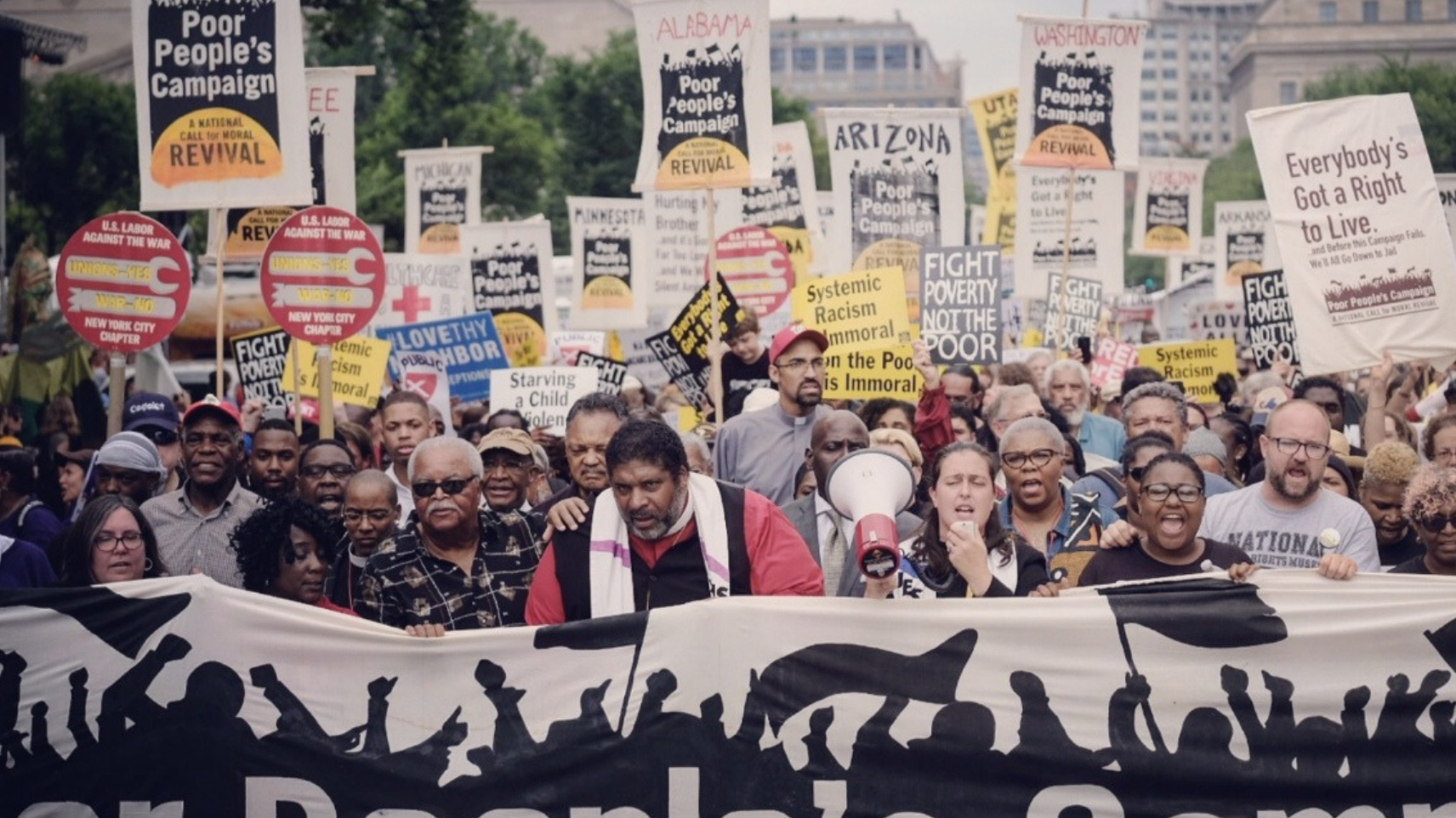
The fight for a Third Reconstruction is the subject of recent essays by Brad Crowder and Derek Dougherty. Reconstruction, of course, refers to the post-Civil War efforts to dismantle the legacy of slavery through measures such as land redistribution, universal public education, and voting rights. Crowder correctly points out that these radical reforms were overthrown after the Hayes-Tilden Compromise in 1877 and the withdrawal of federal troops from the South. A century of fascist-like KKK rule resulted.
After World War II, the Civil Rights movement arose to address this white supremacist legacy. The Supreme Court’s Brown v. Board of Education aimed at ending segregation in public education and after mass protests led by Martin Luther King Jr., a new wave of reforms was enacted in the 1960s, among them the Voting Rights Act, the Fair Housing Act, Medicaid and Medicare. Affirmative Action — special compensatory measures to make up for past discrimination against people of color and women — was also a product of this period. Civil Rights leaders refer to these measures as a Second Reconstruction.
A civil rights counter-revolution
This Second Reconstruction too has been the object of a sustained many-sided assault, not only on civil rights but also on the entire edifice of the New Deal. In this regard, the Moral Majority, the Tea Party, and now MAGA represent successive moments in ongoing wars of position by ruling class proponents of neoliberal austerity.
MAGA, however, has taken these attacks to an entirely new level. Today we are witnessing a general offensive against democratic rights including DEI, abortion, and collective bargaining rights. Indeed, since Trump’s election, the Civil Rights Division of the Justice Department has been gutted, majority Black districts in the South have been declared unconstitutional, and white people are now officially portrayed as the main victims of racist discrimination. Taken as a whole, the country is in the midst of a veritable civil rights counter-revolution. The demand for a Third Reconstruction seeks to right these racist wrongs.
The Third Reconstruction, however, as a concept was introduced by historian C. Vann Woodward after MLK’s murder in ‘68 to address the next stage in the fight for Civil Rights, one that would redress social and economic discrimination. After the turn of the century the term was popularized by Rev. William J. Barber II, then head of the North Carolina NAACP, to address the systemic roots of social inequality. Third Reconstruction demands have since become the property of the African American Civil Rights movement as a whole. It is vital to point out here that this movement is independent and self-governing, and like all self-determining movements of the racially and nationally oppressed, its goals and demands must be respected. A failure to do so by outside movements or groups, no matter what their stripe or political party, could do grave harm to the cause of people’s and working-class unity.
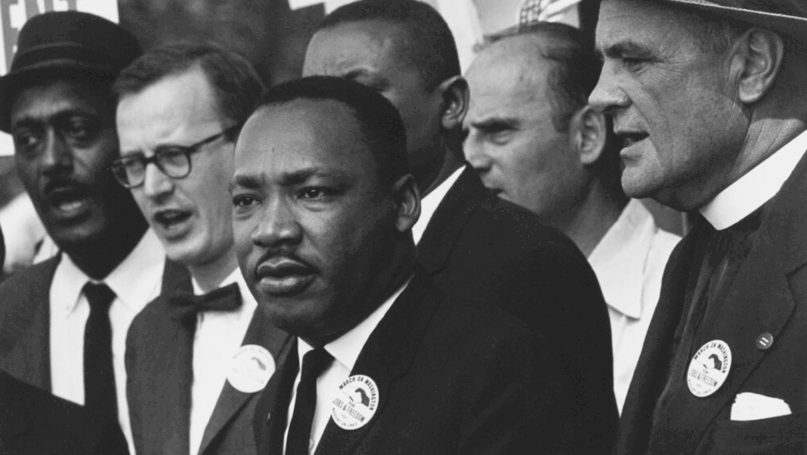
This cautionary note applies to Crowder’s and Dougherty’s articles, both of which explore finding paths toward achieving the Third Reconstruction goal. For Crowder that path lies in building an all-peoples front (the terms people’s front and popular front are used interchangeably in this article) that would be guided by an anti-monopoly strategy in pursuit of what he calls a “national democratic revolution.” In his opinion “Monopoly is the stage at which the bourgeoisie’s capacity to lead a democratic revolution exhausts itself entirely. Bourgeois-democratic tasks are transformed into national-democratic tasks.” Further, “The anti-monopoly struggle” he contends, “has to stand at the core of this rising movement, because only the working class, organized and at the head of a broad popular coalition, can finally complete the democratic revolution launched on July 4, 1776.”
Dougherty calls aspects of this argument into question, and suggests that the call to build an anti-monopoly coalition immediately is abstracted from today’s fascist danger. Crowder, he counters, is skipping stages. For Dougherty, before anti-monopoly measures can be taken the MAGA right has to be defeated. “The anti-fascist struggle” he writes, “is primary. It is a direct and immediate defensive struggle for bourgeois-democratic rights and working-class organizations against the most reactionary and terroristic section of monopoly capital, which today unequivocally finds political expression in the MAGA movement.”
What are we to make of these contrasting arguments? Is Dougherty right? Is defeating MAGA a precondition to Crowder’s approach to achieving anti-monopoly goals? Or given monopoly capital’s support for the MAGA offensive, does Crowder’s strategy better fit today’s circumstances?
Before answering, it might be helpful to understand what’s meant by people’s front, anti-monopoly coalition, and national democratic revolution, as each have specific histories and meanings in Marxist-Leninist science.
The all-people’s front and the anti-monopoly coalition
First, the people’s front as viewed by CPUSA, is an informal multi-class coalition of the U.S. people in their broad majority, including workers, farmers, small-and-medium sized enterprises along with some big businesses. It is multiracial, multinational, multigender, and intergenerational. It includes labor, peace, civil rights, youth, environmental, and other social movements and can even — as happened during World War II — contain groups of countries.
This popular front strategy in its developed form was theorized by collectives leading the 7th World Congress of the Communist International fighting fascism in 1935. The case for a multi-class strategy against reaction, however, was first made by V. I. Lenin in his Two Tactics during the battle against Czarism. In Two Tactics, Lenin argued for a multi-class coalition not only of workers and peasants, but also the republican bourgeoisie against feudal reaction. Defeating the Czar was the main thing, the first stage in a multiple stage revolutionary process, one that required bringing the widest — and deepest — possible coalition to bear.
This coalition concept was reintroduced into the work of the Communist International in the early 1920s after the defeat of the German and Hungarian uprisings. The united working class front tactic was developed by the Third and Fourth Congresses of the Comintern. As compared to Lenin’s earlier multi-class concept, this coalition had a more restricted, that is, a more specific proletarian focus. The united working class front’s primary aim was healing the rift that developed between social democratic and communist workers after the split in the Second International. It called for working-class unity on issues regardless of ideological difference.
The anti-monopoly strategy was developed after World War II and was heavily influenced by the 19th and 20th Congresses of the Communist Party of the Soviet Union (CPSU). Like the popular front, it sought unity of action between different classes but this time minus a temporary alliance with sections of big business.
Simply put, parties advancing an anti-monopoly strategy posit that, in developed capitalist countries, big monopolies dominate the state/government, and that the interests of large majorities of workers, farmers, small businesses, and other strata are in conflict with monopoly — creating the basis for a coalition that, if led by the working class, could follow a parliamentary path to power. The theory is that this would lay the groundwork for establishing an anti-monopoly government. This anti-monopoly government, by breaking the monopolies’ grip on the state, could then open the way to a socialist transition.
The national democratic revolution concept builds on Lenin’s theory of imperialism. While advanced in the work of the Communist International, it too came to prominence after the Second World War to address decolonization and national liberation in Asia, Africa, and Latin America — a highlight of which was the revolution in China in 1949. It posits the need for countries subjugated by imperialist domination to form “national democratic fronts,” a cross-class alliance including the national bourgeoisie to mobilize the entire nation in the fight for independence. This national democratic revolution concept today, while not used widely, is most prominently advanced by the South African liberation movement. The goal is nation building: to create a non-racist and non-sexist new nation among the land’s diverse peoples, overcome apartheid and colonialism of a special type, and forge a common national identity.
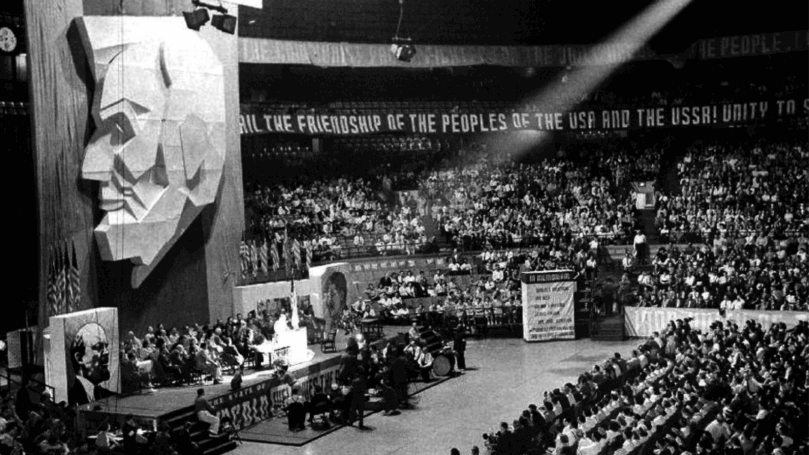
With respect to Comrade Crowder’s essay, then, the question is how do these concepts apply to the U.S. today? The CPUSA Program holds that in the current moment defeating the far right is the main question before the country. It postulates that at this stage, anti-fascist tasks — not anti-monopoly measures — are the order of the day. In this respect Comrade Dougherty’s statement that “the anti-fascist struggle is primary” seems to have merit. While one might quibble with Dougherty’s use of the word primary — a category that belongs to class struggle — Crowder does seem to be skipping stages. On the other hand, Crowder’s position shouldn’t be casually dismissed. Indeed, can MAGA be defeated without breaking the billionaire grip on the federal government? An interesting question no doubt, but would that require anti-monopoly measures?
Consider that the CPUSA program argues further that a multi-class, all-peoples front is the political form of coalition through which those tasks must be organized. While fully embracing the anti-monopoly strategy as a necessary goal, the party program insists that defeating the far right is a precondition for moving in that direction. Does not the rise of MAGA and the full-on fascist assault on democracy make this all the more necessary?
The working class and the struggle for democracy
Who will carry out this struggle? Crowder is very concerned — as well he should be — that big business can’t be relied on: “Monopoly is the stage at which the bourgeoisie’s capacity to lead a democratic revolution exhausts itself entirely” he asserts. But here one must ask when have bourgeois forces, monopoly or not, ever had the capacity to lead a democratic revolution? From the time of Lenin at the very least, the revolutionary working-class movement has never had confidence in big capital’s capacity to do anything other than pursue the drive for maximum profits. Their “leadership” of the bourgeois-democratic revolution has always been to lead their class’ domination over society, the result of which has been to trample over and over again the rights of workers, women, and oppressed nations. However, that does not mean that sections of the capitalist class, including sections of monopoly, cannot from time to time be compelled to support more advanced democratic demands. Hence the CPUSA’s call, following Lenin, to place a working-class stamp on the democratic fight — a fight that must compel some elements of big capital to support its demands.
With regard to this democratic fight, two issues stand out. First, as it applies to the fight for equal rights, that is, the national question, this is a struggle for the fulfillment of bourgeois-democratic rights. The movement’s “reconstruction” or Civil Rights demand as Martin said in ‘63 was a demand to fulfill a promise. Listen: “When the architects of our republic wrote the magnificent words of the Constitution and the Declaration of Independence, they were signing a promissory note to which every American was to fall heir. This note was a promise that all men, yes, Black men as well as white men, would be guaranteed the ‘unalienable Rights’ of ‘Life, Liberty and the pursuit of Happiness.’”
Secondly, it must be recognized that this fight in the USA today is by definition a fight in a two-party political system dominated by monopoly capital: this has been the case for over a century. Notwithstanding this two-party domination, however, the Civil Rights movement has always insisted on an immediate addressing of its demands. To sum up Martin’s central argument in Why We Can’t Wait: “We want freedom and we want it now.” And in order for those demands to be met, monopoly forces in both the Democratic and Republican parties had to be compelled to support the Civil Rights, Voting Rights, and Fair Housing Acts.
The popular front against fascism
Today, advocates of the Third Reconstruction are confronted by the same two-party system in which one of the parties has carried out a civil rights counter-revolution. Shouldn’t communists support this call to upend MAGA’s plans? Consider what it would mean for the Communist Party to distance itself and instead say, “Sorry, your Third Reconstruction will have to wait until the working class leads a fight to defeat monopoly.” Moreover, would that be substantially different from the position taken by the Socialist Party in the early 20th century which argued that addressing racism would have to wait until the arrival of socialism?
It’s well worth noting here that the all-peoples front concept was developed in the late 1980s by party collectives led by Gus Hall. They emerged in response to a shift to the far right in the U.S. ruling class after the Nixon and Reagan elections, a fight in which racism played a major role. Let’s not forget that the Moral Majority rise was in large part a response to efforts to desegregate public education. Hall’s “whiff of fascism” thesis marked the beginning of this process. In this regard, the party’s concerns about the degree of the fascist danger grew ever more pronounced with the appearance of the GOP’s Southern Strategy, Iran–Contra, Gingrich’s Contract On America, the Tea Party, and now Trump.
It’s important to recognize here a transition in the party’s propositions from an emphasis on fighting monopoly as a whole to fighting that section of monopoly dominated by far right and fascist forces. This shift began in the mid-80s. It’s true that for a time the terms “all-peoples front” and “anti-monopoly” coincided in the same documents and were used interchangeably. But as time went on, and the fascist danger grew ever more pronounced, the people’s front replaced anti-monopoly as the point of emphasis.
Consider also that the popular front, since the 7th World Congress, is seen as a specific form of coalition to combat a very specific danger: fascism. Why? Because to be successful, the coalition must be able to peel off sections of monopoly itself. Thus, it is a multi-class concept. Is it risky and fraught with all manner of betrayals? Yes. But the danger posed by a dictatorship is far greater.
In this regard, the popular front does not fit with other strategic objectives and the tactics needed to achieve them, notably the anti-monopoly coalition. Why, for example, would monopoly corporations participate in coalitions predicated on breaking their very power? One must conclude then that the anti-monopoly goal requires another front or coalition, narrower in some regards with a different political goal and program.
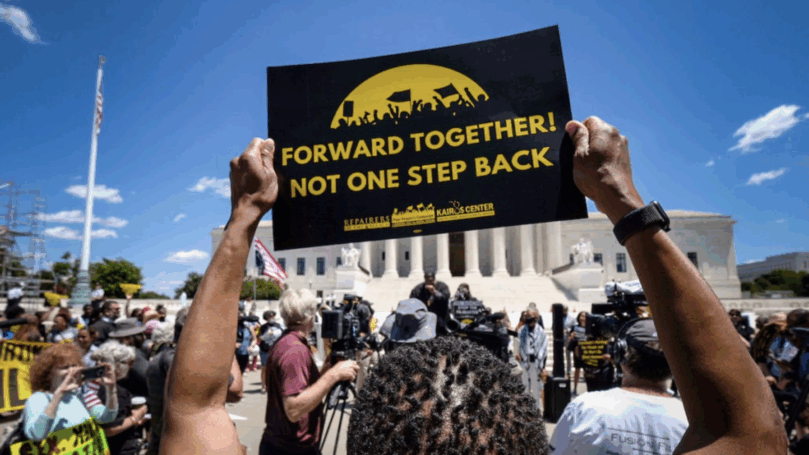
The national democratic revolution
This brings us then to the issue of the national democratic revolution. Does a front developed by communist and national liberation activists in the developing world to mobilize the entire nation to oppose colonialism have any application at all in the imperialist center? The main goal of the national democratic revolution — which by the way is at base a bourgeois-democratic revolution (the nation after all is a creation of capitalism) — was to establish the nation state. This meant raising an army, conquering the home market, establishing a common language etc., most of which was achieved in the imperialist centers during the 18th and 19th centuries. In other words, in the developed capitalist countries the national democratic revolution has been completed.
But has the national democratic revolution been completed on these shores? It’s true that here a racist social division of labor, that is, institutionalized racism has marred capitalism’s historic development. It’s also true that as a result our country has experienced a somewhat incomplete bourgeois-democratic revolution. Still the answer is largely yes. It’s beyond doubt that the home market has been long established along with the currency of a common language. It’s also very clear that monopoly capitalism has forged in this country a single working class comprising many different nationalities, ethnicities, and cultures.
On the other hand, national questions in the U.S. continue to rage, with a people of color majority expected by 2040. But solving these questions requires an appropriate strategy for these times and the tactics needed to achieve them. Today that means placing the fight against racist inequality at the center of the fight for class unity. In other words, it would be a mistake to suggest that the tasks before the multinational U.S. today are akin to tasks before a national liberation movement: to do so would run the risk of replacing multinational, multiracial class tasks with “national”— that is, racial/ethnic — ones, a goal that Crowder seems to be advancing by arguing that achieving a Third Reconstruction would require anti-monopoly measures led by the working class.
The centrality of the fight against racism and the fight ahead
After all, achieving a Third Reconstruction as conceived by African American activists, is not a national democratic task but an advanced democratic one requiring not only the support of Black Americans as a whole, but Latinos, Asian Americans, Native Americans, women, white workers, youth etc. Reverend Barber places the question this way.
“In a fusion coalition, our most directly affected members would always speak to the issue closest to their own hearts. But they would never speak alone. When workers spoke up for the right to organize and engage in collective bargaining, the civil rights community would be there with them… Our biggest challenge is to see the intersectionality of our issues and build fusion coalitions that are stronger than divide-and-conquer strategies.”
As Henry Winston emphasized when arguing for the concept of centrality, solving African American oppression and racism is central to class unity — it does not replace it. The main issue before the country in this moment of late stage imperialism is defeating the drive towards white supremacist nationalist fascism — a struggle that on the one side cannot be won without broad multi-class unity, but on the other side, must place racist and gender inequality, in other words, the struggle for democracy at the center of the fight.
Can Third Reconstruction measures be realized given today’s balance of forces domestically? Honestly, we do not know what the future will hold. What we do know is that they cannot be postponed but must be fought for as hard as we can in the here and now. And like it or not, the struggle must proceed from defeating the far right attack on civil and labor rights, to anti-monopoly or “advanced democracy” and from there to socialism. It would be a mistake to skip stages but to also mechanically place walls around each of these phases as we fight to break the billionaire grip on the federal government.
The opinions of the author do not necessarily reflect the positions of the CPUSA.
Images: Poor People’s Campaign march in Washington, D.C., 2022. Poor People’s Campaign; Dr. Martin Luther King Jr. during the 1963 March for Jobs and Freedom. Wikimedia Commons; CPUSA 10th National Convention in New York City, 1938. CPUSA archives; Poor People’s Campaign slogan ‘Forward Together, Not One Step Back’ during Moral Mondays. Poor People’s Campaign.

 Join Now