


“The Third Reconstruction and the anti-monopoly strategy,” by Brad Crowder, offers a contribution in grounding current struggles in the fight against monopoly capital and the rich, tragic, and instructive history of the First and Second Reconstructions. It identifies the fusion of the state and monopoly capital as the central obstacle to genuine democratic advances for the mass of the people.
The article’s emphasis on the material basis for an anti-monopoly coalition is a necessary strategic insight. However, in its enthusiasm for this essential perspective, the article exhibits a tendency to blur distinct stages of struggle and to apply organizational forms, methods, and strategic priorities that belong more properly to the immediate anti-fascist, all-peoples struggle. A thorough examination of these relationships is necessary in order for them to sharpen our analysis rather than blur it.
The primary difficulty lies in the article’s treatment of monopoly capital itself, along with the relationship between the anti-fascist and anti-monopoly struggles. Crowder’s conclusion states “The freedom struggle and the labor struggle have been targets of the same ruling class offensive from 1877 to the present, and they will only defeat that offensive together. … That strategy starts with the anti-monopoly struggle, proceeds through the National Democratic Revolution, and demands a Popular Front capable of fighting for state power …”
Emphasis was added to highlight the particular “order” of the process that is presented here. This contribution aims to build upon the article’s strengths while offering another view of the framework for the tasks ahead.
The question of “the front”
What, exactly, is “the front?” The question of unity, with whom, on what basis, and to what end, should be central to each stage of struggle. This demands a precise distinction between strategic unity, tactical unity, and political unity. These forms of unity are qualitatively different yet at times interconnected, and confusing them leads to many disastrous consequences.
Understanding the character, composition, and function of “the front” at each stage of struggle is essential for building an effective strategy for that struggle. When taking the entire historical process of class struggle into consideration, it could not be possible for there to be only one singular formation or group that develops in a clear and linear fashion straight towards socialism.
There is a succession, a development and passing, of distinct organizational forms and methods, each appropriate to the specific concrete conditions of struggle and level of development at every stage of struggle, each emerging from the contradictions of the previous stage, and each preparing the ground for the next. For each stage of struggle, the general process is much the same; identify the primary antagonistic class or social forces, isolate those forces from their bases of support, consolidate the forces capable of defeating it, and strategically advance to the next stage following the defeat of those antagonistic forces.
However, the forces that can be united and fought at each stage, the organizational forms and methods required, and the character of working-class leadership within the process are all qualitatively different. This process also is not linear, and will twist and turn as the realities of struggle unfold.
Tactical unity is a lower form of unity. It means that the forces in question find themselves cooperating on a specific immediate objective or method despite differing strategies and long-term goals. It represents, ultimately, only a temporarily shared position of opposition to a common enemy.
Strategic unity is a higher form of unity. It means that the forces in question possess a shared analysis of the primary enemy, a shared vision of the desired outcome, and a shared strategy for achieving these. It represents wide agreement on fundamental questions of the relationship between classes and the state, as well as the necessary path for the working class.
Political unity is the highest form of unity. It is the organizational expression of strategic unity and requires a common political program, common discipline, and common form of organization.
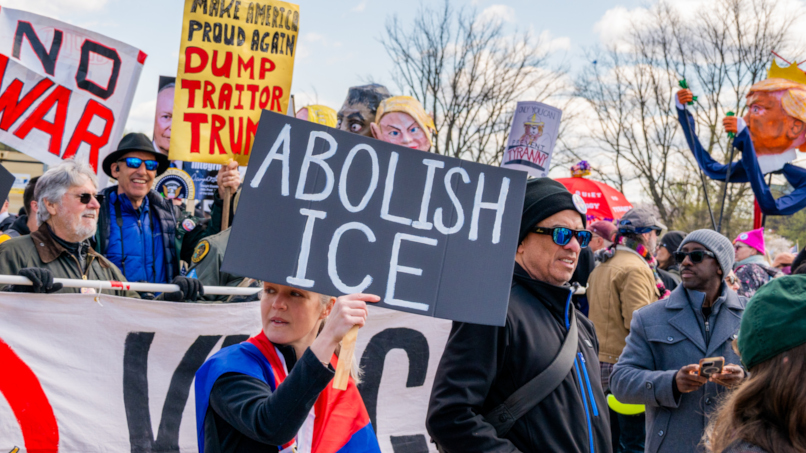
In the anti-fascist stage of struggle, the front is a broad, defensive collection of forces whose unity is based on a shared enemy rather than necessarily on a shared program or organizational form. This is what has historically been known as a popular front, or a people’s front. It is a “coalition” of necessity, not of conviction, and its members have radically different visions for society after the immediate fascist threat is defeated. This is the kind of front that has emerged in practice against the MAGA movement, uniting socialists, labor unions, civil rights organizations, LGBTQ+ and women’s groups, and certain sections of the Democratic Party, all in a common struggle against the many fascist assaults of the Trump regime.
Left only to this formulation, the working class may be able to lead this front, but its leadership is quantitative rather than qualitative. That is to say, it is the numerically largest group but it is not able to influence the direction of events as a class from this defensive position. In order to do so, the particular form and unity of the popular front must be built on the basis of another particular kind of front.
This means that the anti-fascist front contains a class struggle within it. The workers fighting for union recognition may, in certain specific cases, find themselves in tactical unity with their own employers in the broader struggle against MAGA forces, just as they are simultaneously in strategic opposition to both their employers and the MAGA forces. In the electoral arena, this means fighting alongside sections of Democratic Party-aligned capital, against the organized fascist movement within the Republican Party, while simultaneously fighting against all sections of capital’s grip on the labor movement, the liberation and people’s movements, and its opposition to workers’ power.
The blurring of these distinctions results, as we have seen time and again, in treating those sections of capital which are aligned with the Democratic Party, for example, as an ally rather than a class enemy with whom we have found ourselves in temporary tactical alignment. The anti-fascist front requires constant attention to this class struggle that is taking place within it. Communists, therefore, must work tirelessly within the anti-fascist front in order to strengthen the working class organizationally, ideologically, and politically, so that when the conditions do change, it is the working class assuming strategic leadership of the situation and not a class enemy.
In the anti-monopoly stage of struggle, there is a coalition of conviction. It is united around a program to democratize the economy and complete the democratic revolution. Its unity is based on, at least some, shared interests and a shared vision. This coalition is led by the working class because workers have the greatest stake in breaking monopoly power, and possess the greatest power to do so. However, it also includes farmers, small business owners, professionals, and others who are squeezed by monopoly capital and who have a material interest in its defeat.
Within this coalition, the working class exercises a different kind of leadership, no longer only quantitative, it now assumes qualitative leadership on particular questions, that is, it gains the ability to set the political direction, organize the struggle, and represent the interests of the class, as a class. This type of working-class leadership arises from the realization of another kind of front, a united front of the working class.
From this, we see that even the anti-fascist, all-peoples front demands that political unity should never be confused for tactical or strategic unity, and further, that the all-peoples front must be led by a united front of the working class. To conflate these many concepts is to risk organizing for a battle we are not fighting, to fail to organize appropriately for the battle that is upon us, and to be caught off guard when the conditions rapidly change.
Each struggle is a specific response to a specific task which, in turn, takes into consideration the specific level of development of each. The passage from one to the next is not an automatic process, it requires conscious political work, ideological struggle, and the patient building of particular forms of working-class organization and leadership. The former creates the conditions for the latter, while the latter resolves the contradictions which create the former.
The relationship between tasks and stages
It is historically and theoretically correct to state that “the freedom struggle” and the labor struggle are targets of the same ruling class and that they will ultimately defeat that ruling class together. To state this correctly, however, means not collapsing the distinctions and particularities inherent in the statement. What, exactly, is meant by “the freedom struggle” for instance? The current period is characterized by a unique and dangerous intertwining of tasks, but the stages of struggle, and the contradictions within them, remain distinct. To state that certain tasks are becoming intertwined is likewise not to say that they are now identical or that they occupy the same strategic moment and orientation.
The anti-fascist struggle is primary. It is a direct and immediate defensive struggle for bourgeois-democratic rights and working-class organizations against the most reactionary and terroristic section of monopoly capital, which today unequivocally finds political expression in the MAGA movement. This struggle is still the precondition for any sustained anti-monopoly struggle and the fulfillment of democratic tasks. However, “defensive” does not mean passive, nor does it mean that struggles within the anti-fascist front are limited only to defensive forms. The struggle is defensive due to the fact that it arises in response to an opposing offensive.
Consider the widely varying forms of community defense against ICE terror which have sprung up in the past 16 months, particularly following the shootings of Ruben Ray Martinez, Silverio Villegas-Gonzalez, and others, as well as in Minneapolis where federal agents executed Renee Good and Alex Pretti in broad daylight. The immediate and nationwide response which followed; of organizing massive, peaceful, and disruptive protests in resistance to the expansion of ICE operations; of providing legal support to communities under attack; of creating grassroots rapid response networks for community support; of bringing all of this work into active coalition with the labor movement, in particular, ultimately resulting in a localized general strike, were all undeniably defensive in their ultimate strategic orientation of stopping the ICE offensive.
Yet this defensive work also contains an offensive struggle. It builds concrete and lived solidarity, organizational capacity, develops leadership, tests ideas, and raises consciousness among the whole working class regarding the very nature of the Trump regime, of capital itself, and of the tasks demanded of the working class moving forward.
Similarly, the Target boycott, organized in response to the company’s retreat from DEI and later expanding to opposing ICE operations as well, is another defensive struggle against those sections of capital capitulating to MAGA pressure. Yet it is also an offensive use of power resulting from a strategic analysis, and a tactical consolidation, of forces involved. It demonstrates to the workers that they themselves, in alliance with “the freedom struggle” as our comrade calls it, and others, can impose costs on capital for objective gains, that multiracial and multinational solidarity can be mobilized around concrete and immediate demands, and that pressure from below can, in turn, force certain retreats from above along with the limits of each type of pressure.
The anti-fascist struggle is not a simple holding action. It is within itself a contest, a struggle, over the terrain of struggle both present and future. Through struggle, we build the capacity to struggle on different terrain.
Understanding this, the article’s treatment of the Popular Front concept, while drawing on Dimitrov’s invaluable framework, tends to apply that framework mechanically. Again with emphasis added, the article states that “a Popular Front is the organizational form…” while in Dimitrov’s view, “correct utilization of experience does not by any means denote mechanical transposition of ready made forms and methods of struggle from one set of conditions to another, from one country to another, as so often happens in our Parties…” (Unity of the Working Class Against Fascism)
In addition, Dimitrov said “We must find and advance those slogans and forms of struggle which arise from the vital needs of the masses, from the level of their fighting capacity at the present stage of development. … We must tirelessly prepare the working class for a rapid change in forms and methods of struggle when there is a change in the situation… It goes without saying that the practical realization of a united front will take various forms in various countries.” (The Fascist Offensive and the Tasks of the Communist International in the Struggle of the Working Class Against Fascism.)
Dimitrov’s analysis was forged in the immediate context of the fascist threat, where the primary task was to unite, with working-class leadership, all forces who share the common enemy of the fascist dictatorship, including some sections of capital, to defend bourgeois-democratic institutions and working-class organizations. The forms of unity, the criteria for alliance, and the immediate political demands of the period were all being shaped by that specific conjuncture.
The anti-monopoly struggle, as a strategic project for state power by an anti-monopoly coalition, operates on a different plane entirely, under different concrete conditions of struggle. While it may build upon the specific alliances forged in the anti-fascist fight, its leadership, program, and organizational forms and orientation must be determined by the specific conditions of struggle of the moment, the particulars of monopoly capital oppression and rule.
To overcome the blurring of these stages of struggle, we must clearly distinguish between the anti-fascist struggle and the anti-monopoly struggle while understanding where, and why, they are interconnected. The concrete conditions of struggle determine the tactics used, tactics are not arbitrary rules that apply everywhere.
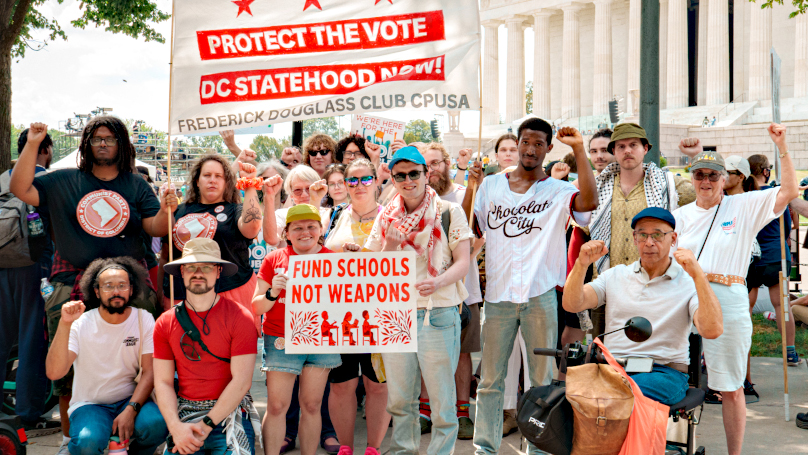
Our strategy regarding the anti-fascist stage of struggle, as noted, is what we call the All-Peoples Front, which is united around “minimal” democratic demands against the fascist assault. Its primary methods, under current conditions, are to strengthen labor led and anti-racist struggles, build democratic mass mobilizations, and electoral defense, combined with the legal and physical defense of communities against fascistic terror. The success of this stage is measured by the ability of all anti-fascist forces to halt the fascist offensive against the people and against the remaining bourgeois-democratic institutions.
U.S. capitalism is presently in the transnational monopoly capitalist, imperialist stage of development: state monopoly capitalism moving toward fascism. Once fascism is defeated, it will be both necessary and possible for the people’s democratic forces to take on the transnationals as a whole. This more advanced, anti-monopoly stage of struggle will be the next key step on the road to socialism in the U.S.
The anti-monopoly people’s coalition likely will put forward a program of public policies and government practices as the coalition grows and strengthens. A developed anti-monopoly program will build on the many struggles and issues already begun and won in the fight against fascism. A key, but by far not the only, demand the CPUSA would put forward at this stage of struggle would include the building of a mass people’s party capable of contending for governmental power, a party free of domination by any monopoly interests.
The struggle for a program that radically curbs the power of the transnationals will take place not only through such a people’s party, but also through non-electoral struggles at all levels, in workplace and neighborhood grassroots forms, and city, state, and national coalitions. These organizational forms can gradually coalesce into ongoing multi-issue coalitions and an anti-monopoly united front of joint struggle. Methods of struggle include demonstrations, strikes, petitioning, picketing, boycotts, civil disobedience, and mass and general strikes, in addition to electoral struggle.
It is possible and desirable that a people’s party, united around the anti-monopoly coalition, will win governmental control at the local, city, state, or even national level. The goal of this governmental participation is to implement those parts of the program of radical democratic demands not already won, and to point towards, and popularize, the struggle for socialism.
The anti-monopoly struggle is an offensive struggle for state power, under specific prevailing concrete conditions. It requires a different strategy and a different organizational form from the anti-fascist struggle. It requires a concrete coalition of forces under the strategic leadership of the working class, in other words, it requires the struggle for working-class hegemony united around a program that challenges the very basis of monopoly capital’s rule. Its primary methods, likely, will include electoral struggle, workplace and community organizing, strikes, and political action aimed at breaking the grip of monopoly capital on the economy, politics, and culture of the United States. Our program envisions a labor-led People’s Party as this electoral vehicle, however, such a party does not yet exist. As the anti-monopoly struggle succeeds in breaking this particular grip of monopoly capital, the contradictions within this coalition also surface and sharpen. The success of this stage is measured, in large part, by the ability of the working class and oppressed peoples to construct alternative centers of electoral and other political power, and ultimately, to break the two-party electoral system.
The anti-fascist struggle creates the conditions under which the anti-monopoly struggle develops and takes hold, while the anti-monopoly struggle, by beginning to address the root causes of fascist political power, that is, the vacillation of particular sections of monopoly capital, lays the foundation for the only permanent solution to the fascist threat, socialism. To collapse them entirely risks fighting the anti-monopoly struggle prematurely without the necessary support, or to limit the anti-monopoly struggle to only defensive forms and methods appropriate for defensive stages of struggle.
The central strategic principle is that the all-peoples front against fascism must be led by a united front of joint struggle of organized labor, the working class, oppressed peoples, and women, but also must include all sectors of the population negatively impacted by fascism. Without labor’s leadership, the popular front can become a class-collaborationist trap. With it, the popular front becomes a consistent vehicle for anti-fascist struggle and building working-class hegemony both.
A democratic revolution… for whom?
The article, also, correctly identifies that another primary task before us is to complete the unfinished democratic tasks that were, for a very select few, begun in 1776. To do so, it argues for a framework it calls the National Democratic Revolution. While this framework has different sources, the source that matters in this context is the 1960 International Meeting of 81 Communist and Workers Parties. This particular analysis was developed in response to anti-colonial struggles in Africa and Latin America, and in particular in South Africa. The theory held that such states could take a “non-capitalist path,” skipping or shortening a full capitalist stage, led by a broad “national democratic front” of the working class, peasantry, petty bourgeoisie, and the “progressive,” anti-imperialist wing of the national bourgeoisie — with the promise, never fully cashed out, that this would eventually mature into a transition to socialism.
The Statement of the Meeting says:
The monopolies try to retain their hold on the levers of economic control and political influence in Asian, African and Latin American countries. These efforts are aimed at preserving their positions in the economy of the countries which have gained freedom…
The urgent tasks … facing the countries that have shaken off the colonial yoke cannot be effectively accomplished unless a determined struggle is waged against imperialism and the remnants of feudalism by all the patriotic forces of the nation united in a single national-democratic front. The national democratic tasks on the basis of which the progressive forces of the nation can and do unite in the countries which have won their freedom, are: the consolidation of political independence, the carrying out of agrarian reforms in the interest of the peasantry, elimination of the survivals of feudalism, the uprooting of imperialist economic domination, the restriction of foreign monopolies and their expulsion from the national economy, the creation and development of a national industry, improvement of the living standard, the democratization of social life, the pursuance of an independent and peaceful foreign policy, and the development of economic and cultural co-operation with the socialist and other friendly countries.
The working class, which has played an outstanding role in the fight for national liberation, demands the complete and consistent accomplishment of the tasks of the national, anti-imperialist, democratic revolution, and resists reactionary attempts to check social progress.
From its earliest inception, even before this “formalization,” the concept was fraught with tensions regarding the nature of the state, class alliances, and the path to socialism, illustrated most clearly through the numerous debates among the various parties of Soviet, South African, Indian, and Chinese comrades both before and after 1960. The application in South Africa provides a particularly instructive case study of its contradictions. Here, the concept was institutionalized as the framework for dismantling apartheid and constructing a new society.
This “two-stage” theory posited that the first stage was the national liberation struggle against white minority rule, and the second stage, the National Democratic Revolution (NDR), would be a lengthy socio-economic transformation aimed at fundamentally altering the structure of the economy, addressing historical injustices, and laying the basis for socialism. Post-1994, this framework has remained deeply controversial. The South African Communist Party has consistently argued “… as we had always done, that a national democratic revolution with a capitalist orientation ceases to be an NDR.” (Blade Nzimande, Red Alert Volume 5, No. 66, 18 October 2006)
Keeping this in mind, we can see that July 4th, 1776 marked the turning point of a certain historical process. Whatever name may be applied to that event, what can be said with certainty is that it was a particular form of revolution, a process which based itself on the “promise” of political equality, economic justice, and popular sovereignty, and which birthed a particular form of government from a previous colonial administration. That revolution, however, was incomplete from its very inception. This “promise” was, as we know, specifically denied to enslaved peoples, Indigenous peoples, to women, the propertyless, and more. The “promise” of economic justice was intended for the planter and merchant classes, the emerging industrial bourgeoisie. It was a revolution which established national political independence, shattered the restrictions placed upon the colonial productive forces by England and thereby freed a particular national market, at least partially broke up the feudal system of land tenure, and it brought very limited democratic rights into the political system for a carefully selected few. We have here, in essence, a bourgeois-democratic revolution. The unavoidable question is: democratic for whom?
This revolution of 1776 was not only incomplete in its democratic tasks, it was built on the systematic genocide of Indigenous peoples and annexation of their lands, both of which were sacrificed for the expansion of the new American state. The NDR framework, as developed in anti-colonial contexts, posits a unified oppressed nation seeking liberation from an outside colonial power, but in the American context, the “nation” in question is not a single entity, not an oppressed American nation, but a complex relationship of cooperation, subjugation, and extraction between an interconnected array of forces occupying different positions on different questions. Here, we have multiple questions, of oppressed nations, of national minorities, and of racialized oppression, all influencing one “national” democratic struggle alongside their own struggles.
What does this wealth of history teach us? It demonstrates that, like all concepts, the NDR is not a rigid schema to be mechanically declared and applied. The mechanical importation of formulations developed for other conditions, whether South Africa, India, or elsewhere, risks blurring distinct local, concrete, stages of struggle.
The relationship between sections of monopoly
Crowder’s analysis could also be strengthened by a more thorough examination of the relationship between different sections of monopoly capital and how this relationship affects our strategic approach to both the anti-fascist and anti-monopoly struggles. Monopoly capital is not a monolithic bloc, it is composed of different sections with different interests: finance capital, industrial capital, tech capital, and others.
These sections have particular interests on questions such as trade policy, regulation, taxation, military spending, and the managing of class and social relations in society. These interests may conflict at times, and converge at others, to varying degrees according to the specific level of development of each. At times, some may see fascism as a threat to their long-term stability, others may see it as the only available instrument for suppressing labor and securing their profits.
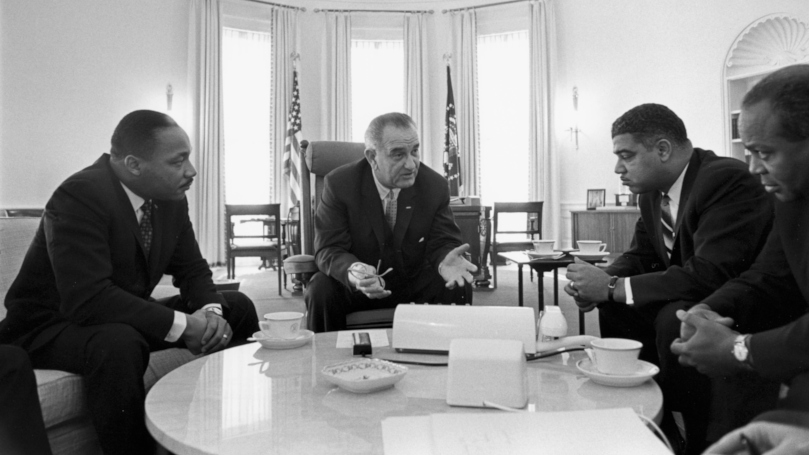
The history of the First Reconstruction demonstrates the importance of understanding these divisions. This period represented the first major attempt to fulfill these democratic tasks by extending political equality and economic justice to the formerly enslaved peoples, by moving forward for the first time with the uprooting of planter’s chattel slave property relations on a large scale, by reconfiguring the very class composition of the political state. Industrial capital supported the policies of Radical Republicans insofar as it needed to break the planter class and secure the South for its own national markets. Once that specific goal was achieved, this section of capital’s “commitment” to these policies evaporated, and with it evaporated its “commitment” to these remaining democratic tasks, to which it struck its own bargain with the Southern planters.
Similarly, the anti-fascist struggle today requires us to understand which sections of monopoly capital are supportive of fascism and which, if any, are not, and why that is. The events of the past few years have placed these divisions front and center. Historically, and to this day, sections of monopoly capital have fluctuated widely in their support for either the Republican or Democratic Parties, with the exact composition of each, at times, seeming to shift entirely on a dime. This pattern of fluctuation has increasingly shifted in favor of the Republican Party. The MAGA movement is the product of a specific alliance between sections of monopoly capital, particularly finance, tech, and energy, utilizing a mobilized petty-bourgeoisie.
The rise of MAGA and the Trump administration is not an accident, it is a product of the inherent contradictions of capitalism, particularly under the crises of neoliberalism where sections of the ruling class have ideologically shifted from bourgeois democracy to neofascism. This reality explains why the anti-fascist struggle is primary today. It is not only a direct confrontation with the most reactionary section of monopoly capital, this section has been striving for near-total state power and, toward that goal, begun the dismantling of bourgeois-democratic rights.
What these fluctuations reveal is that monopoly capital’s political alignments are determined not by principle but by material self-interest. Sections of capital will support whichever political formation appears most likely to secure their profits, protect their markets, and suppress threats to their power. This means that their support for fascism, for anything, is conditional. This conditional relationship is crucial for our strategic analysis. It means that the anti-fascist struggle can sometimes find itself in tactical unity with sections of monopoly capital which recognize fascism as a threat to their interests at a particular moment and under particular conditions. Their opposition is based on a narrow, calculated self-interest at a given moment, and not a condition of any inherent tendency. They will abandon their anti-fascist pretenses when they feel it no longer serves their purpose, just as Northern industrial capital abandoned the First Reconstruction.
Conclusion
The reality today is that the anti-fascist struggle is primary in the United States, and indeed globally. The fascists must be defeated to create better conditions for continued struggle toward socialism.
The anti-monopoly struggle, likewise, must indeed be understood as the struggle through which certain democratic tasks can be finally completed. This, by necessity, requires moving beyond the forms of the anti-fascist all-peoples front and building a coalition united around a program that challenges the very basis of monopoly capital’s rule. This is not a future task, it is happening now, and we must also recognize this and organize accordingly.
The upcoming midterm elections present a concrete test of the level of unity achieved in the working class, oppressed peoples, women, and allies. The broadest possible anti-fascist unity against the MAGA regime requires engaging in electoral work to defend voting rights and engage the people in immediate political action. Yet these midterms are also a primary, potentially decisive, site of the class struggle within that anti-fascist front.
The Democratic Party is one vehicle through which the labor and people’s movements seek to exercise their electoral power, in spite of a DNC controlled by sections of monopoly capital. Lacking a viable alternative electoral vehicle for the all-peoples movements, this can only be assumed to remain the case; therefore, the Democratic Party’s electoral opposition to the current fascist movement may be real, but it must never be obscured or hidden that it is an opposition which is intentionally limited and incomplete, conditional, and designed to ultimately preserve capitalist class rule; which, in turn, recreates the conditions for the birth of a new fascist movement whether directly or indirectly.
In practice, this demands that Communists engage in bourgeois elections as an arena of struggle while simultaneously helping build, where and when possible, independent and labor-led working-class electoral vehicles at all levels. We must run Communist candidates under our own proud, red banner. We must push beyond “lesser-evilism” by concretely linking electoral work to other forms of organizing, so that the electoral strategy is never the whole strategy. We must use the elections to build the organizational infrastructure, neighborhood support, and workplace engagement that will survive the electoral cycle. The midterms are not an end, they are a pivotal moment in a longer struggle.
We must also remember that the anti-monopoly struggle is, itself, not the end of these stages, it is the necessary stage through which the working class and oppressed peoples must pass on the road to socialism, which is itself a period of class struggle under specific concrete conditions. Clarity on the requirements for struggle at each stage of struggle, where the stage is concretely defined, and the appropriate organizational forms and methods for the specific conditions of struggle, is what will lead to the completion of the democratic revolution under working-class leadership. This requires understanding the particular historical processes unfolding in the United States, including the multi-national character of U.S. society and the oppression of both nations and national minorities as integral to the monopoly capitalist system.
The task, then, is to recognize when one stage of struggle gives way to the other, and to organize accordingly, always with the goal of the socialist transformation of the economy and culture.
The opinions of the author do not necessarily reflect the positions of the CPUSA.
Images: Defend the vote by The Carolinian Newspaper. Facebook. DC, March 28th – 266.jpg by Hillel Steinberg. CC BY-SA 4.0. Lyndon B. Johnson sits with Civil Rights Leaders in the White House. Public domain. CPUSA March on Washington 2026-34 by People’s World. CC BY-NC 4.0.
Author

-
Derek Dougherty is an activist with the Louisville KY Club, CPUSA.
 Join Now