

Trump has already pressured Congress to pass the SAVE America Act before the rapidly approaching midterm elections and even went so far as to refuse to sign the bipartisan 21st Century ROAD to Housing Act. The act became law after 10 days absent his signature. He made his signature conditional on the passage of the SAVE America Act. He held the housing bill hostage.
The SAVE America Act is designed to obstruct communities, in particular those of Tribal Nations, from exercising their right to vote. It would compel those registering to vote in federal elections to prove U.S. citizenship by presenting documents such as passports or birth certificates. If put in place, the SAVE America Act would alter voter eligibility and registration requirements for federal elections.
This abhorrent legislation would not accept tribal identification cards, as many tribal IDs do not include information as to place of birth.
The exercise by Indigenous citizens of the right to vote can be historically complicated. Native citizens of federally recognized Tribal Nations have dual citizenship. They are citizens of their own tribal nations in addition to being U.S. citizens. There is the issue of tribal sovereignty, which has existed long before the United States was founded. Tribal Nations have existed as separate, sovereign entities long before the 13 colonies revolted against Great Britain. Tribal Nations are sovereign polities that have their own governments, lands and tribal citizens. This was recognized by England and other European governments long before American independence.
During World War I, Indigenous Americans were legally considered as members of their own nations rather than U.S. citizens. In fact, Native people who volunteered for the U.S. military were classified as “foreign nationals.” In 1924, with the passage of the Indian Citizenship Act, Native people were granted American citizenship. But voting qualifications were left up to individual states.
Presently, as proposed, the SAVE America Act would not accept tribal identification cards as satisfying documentation requirements, as many tribal IDs do not have information such as place of birth. The refusal to accept tribal IDs would violate tribal sovereignty, as this would also be a refusal to recognize tribal governmental authority. Therefore, many Indigenous voters would be required to provide additional documents such as birth certificates or passports. This could place serious obstacles for tribal citizens residing in rural and remote locations.
It must also be noted that there is the strongest connection between the voting rights of Native people and the passage of the Voting Rights Act of 1965, which was the result of the heroic struggle of the Black Liberation Movement of the Civil Rights Era. Conversely, it can be seen that the depletion of the voting rights of all oppressed people would result from the weakening of the Voting Rights Act.
A little more historical background is in order. Despite the fact that Indigenous people were granted U.S. citizenship by the Indian Citizenship Act of 1924, many states, through decades of discriminatory laws, prevented Indigenous citizens from voting. Tribal Nations and Indigenous advocates struggled under the Voting Rights Act to dismantle barriers that barred access to the right to vote.
Indigenous organizations such as the Native American Rights Fund (NARF) and the Four Directions Native Vote have voiced opposition to the proposed proof of citizenship requirements that would adversely affect Native American and Alaska Native voters.
The opinions of the author do not necessarily reflect the positions of the CPUSA.
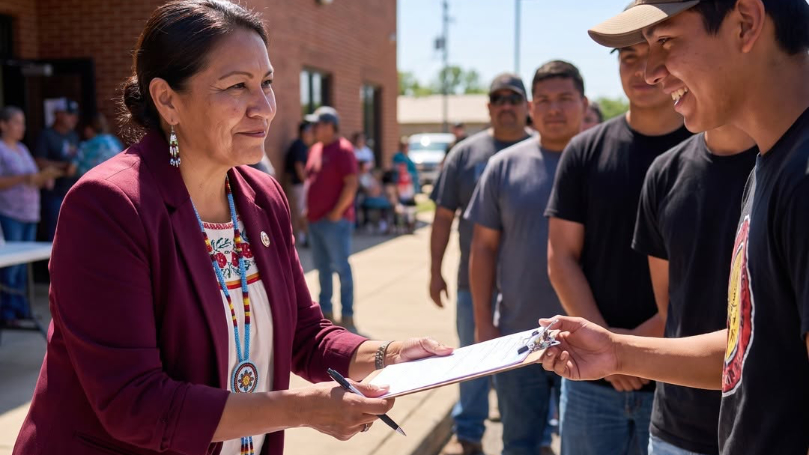
Image: Your vote is your voice by Cherokee Women Rise. Facebook.
Author

Albert Bender is a Cherokee Indian. He is a freelance reporter and political columnist for News From Indian Country, and other Native and non-Native publications. He is also a historian and attorney specializing in Native American law. Currently, he is writing a history of the Maya Indian role in the Guatemelan civil war of the late 20th century.
 Join Now