

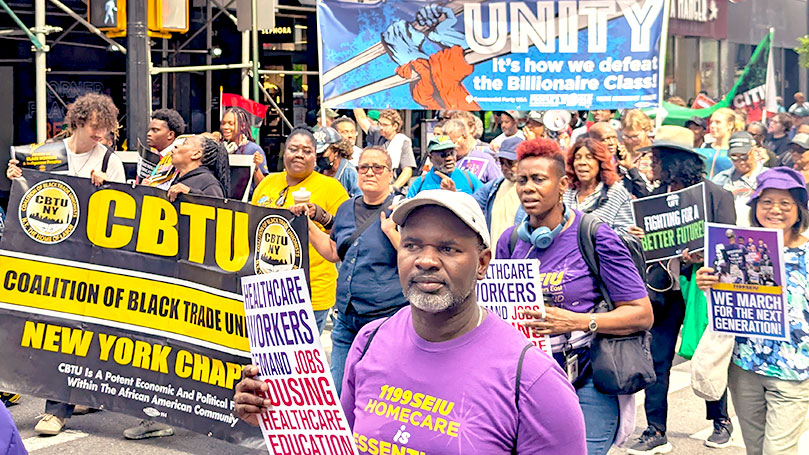
In September 1972, over 1,200 Black trade unionists gathered at a hotel in Chicago. They had come because the AFL-CIO leadership was preparing to declare neutrality in Richard Nixon’s re-election campaign. For these workers, the labor federation’s neutrality was not a “neutral act” but was a betrayal of the special oppression facing Black workers, including rising unemployment, wage stagnation, and hostile Supreme Court appointments.
The formation of the Coalition of Black Trade Unionists (CBTU) in 1972 was a practical expression of workers struggling against both an ascending far-right movement and a business unionist leadership whose narrow focus on “institutional stability” came at the expense of the fight for broader political and social equality.
This moment of our labor history illustrates a tension that has run through the U.S. trade union and socialist movement for over a century — the tension between a narrow focus on economic concerns and a broader, more political conception of class struggle.
Italian communist Domenico Losurdo’s book, Class Struggle: A Political and Philosophical History (2013), offers a helpful theoretical insight into this historic tension. It can help point toward theoretical understanding conducive to bringing into being the social forces necessary to rid us of the MAGA fascist menace, as well as build the movement for political and economic democracy desperately needed in our country.
While the book touches on several important issues, I would like to focus attention particularly on Losurdo’s rejection of “economism” and his vision of class struggle as a “multi-dimensional social conflict.”
What is economism?
In the Leninist sense, economism is not simply “focusing on wages.” It is a specific political tendency characterized by four key features:
- Reductionism — treating politics as merely the expression of economic interests.
- Spontaneism — believing that workers will spontaneously develop revolutionary consciousness through economic struggle alone.
- Tailism — following rather than leading the mass movement, content to articulate existing demands rather than pushing beyond them.
- Abdication of politics — forgoing independent political action in favor of trade union and “practical” work.
When a party or organization treats class struggle purely as an economic struggle, it ends up limiting working-class politics solely to basic issues like wages, hours, and benefits. While those issues do matter, and are largely the basis on which a working-class party is built, treating them as the only avenue of struggle steers the labor movement toward social democracy and left-populism.
Lenin’s What Is to Be Done? (1902) was in part a polemic against this tendency. In it, he argued that trade union activity, left to itself, will lead only to “trade union consciousness” — a narrow focus on wages and benefits absent broader political struggles. The working class will not spontaneously become politically revolutionary simply by fighting for better wages. Socialist consciousness, he argued, must be introduced from “outside” the economic struggle.
While labor bodies like the AFL-CIO frequently engage in political lobbying and electoral campaigns, this activity still represents a reformist, bourgeois politics that seeks concessions within the capitalist framework. In contrast, genuine Marxist-Leninist political consciousness means looking beyond immediate reforms or electoralism. It means understanding the state as an instrument of class rule and targeting the root cause of exploitation — the capitalist system itself.
This is why the Communist Party USA has always insisted on what we call the “communist plus” — the unique political and ideological contribution that Marxist-Leninists add to all struggles.
Class struggle as a framework for social conflict
Losurdo’s main contribution is to argue that the theory of class struggle is not a narrow economic formula, but a “general theory of social conflict.” Rather than viewing racial or gender oppression as secondary issues separate from class, Losurdo insists that these emancipatory movements are themselves distinct, structural forms of class struggle. In his view, class struggle operates as a multi-dimensional framework through which we must grasp the interrelation of all major social conflicts, noting that “each time, the most adverse social conflicts are intertwined in different ways.”
Losurdo identifies three arenas of class struggle, each simultaneously a “struggle for recognition” in the Hegelian sense:
- The struggle against the proprietary classes — the classic conflict between capital and labor over exploitation.
- The struggle against national exploitation — as Marx denounced, the “exploitation of one nation by another.”
- The struggle against patriarchy — to paraphrase Engels, the oppression of women at the hands of men.
Crucially, Losurdo’s framework suggests that treating national or gender struggles as subordinate or fully reducible to economic exploitation is itself a form of economism. This is precisely why Lenin expanded the classic formula to encompass both the “workers of the world” and the “oppressed peoples” — recognizing that national oppression crosses class lines within an exploited nation and represents a distinct, structural conflict that cannot be reduced to a mere subset of economic struggle alone.
Communists have long recognized this multi-dimensional character. The struggles against capitalist exploitation, against racial and national oppression, and against male supremacy are separate but interdependent — overlapping, yet distinct in their history and demands.
While Losurdo attempts to synthesize these fights into an expanded definition of class struggle, the Marxist-Leninist tradition — and the historical line of the CPUSA — underlines that national and gender oppressions are multi-class, or “all-class,” democratic issues. They possess an independent reality and cannot be reduced strictly to economic status. To fight them effectively requires recognizing that while they must be analyzed from a working-class viewpoint, they rally forces across class lines against a common oppression. These struggles serve as a vital bridge to broader revolutionary unity rather than just a secondary contradiction.
The political and the economic: irreducible but intertwined
One of Losurdo’s arguments is that class struggle cannot be reduced to a binary logic alone (the populist “Us vs. Them” or even the classical “Proletariat vs. Bourgeoisie”). Each historical situation “emerges with specific and unique characteristics that necessitate serious examination, free of schematic and biased analysis.”
This is precisely the method that Lenin employed in his own analyses before the Russian Revolution. It demands “a concrete analysis of a concrete situation.” The same task confronts communists in the U.S. today.
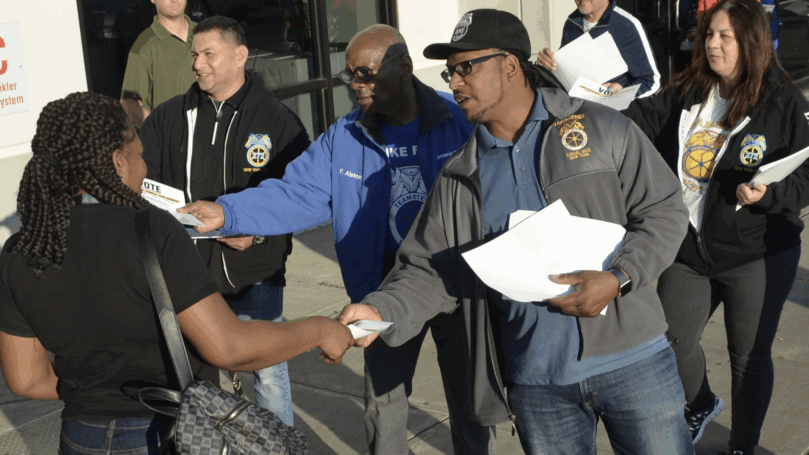
The tension between a narrow economism and the broader political struggle continues to play out daily inside the labor movement. For example, at Amazon where the Teamsters are organizing tens of thousands of workers, their focus remains heavily on workplace issues — wages, safety, and classification — while the broader political issues such as Amazon’s complicity with ICE, its environmental destruction, and its role in the military often take a backseat to day-to-day shop-floor fights.
Of course, internal debates rage within organizing committees over how political to get. Within the Teamsters more generally, organizations like Teamsters for a Democratic Union grapple with these same tensions by having to balance economic militancy against broader political stances. Importantly, the Teamsters leadership opted to not endorse a candidate for the 2024 elections, with some members pointing to their “political independence” and still others criticizing them for abandoning their political role in favor of “neutrality.”
However, a caveat must be stated here: the trade unions are not the Communist Party, nor should they be expected to act as one. Unions’ primary tasks are improving working conditions and they are structurally geared toward workplace struggles and the immediate material interests of their members. Expecting them to substitute for a revolutionary political organization is a major error by burdening unions with tasks they cannot fulfill.
The role of the Communist Party is not to demand that unions become “revolutionary vanguards,” but to intervene politically within and alongside them, bringing the communist plus that connects workplace battles to the fight for systemic change.
The party as ‘tribune of the people’ and the all-people’s front
If economism reduces politics to economics, then it also inevitably reduces the party to a mere service organization for trade union demands.
Again, in What Is to Be Done?, Lenin wrote that the role of the revolutionary party should not be merely a trade union secretary, but a “tribune of the people” — a party that “is able to react to every manifestation of tyranny and oppression, no matter where it appears, no matter what stratum or class of the people it affects.”
Thus, the Communist Party must connect every form of oppression — racist discrimination, anti-immigrant attacks, sexism, environmental destruction, imperialist war — to the capitalist system that generates it. For the CPUSA, this is the essence of the communist plus concept.
Antonio Gramsci deepened Lenin’s insight by describing the party as the “Modern Prince” — a “collective intellectual” capable of winning ideological leadership through patient work in not only unions, but in the communities and cultural institutions too. For Gramsci, the party cannot be a sect; it is an organizer of a historical force (the proletariat) capable of “building hegemony” across diverse social forces towards definite political ends.
Georgi Dimitrov is also relevant here. As the General Secretary of the Comintern in 1935, Dimitrov famously called for a broad “all-peoples-front” (or Popular Front) against the rise of fascism across Europe. Unlike economism’s narrow focus on immediate economic demands, Dimitrov understood that defeating fascism required uniting workers, peasants, the middle strata, intellectuals, and even progressive sections of capital around a common anti-fascist program.
The U.S. context today
We can see this playing out right now under the second Trump administration. The growing scale of recent resistance — like the 70,000 plus labor-led statewide shutdown in Minneapolis against ICE terror, the 7 million strong No Kings protests, the trade union turnout for May Day, and the beginnings of the 2026 Freedom Summer — shows exactly what Losurdo means by “multi-dimensional struggle.” These movements aren’t just about economic demands. They are fights against oppression and for basic democratic recognition. If the working class is going to lead the fight against fascism, it has to see itself as a political force, not just an economic group.
As Lenin argued in Two Tactics of Social Democracy in the Democratic Revolution (1905), the leading role of the working class in the fight for democracy is achieved not by sectarian isolation but by building alliances and coalitions based on concrete political struggle. The historic and current fight against fascism requires a policy of unity — bringing together labor, civil rights groups, immigrant rights groups, women’s organizations, faith communities, and all who are willing to fight for democracy — while at the same time maintaining the independent political role of the Communist Party.
What’s important about Losurdo’s Class Struggle, while not necessarily novel, is that it reminds us that the working class is not a fixed economic label but a living political subject shaped and reshaped through struggle. The central lesson for communists today is that the task set out for us is to intervene in every arena where our people are fighting — economic, political, cultural — adding the “communist plus” which connects the fight for a wage increase to the fight against deportations, the fight for union recognition to the fight against racist policing, and the fight for democracy to the fight for socialism.
Ultimately, Losurdo argues, the working class fights not only for material improvement but for recognition, dignity, freedom from subordination, and political power. The task of communists is to help develop the working-class movement to see that the fight is not only for better conditions within capitalism, but for a completely different society and economic system — one based on ending the private accumulation of socially produced profits. In a word, socialism.
The opinions of the author do not necessarily reflect the positions of the CPUSA.
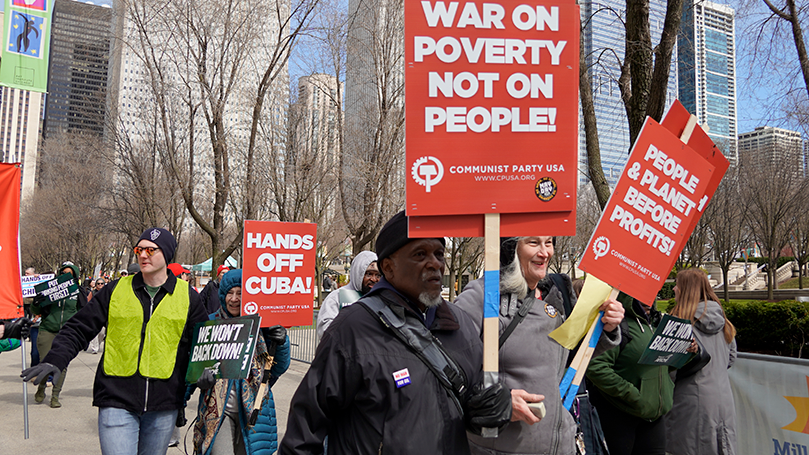
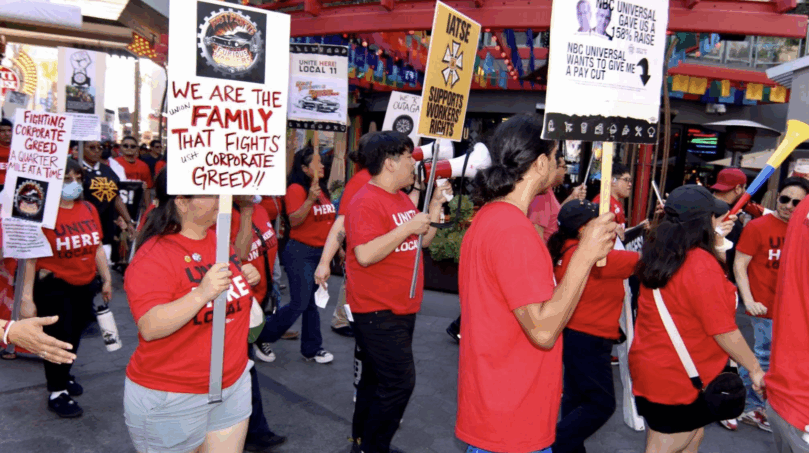
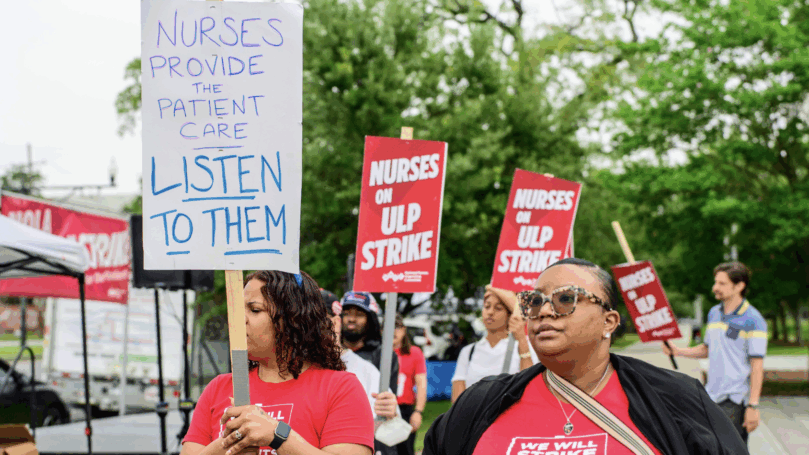
Images: CPUSA marches in NYC. CPUSA; Chicago club CPUSA at No Kings III. CPUSA; Unite HERE Local 11 pickets NBCUniverisal. Unite HERE on X; Teamsters leaflet Amazon facility in New York. TDU on X; National Nurses United on strike in New Orleans. NNU on X.
Author

-
Cameron Harrison is a trade union activist and organizer for the CPUSA Labor Commission.
 Join Now