


An interview with Eric Brooks, member of the CPUSA National Board conducted by Soran Kahtan. This originally appeared in Al-Thakafa Al-Jadeda (الثقافة الجديدة), an Iraqi publication.
Al-Thakafa Al-Jadeda: There were significant changes in the domestic and foreign policies of the U.S., especially since Trump’s second presidency. These changes were reflected in the shifts and transformations in the National Security Strategies. Comrade, could you clarify the most prominent features of these new policies? Are we witnessing a new era which involves the end of American domination and the emergence of a new multipolar world system, or is it just a rearrangement, or just a change in style?
Eric Brooks: The United States today is under the administrative control of a fascist-leaning administration that has been consistently attacking the progressive advances won in the pre-WWII “New Deal” and expanded in the civil rights and labor struggles of the 1950s through the 1970s. These include voting rights, civil rights protections, Medicare, Social Security, protections against racism and anti-women initiatives, and support for families (like maternity and paternity leave) and the disabled.
The laws that were won through mass working-class upsurge remain, for the most part, on the books, but the enforcement mechanisms have been hollowed out. Without enforcement, the laws have no teeth and are ignored by the federal government. President Trump and his MAGA billionaire cronies are systematically attacking the gains of the working class, claiming to fight against terror or to correct “unconstitutional” laws that protect labor unions. The content of their actions, under the guise of fighting terrorism, is to inflict terror not just on working people in the United States but, under the National Security Strategy (NSS) and the Trump Corollary, to claim that the resources of the entire Western hemisphere, including Greenland, belong to him, as does the oil of Venezuela.
The NSS is an assertion of fascist control “to ensure that America remains the world’s strongest, richest, most powerful, and most successful country for decades to come.” These are not the goals of an administration that respects the sovereignty and right to self-determination of any other country. The NSS asserts that the U.S. has “God given natural rights” to protect “their wellbeing and interests.” What they mean is that the billionaires and other capitalists have a natural, not a democratic, right to do whatever works to their financial benefit. As the U.S. aggression against Iran shows, the Trump administration will attempt to seize control of natural resources anywhere using “security” as the pretext, and economic and physical violence as the inducement to cooperate. The Trump/MAGA fascists are bent on control, not cooperation, and that, fundamentally, is the message of the NSS as I read it.
What will emerge from the current period will depend on the peace struggle here in the U.S. and the actions of other countries globally. The Trump/MAGA horror show is, in my view, forcing a rearrangement of capitalist alliances worldwide, with the NATO Alliance being threatened by Trump, and the U.S.-instigated oil crisis that arose from the attack on Iran. Nations around the world are correctly questioning the U.S. role as a guarantor of world peace. Tensions between nations are high, as China demonstrated when it escorted its oil tankers with heavy military cruisers through the U.S. blockade of the Straits of Hormuz. We are seeing a real change, not a superficial change in style. How far toward global war this change will go may be related to the level of democratic organization for peace, mutual respect, and working together.
Even under the fake U.S. pretense that it was the “leader of the free world,” the world has generally been multi-polar. After the Soviet Union ceased to exist, the U.S. claimed an end to multipolarity, but that was a short-term view that dismissed the dynamics fueling China’s economic growth and economic alliances in South America and with China. The end of using the U.S. dollar for foreign transactions, especially around natural resources and oil, puts an exclamation point on the fact that the U.S. has always been a gun-boat oppressor of nations, not a builder of alliances of mutual respect. If Trump has succeeded in anything, it has been to demonstrate the limits of U.S. power and the extreme self-interest that denies the legitimacy of interests of any other sovereign nation and rejects treaties and economic agreements. In this context, the U.S. is no longer seen as a legitimate partner, even among capitalists.
A lot is changing, but where it will end up depends on both people’s movements for peace globally and in the United States, and on the willingness of capitalist leaders of nations to work together — which is not something that capitalism as a system promotes. I see this moment as dangerous to working people, and believe a focus on building massive, democratic, anti-racist peace movements that limit military spending and work to meet the needs of working people is urgent today.
Al-Thakafa Al-Jadeda: It’s hard to understand U.S. policy and its recent shifts without fully grasping the underlying socio-economic context. Could you, comrade, shed some light on the defining characteristics of this socio-economic background?
Eric Brooks: The U.S. is in the grip of an anti-democratic, racist, anti-woman, anti-migrant, anti-LGBTQ administration that sees itself as beholden to no one and has no interest in anything but self-enrichment and extending control. The domestic impact of this is a nation where housing, food, healthcare, education, and culture are extremely limited for the majority of people — the working class. The socio-economic context is anti-union, and is going so far as to say that anyone who questions capitalism is a terrorist subject to deportation.
This oppression is the Trump response to the needs of the many in the U.S. Mass firings, union busting, maintaining low minimum wages, constant violent pressure on migrants and other workers (including white workers), and huge tax cuts for the super-rich while expanding the military budget to a trillion dollars have hollowed out the U.S. economy. This has left it with a very few billionaires and very many people struggling, with the lucky ones living pay-check to pay-check.
In this context, U.S. policy is geared to using force to guarantee the enrichment of the super-rich based on global control over resources. However, the buying power of the mass of people worldwide, and in the U.S., is constantly diminishing, exhibiting the contradictions of capitalism in full. The Trump administration is doing nothing to make life for working people in the U.S. or globally any easier, and they are clear that is not their interest. Their only interest is self-enrichment, including using the U.S. tax system to siphon money from workers that goes directly to feed the military-industrial complex, from which a very few make billions.
The underlying socio-economic context of today’s struggles in the U.S. is vast income inequality, lack of funding for government services that the majority of working people depend on for retirement and health care, and an all-out attack on people’s organizations that fight for workers’ needs, against racism, and for an inclusive society. The issue now, in the United States, is to build an all-people’s movement for democracy and peace, and for policies that meet the needs of working families and communities. What is new, what we build, must have an anti-monopoly character. If successful, these struggles would effect a fundamental change in the socio-economic structures in the U.S. and, insofar as it successfully fights for peace, for the world.
Al-Thakafa Al-Jadeda: Building on the previous two questions, could you explain the “Trump Redux” in 2024? Or more generally, how can we account for the so-called “Trump Phenomenon” since 2016? What were the circumstances or conditions that allowed for such a populist rhetoric master, this “outsider,” to be accepted as the leader of the elite of the Grand Old Party?
Eric Brooks: It is important to understand that Trump did not win a mandate in either 2016 or 2024. In 2024, he won by 1.25% of the vote, and about a third of the electorate did not vote. The question is why do so many people feel alienated from the electoral arena in the U.S.? To answer that, one needs to look at the ridiculous anti-democratic limits placed on participation in the electoral process, including vote suppression and an enforced two-party system where the “opposition” Democratic Party is also a party controlled by capitalists, even while providing the framework for organized labor and people’s organizations to fight for power.
The Trump wins arise, in my view, from two streams of discontent: one among youth who correctly see their voices actively silenced by the aging and corrupt Democratic Party leadership, and the other by white folks who were manipulated by patently false racist assertions into erroneously believing that their self-interest resided with the fascist Trump/MAGA cause. Trump sold himself as a candidate who would stand up for workers (or at least for white workers), as a peace candidate, and as someone who would restore the preeminent economic position of the United States — which some working people were deluded into believing would help people here.
The Trump phenomenon is a by-product of the massive ad campaigns that confused and lied to the electorate, by the exhaustion of the U.S. population from endless wars, and by the Democratic Party’s attack on its left flank, which alienated many people. U.S. support for the Israeli genocide against the peoples of Gaza played a part too, as some people saw abstaining from the elections as a moral statement of protest, though their action objectively contributed to Trump winning.
There is a struggle in the U.S. to convince people that voting is just one part of the struggle for peace and economic and social justice, and that voting is not a moral statement but a collective assertion of power. We have seen in recent midterm elections that Trump is not a winning proposition any longer. The Trump/MAGA folks recognize this and have focused their work on limiting access to the voting booth in those areas that have historically challenged them, including an attempt to define who is a citizen and who, therefore, is able to vote. Citizenship itself in the U.S. is being debated, with the express racist intention to limit it to white people.
Al-Thakafa Al-Jadeda: Many Marxists still believe that Trump’s foreign policies — claims to Greenland, the demand for the return of the Panama Canal, threats against Canada, the kidnapping of the Venezuelan president, and finally, the aggression against Iran in which Israel participated — can only be explained through the lens of the theory of “Imperialism,” necessitating the development of the theory and its associated conceptual framework to be more contemporary. What is your perspective on the specific aggression directed at Iran?
Eric Brooks: Trump must be understood through the lens of the struggle for peace. He is a figurehead for a class that must pursue imperialist policies in order to guarantee profits, especially during a time when workers have less and less money to spend, and control over markets and resources is needed to lower costs and guarantee the volumes of sales that bring profits. Imperialism also guarantees the need for a continued and expanding military budget, which is the mechanism by which massive wealth transfer occurs via taxes to the billionaires.
U.S. imperialism is being challenged by workers, but the struggle to build strong working-class internationalist mutual solidarity on the basis of equality of nations, mutual respect for each other’s sovereignty, and respect for the right to determine one’s own socio-economic developmental process is at its core the struggle for peace. It is anti-imperialist and necessary today. The U.S. working class has a special role to fight for peace, but that movement is fighting strong headwinds as there is some confusion about the relationship between working people in different countries and whether they are more structurally competitors or allies. I believe we must fight for working-class internationalist solidarity and the end to U.S. imperialism here in the United States. There are splits in the peace movement, specifically around the Gaza genocide and around the U.S. aggression against Iran. These splits have to be addressed and a strong and unified peace movement brought into being.
Al-Thakafa Al-Jadeda: The worldwide condemnation of horrific war crimes and genocide committed by the Zionist occupation in Gaza against the Palestinian people — with the full support of American imperialism and its allies — has played a pivotal role in revitalizing workers’ unions and progressive and Leftist movements. We witnessed a similar international movement of solidarity with Cuba, and especially against the U.S. war on Vietnam, in the 1960s. We saw numerous Pro-Palestine protests, rallies, and demonstrations in many American cities and universities. Dear comrade, can you shed light on the situation of the left in America in the last years, in particular the radical Left? And did the Palestinian issue and the crimes committed in Gaza play a role in its mobilization?
Eric Brooks: There was a welcome upsurge in protests against the U.S. funding of the genocide against the peoples of Palestine, and especially Gaza. However, those demonstrations were in too many cases limited to youth, separated from the labor struggles going on, and without a clear strategy on how to change policy through mass united action.
Organized labor, the largest working-class organizations in the U.S., did not broadly engage with the movements to end the genocide. It did take important positions, though, that reflect an important shift to the left. The AFL-CIO put out a statement on February 8, 2024, calling “for a negotiated cease-fire in Gaza — including the immediate release of all hostages and provision of desperately needed shelter, food, medicine and other humanitarian assistance to Gazans — and reaffirms our support of a two-state solution for long-term peace and security.”
In regard to Iran, labor responded immediately. SEIU was the first to issue a statement, on the day the war began, denouncing the Trump administration’s “reckless regard for working people’s lives,” saying “war hurts working people, poor people, women, and children” and standing with workers in Iran and around the world. National Nurses United condemned Trump for committing “yet another imperialist act of war without approval from Congress,” drawing a direct line between billions spent on war and austerity forced on working families at home, and called out the bombing of a girls’ school that killed more than 150 people as a violation of international humanitarian law. In its statement, the American Federation of Teachers (AFT) raised “its collective voice in support of the people of Iran, as they bravely fight in the streets of their nation for freedom, justice and fundamental human rights, and courageously confront an authoritarian, theocratic regime.”
On March 6, 2026, the AFL-CIO released a statement demanding an end to the conflict, strict respect for international law, a renewed commitment to nuclear disarmament, and full respect for the freedom of association.
There are many influences, though they are diminishing, that see war and a huge military budget as good for the U.S. worker behind the false claim that it keeps jobs in the United States. In regard to Cuba, there are both business interests and leftists that believe the sanctions against that nation should be lifted, but it has not yet become a mainstream issue with a mass movement behind it.
I don’t think the attacks on Gaza and Cuba played the “pivotal role in revitalizing workers’ unions and progressive and Leftist movements” in the United States that you describe. Labor in particular is responding to the economic and union-busting actions of the Trump administration, and to some degree to the attack on democracy and on the existence of unions. They are more concerned with domestic struggles, in my view, rather than international working-class solidarity. However, the SEIU statement on Gaza was firmly in support of working-class internationalism and solidarity, and I see that as a growing trend in labor in the U.S.
Al-Thakafa Al-Jadeda: On the occasion of International Workers’ Day (since the interview is part of the May issue): Can you, comrade, explain the socio-economic and political situation of the American working class, and the circumstances in which they struggle?
Eric Brooks: The U.S. working class is struggling against the anti-democratic, fascist initiatives of the Trump/MAGA administration and their billionaire backers. This year’s May Day, or International Workers’ Day, represents a new front in that struggle, with organized labor taking a leading role for the first time in decades. Workers here are going to be continuing the expanding cadence of related protests initiated by No Kings Days 1, 2, and 3, and others, including walkouts by students in high schools. The working class, including youth, are hurting in the U.S., and over 8 million people protested at No Kings 3. The challenge is to help continue the growth of these demonstrations and increase the organizational and political unity underlying them.
The entrance of organized labor, as demonstrated recently in the Minneapolis, MN, protests against ICE, makes a huge difference in the focus and political unity around the protests. This is expected to be reflected again in the May Day protests. There is also a resolution put forward by the Coalition for Black Trade Unionists for a labor-led all-people’s March on Washington for workers’ rights and democracy.
There are over 3,000 May Day protests this year. The AFL-CIO is supporting May Day for the first time. New York, Chicago, Detroit, and Los Angeles labor councils have endorsed and are mobilizing. May Day has come back to the U.S. in a big way.
Workers are struggling, while under constant fascist attack, to find ways to unite and fight, and I expect this trend to continue as the country moves first to the 2026 mid-term elections and then to the 2028 presidential elections. The people of the U.S. are struggling to live — Black and brown people, Asians, the LGBTQ community, women, and all workers are struggling to live. Trump and the GOP are relying on anti-democratic force to curtail the pro-democracy and pro-worker movement that is building momentum today. The pro-peace component of this struggle has to be expanded to include demands for respect for the right to self-determination of nations. If the working class is successful in ending Trump’s control over Congress, as expected, that would indicate a huge change in power and in what can be won going forward, both on the domestic and the peace front, which are intimately connected.
The broad left in the U.S. is anti-corporate, anti-racist, anti-sexist, pro-immigrant, pro-LGBTQ, and pro-labor. There is a growing socialist current represented by the election of Mamdani in New York, and others around the country. It has an increasingly working-class character, as represented by the entrance of the trade unions into the anti-MAGA fight, demonstrated forcefully in the Minnesota anti-ICE protests. That working-class character is making its impact on May Day organizing. Anti-communism has dropped, and the Communist Party USA is playing an open role in these coalitions and is not getting pushed out. The broad left’s ongoing strength will be decided by its ability to focus on the fight for unity.
The word “resistance” is everywhere in the U.S. today. We are not going back to neo-liberal capitalist forms of governance. What comes next depends on the labor movement and the unity that can be built among working and oppressed peoples in the U.S. and globally. Workers of the world, unite!
The opinions of the author do not necessarily reflect the positions of the CPUSA.
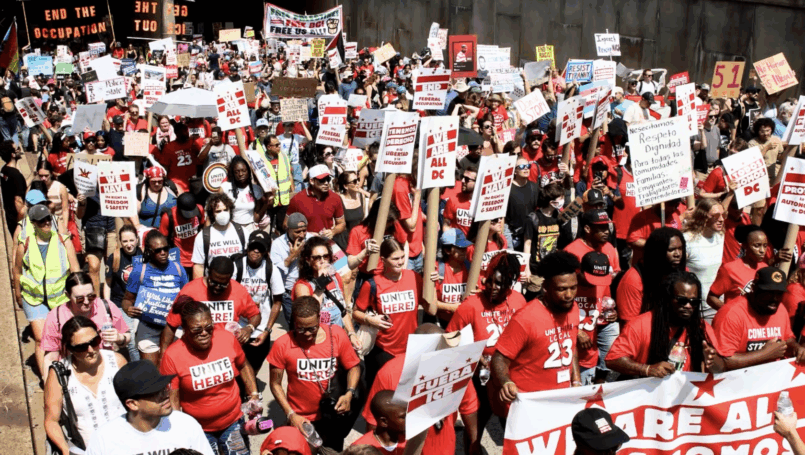
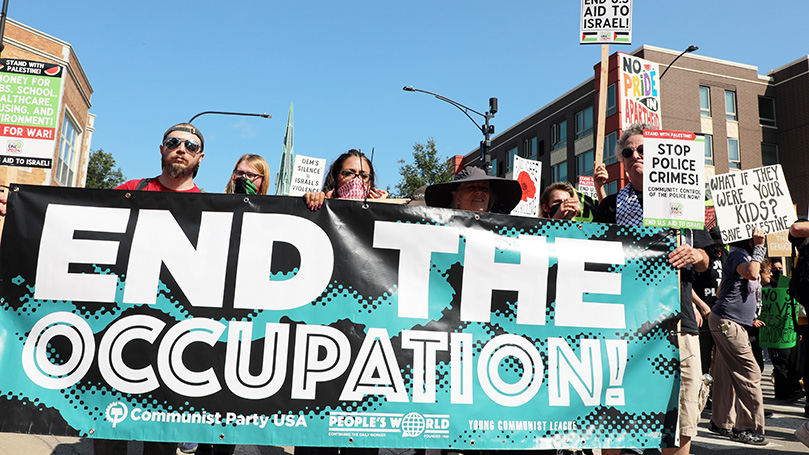
Image: Globe by Fred Barre. CC BY-NC 4.0. Unite Here contingent in FreeDC March. Unite Here on Facebook; CPUSA “End the Occupation” march and protest. CPUSA.

 Join Now