

CPUSA Labor Commission statement adopted by the CPUSA National Committee on Jan 31, 2026.
What will it take to bring the millions of unorganized workers into active union membership? Can U.S. workers be won to support a foreign policy based on peace and international solidarity? Why has organized labor’s response been so muted to the Trump administration’s largest-ever union-busting campaign, stripping rights from 1.3 million federal workers? How can our working class movement build on the lessons from the growing coalition and networks forged in resistance to ICE outrages and attacks on democratic rights?
These are not abstract questions. They are urgent, concrete challenges that define the crisis and the potential of the U.S. labor movement today. This analysis examines the roots of this crisis, the contours of the current monopoly offensive, and the emerging forms of struggle that point a way forward.
The state of the labor movement
For decades, U.S. workers have produced ever-increasing value. Since 1948, our productivity has soared by 250%. Our class now generates more wealth than any generation in history. Yet as productivity climbed, workers’ wages flatlined and exploitation deepened. The share of total value produced, which is returned to the working class as wages, has been systematically driven down, reaching a historic low of 53.8% in late 2025. Full-time work has grown more precarious, and offshoring has gutted working class communities.
These trends have created a profound crisis of inequality. The richest elements of society, a financial oligarchy, now own more wealth than the bottom 95% of the world’s population. For instance, Fortune 500 firms accumulated a record $1.87 trillion in 2024 alone. The wealthiest 10% of Americans own 93% of all stocks, and for the bottom half of Americans, the average retirement savings is zero.
Decades of profit-maximizing strategies — suppressed wages, crippled unions, and engineered job insecurity — set the stage for our current political and economic crisis. The capitalist class’s drive to rapidly implement AI and automation, which analysts predict will displace 25% of working hours, will further weaken collective bargaining and depress the value of labor power. But worker militancy has also risen in response to the decades of stolen wages, intensified exploitation, and the daily insecurity of capitalism.
Since the global pandemic, we’ve seen high-profile strikes across the auto, healthcare, manufacturing, entertainment, logistics, and education industries. This upsurge in militancy isn’t confined to official, large-scale strikes. It also includes countless smaller, often spontaneous workplace actions in low-wage service, food, and retail sectors.
Despite this activity and soaring public approval for unions (70%), our movement continues to face its most profound challenge: union density has fallen to about ~10% of the total workforce, and even less in the private sector. While new union organizing is making inroads in some areas, it remains stagnant in core industries that were formerly heavily organized. The labor movement’s strength relies on its ability to be a mass movement uniting all workers. Its capacity to lead is thus undermined when the proportion of organized workers falls.
Unions must win strong contracts and cement their power through industry-wide action and political struggle. To do this, we must organize unorganized workers at a scale not yet seen in our recent period. In the face of mass layoffs from automation and the concerted offensive of big business, the labor movement must also find ways to organize unemployed workers into their bloc. Developing an independent political agenda that can unite and mobilize the multiracial, multi-gender working class is another key task.
The U.S. labor movement today displays sharp contradictions. On the one hand, we see clear signs of progress and popular support for unions. But on the other hand, these signs exist alongside entrenched structural weaknesses within the unions, a hostile political environment, and the relentless anti-worker offensive of monopoly capital — the financial oligarchy — who remain fixated solely on maximizing profit.
A legacy of class collaboration and division
To fully grasp our current situation, we have to recognize the deep-seated internal crisis rooted in a long history of class collaborationist and anti-communist politics in the U.S. labor movement — from the Gompers era through the Cold War leadership of George Meany and Lane Kirkland.
The anti-communist purges of the McCarthy period systematically removed the most effective, struggle-oriented leaders and dismantled entire unions. This cemented a politics of class collaboration over class struggle for decades and even aligned unions with U.S. imperialist interests abroad. It also reinforced racist, anti-immigrant, and male supremacist forces, as well as anti-democratic forces, within the trade unions.
The result has been a crippled labor movement — one that was unable to really resist the monopoly offensives of the neoliberal period that began in the early 1980s. This entire period left a leadership vacuum that still persists today. Many current leaders and workers have little experience leading major organizing drives or strikes. This has left organized labor under-prepared for the current crisis.
The monopoly offensive
The current crisis must be understood as a strategic offensive by monopoly capital. It is a concerted project that has intensified into an all-out war on workers and democratic institutions under the fascistic Trump administration. This war is advancing on two fronts: direct economic assault and a calculated political strategy of division.
For instance, the national unemployment rate rose from 4.2% (7.6 million) in November 2024 to 4.6% (7.83 million) in November 2025, with Black unemployment reaching 8.3% and youth unemployment hitting 16.3%. Full-time employment fell by nearly one million jobs, with layoffs exceeding 1.2 million. In the first month of 2026, over 108,000 jobs were cut, the highest number since the 2009 financial crisis.
Manufacturing lost nearly 70,000 jobs in 2025 alone, with steep cuts in auto — for example, over 1,000 at GM’s Detroit “Factory Zero” plant and 1,600 planned at Ford’s Kentucky battery facility which just won union recognition with the UAW. The broader picture is equally dismal. A paltry 22,000 jobs were created in August 2025, with a net loss of 41,000 in the year’s last quarter, as well as massive automation-driven layoffs such as the 48,000 jobs cut at UPS.
The Trump administration’s suspension of offshore wind projects and the rollback of clean energy credits directly triggered more layoffs; there are more than 2 million jobs now at risk. So far, there has been a loss of more than 30,000 clean energy jobs nationwide in a single year.
Parallel to this economic assault is a legal and institutional offensive designed to cripple labor’s power. Aggressive union-busting is now routine and enabled by a legal framework skewed heavily toward the capitalist class — executed through the deliberate gutting of institutions like the National Labor Relations Board (NLRB). The firing of member Gwynne Wilcox left the board without a quorum for most of 2025, and Trump’s subsequent anti-union appointees to the board aim to make labor law enforcement effectively nonexistent.
Furthermore, the administration launched the largest union-busting campaign in recent history by stripping collective bargaining rights from nearly 1.3 million federal workers. This was a “shot across the bow” for the whole labor movement which led to a direct attack that saw unemployment among federal workers more than double to 2.7%.
Because a divided labor movement cannot effectively resist, the monopoly offensive deliberately targets working class unity along racial, gender, and national lines. Consider the mass purge of over 300,000 Black women from the workforce following the demolition of DEI and affirmative action. This is an attack on a cornerstone of public sector union organizing and is actively reconstituting racial and gender hierarchies to depress wages for all workers. The super-profits of the oligarchy depend on these divisions.
Similarly, escalated ICE raids against immigrant workers are aiming to create a tier of super-exploited labor and to terrorize vulnerable workers into silence. Thus, the fights for racial, gender, immigrant, and LGBTQ equality are not separate from the labor struggle; they are essential to overcoming the divisions that cripple our collective power.
Voting rights is a worker issue
The corporate assault on the working class extends to the ballot box. The disenfranchisement of Black, Latino, and working class voters through gerrymandering, ID laws, and voter purges is a pre-emptive strike against independent working class political power. Therefore, the struggle for voting rights is a fundamental class issue and a prerequisite for building a political movement capable of challenging monopoly. Labor’s fight for economic justice cannot be won without the democratic fight for full political representation.
In this context, recent union organizing victories, while important, remain a small fraction of what is needed. In 2025, just over 82,000 workers participated in NLRB elections — a minuscule percentage of the workforce. The prevailing hyperfocus on NLRB elections and recognized bargaining units, at this point, is inadequate to organize the millions of unorganized workers. To overcome this, the labor movement must fight to ultimately repeal the Taft-Hartley Act. Getting the PRO Act passed through Congress is an important first step in this battle.
Yet, the critical question is how to build a working class political movement that unites economic and democratic struggles into a labor-led anti-monopoly coalition capable of mobilizing and sustaining independent political power.
Labor’s fight back and the forces of unity
The “Hands Off” and “No Kings Day” mass protests marked a significant shift after the resistance movement was unable to find its footing at the beginning of the second Trump administration. The formal involvement of major unions such as the United Electrical Workers (UE), Communication Workers of America (CWA), Service Employees (SEIU), American Federation of Teachers (AFT), United Auto Workers (UAW), and National Nurses United (NNU) in these demonstrations represented a conscious effort by sections of the labor movement to build a broader front. They brought a working class composition and concrete economic demands to the pro-democracy movement.
However, these protests also exposed weaknesses. The organized labor movement failed to mobilize its members in decisive numbers which highlights a continued hesitation within some of the unions. After the protests, many workers asked: “So we marched… What is to be done now?” This question underscores the critical need to move from momentary mobilizations to an organizing strategy built on developing durable, class-based organizations in workplaces and neighborhoods.
Despite this problem, newer forms of labor-led organizing point a way forward. The “Bargaining for the Common Good” approach, spearheaded by the Chicago Teachers Union (CTU), explicitly links contract fights to community demands for housing, immigrant defense, climate justice, and racial equality. They correctly recognize that labor’s power expands through deep coalitions — a principle also seen in the significant participation of major unions in May Day 2025 actions. Developing robust labor-community coalitions is imperative to tackle the problems experienced at the local level, such as the federal assault on democracy in Washington DC. However, without being first rooted in the workplace, these labor-led coalitions will struggle to find their footing.
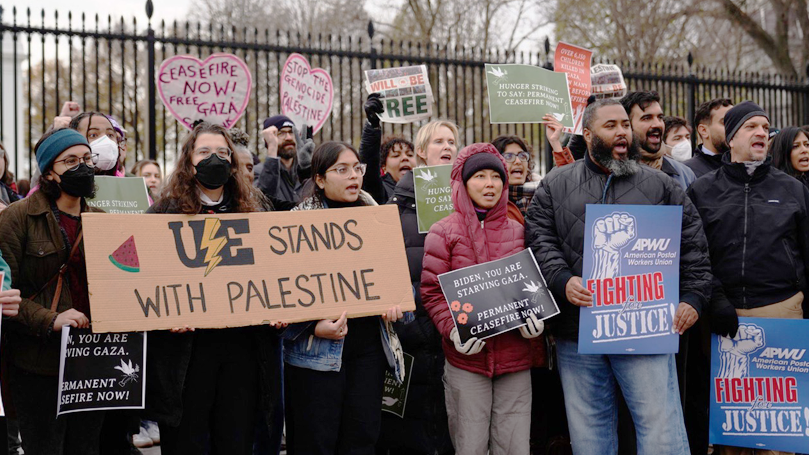
A renewed energy is driven by a growing, broad Left inside and around the labor movement, composed of rank-and-file workers from civil rights, peace, environmental, women’s, immigrant rights, and youth struggles. This layer was the leading force pushing unions to take a stand on a ceasefire in Gaza and is now advocating for an arms embargo on Israel. They are continuing to build up their local unions into struggle-oriented organizations that are willing and able to directly challenge the oligarchy. It will be this Left that must help initiate new organizing, as well as put pressure on their unions to adopt aggressive new union campaigns.
The labor movement’s condemnation of U.S. aggression against Venezuela marks a significant development and contrasts sharply with earlier hesitations. The quick responses from the AFL-CIO and other unions, alongside powerful statements from NNU, UE, and numerous local unions and councils, demonstrates a growing willingness to challenge ruling class foreign policy and war. While their condemnations often framed the issue in terms of presidential overreach and defending the Constitution, this opening creates space for a broader discussion on imperialism. It reveals an active, peace-oriented pole within labor that is building the capacity to challenge U.S. foreign policy as a working class issue, particularly in its demand for the reallocation of military spending to domestic needs.
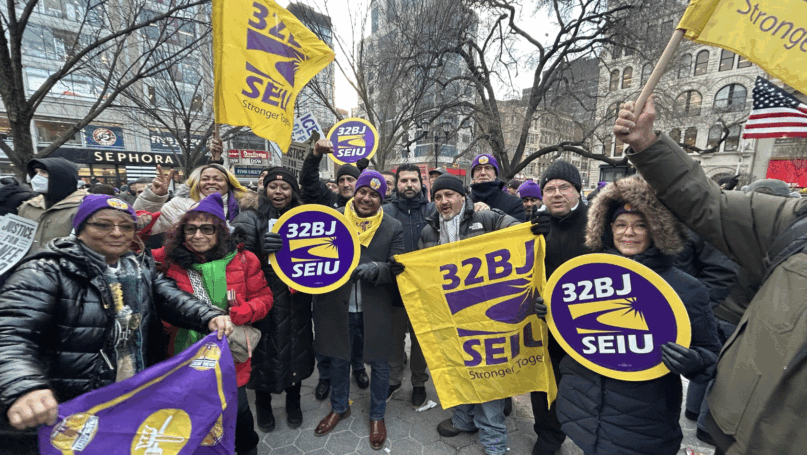
Similarly, labor’s collective outrage against the ICE murders of Renee Nicole Good and Alex Pretti also shows a growing willingness to confront state violence. The responses, which largely tied the ICE terror to the defense of immigrants and the safety of all workers, advance the unifying labor principle that “an injury to one is an injury to all.” While the explicit, class analysis linking ICE terror directly to fascism and the oligarchy remains primarily the work of the Left within labor, this development too shows that there is room for deeper political consciousness to grow.
The opposition to the federal government’s “Operation Metro Surge” occupation of Minnesota sparked what became known as the “Minnesota General Strike” in January 2026. A coalition of unions — including the state AFL-CIO, SEIU, AFT, ATU, CWA and UNITE HERE — alongside community, civil rights, and faith groups, mobilized tens of thousands for a statewide shutdown demanding the complete removal of ICE from Minnesota. They framed the federal occupation as a direct attack on the working class and they consciously merged traditional union action with the fight of the broader community against state violence. The action illustrated the essential, long-held principles of the Labor-Black alliance and Labor-Latino alliance in practice, while showing that the leading role of the working class is indispensable. Contained within it was the beginnings of a genuine anti-monopoly movement.
Furthermore, rank-and-file networks and even some central labor councils are pushing for more coordinated ways to demonstrate working class power at the national level. Some discussions among several unions, including the UAW, are now focused on aligning contract expirations for May Day 2028. While a generalized national strike requires years of preparation, this push reflects the growing demands for a struggle-oriented approach.
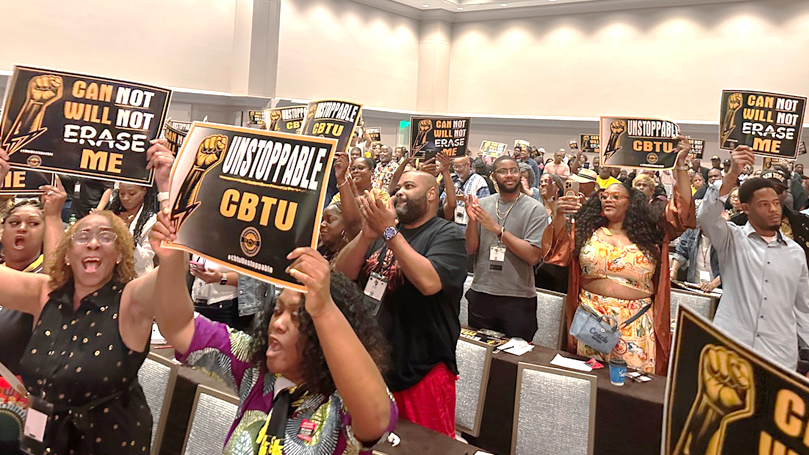
Groups like May Day Strong and Jobs with Justice continue to mobilize to support workers acting without top-down AFL-CIO coordination. Similarly, rank-and-file federal workers are organizing through the Federal Unionists Network (FUN), and the Coalition of Black Trade Unionists (CBTU) has taken a leading role by passing a resolution calling for a national union day of solidarity — an initiative now gaining support in central labor councils and state federations across the country, including at the Coalition of Labor Union Women (CLUW).
Moves toward institutional solidarity are also crucial. For example, the AFT became the first national union to endorse the ongoing Target Boycott. SEIU’s return to the AFL-CIO is another welcome step toward building unity. Union constituency groups, such as the Labor Council for Latin American Advancement (LCLAA), A. Philip Randolph Institute (APRI), CBTU, CLUW, and others, can further build solidarity and unity between the multi-racial, multi-gender, multi-generational working class.
Yet, the labor movement’s overall response remains uneven. While some unions are indeed mounting defenses, however fragmented, and embracing the broader political struggle, others are cautious, risk-averse, or narrowly focused on craft interests. This again reveals a major, unresolved challenge. Significant sections of the labor movement remain accommodated to managing their own decline rather than organizing to fight and reverse it.
For a struggle-oriented labor movement
Nonetheless, the renewed energy and growing class consciousness at the rank-and-file level are undeniable assets. Solidarity is the lifeblood of a fighting labor movement. What has been lacking, however, is organized, mutual support across unions and struggles. For example, the muted response by significant sections of the labor movement to the union-busting of 1.3 million federal workers stands in stark contrast to the militant unity this moment requires.
Another significant vulnerability is the clear unwillingness of major sections to directly address the fascist threat coming from the Trump administration. The danger of economism — a narrow focus on “bread and butter” issues that downplays the political struggle — grows more pronounced under these circumstances.
Therefore, in order to increase labor’s power, we need a multifaceted strategy built from below and facilitated from above. We need aggressive, innovative organizing tactics that move beyond the crippled NLRB process and can build organized power among millions of unorganized workers. We must fundamentally transform current labor law and develop new forms of organization, including for unemployed workers, who are growing in number due to automation and profit-driven layoffs.
In the first place, we must build independent working class political power. This means running trade union and communist candidates for office who are rooted in workers’ issues and who will fight for transformative labor law reform. Our movement must actively champion the democratic struggles against racism, for immigrant rights, LGBTQ equality, women’s rights, and peace. These struggles are essential to achieve overall working class unity.
We need to build a unifying labor program that confronts the fascist threat and offers a peaceful alternative. This program should provide a strategic answer to the monopoly offensive and the MAGA agenda. As an example, it could champion initiatives that unite the class and democratic struggles, like the Just Transition and Third Reconstruction, as advanced by Veterans for Peace and the Poor People’s Campaign. It could serve as a basis for an anti-monopoly coalition.
Such an agenda should center a federal jobs guarantee to provide union jobs building a green, peace-oriented economy, funded by taxing the financial oligarchy and military-industrial-complex. It must be a struggle-oriented program that offers a decisive alternative to MAGA’s fascist agenda. While not explicitly socialist, this type of transitional program would position the working class and its allies to continue fighting forward.
Achieving such a labor program requires a massive investment in political education by all organizations of the working class. Workers need to be engaged and involved in the whole process, from formation to implementation, to ensure understanding and buy-in. To secure this type of participation, we need to strengthen Left-Center unity at every level and consciously foster the broad Left within the labor movement who can be a catalyst for direct action and class consciousness.
Working class internationalism
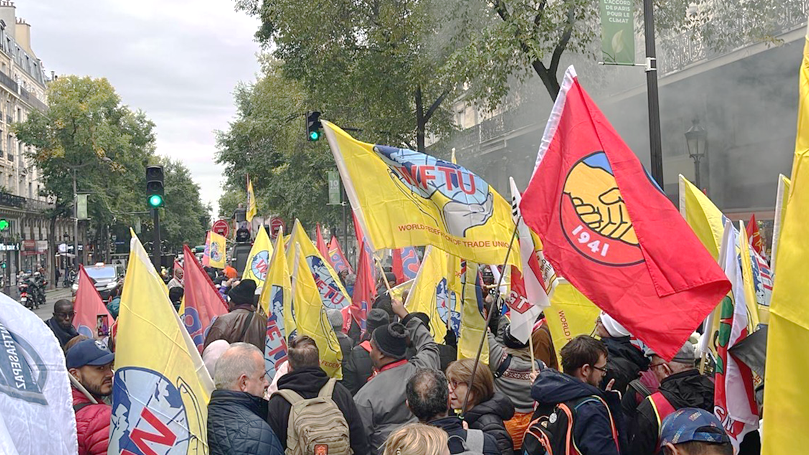
The rising dangers of fascism and imperialist war make international working class unity a practical imperative. U.S. imperialism is actively stoking racism and extreme nationalism worldwide and using the immigration crisis as an organizing tool. The U.S. labor movement’s growing condemnations of the White House’s aggression abroad and demands for peace, from Palestine to Venezuela, represent a major development. These stands must be deepened into a struggle-oriented, ongoing united action with workers of different ideological views worldwide, including in international labor federations, to oppose rising fascism, militarism and the war economy.
The monopolies that drive down wages, bust unions, and exploit divisions within the U.S. working class are the same transnational forces that exploit workers across the globe. The imperialist system is defined by the export of capital and the division of the world among the major monopolies, who seek the highest profits by pitting workers of all countries against each other. Our bosses are international; therefore, our resistance must be international. The struggle against a transnational corporation — whether it’s Amazon, General Motors, or Chevron — demands a conscious strategy of solidarity and coordinated action by workers in every country where the monopoly operates.
Imperialism has profoundly undermined the working class and challenged the labor movement worldwide. A handful of trillion-dollar financial and tech monopolies now dominates the global economy, spanning manufacturing, agriculture, transportation, and communication. This system has drastically shifted the balance of power: capital operates without borders, while labor is confined within them. Corporations possess nearly limitless ability to move investments, seeking the highest profits by pitting workers of different countries against each other. Meanwhile, regulations crafted by capitalist-dominated governments severely restrict the rights and movement of workers. Consequently, workers lose their leverage.
So-called “free trade” agreements exemplify this dynamic. They are engineered by capitalists to maximize their freedom to move investment and depress labor across borders, deliberately fostering a race to the bottom. For instance, U.S. corporations and agricultural interests used government subsidies to dump corn in Mexico below the cost of production, which bankrupted family farmers and forced migration to cities or across the U.S. border. There, the monopoly-dominated U.S. government placed impossible legal impediments on orderly migration, pushing workers into a state of “illegality.” This tactic created a super-exploitable workforce — comprising about five percent of the U.S. working class in meatpacking, agriculture, and construction — and generated huge profits for the capitalist class.
Internationally, over 100 million workers have been forcibly displaced, to the advantage of capital and the severe disadvantage of the world’s working class. In the U.S., this imperialist foreign policy has been supported by both Republican and Democratic parties, as well as by sections of organized labor.
This reality makes fighting for international working class unity a practical imperative. Yet, this unity is actively sabotaged by the fomenting of nationalism and racism, which foster the false idea that workers share common interests with their exploiters against fellow workers in other countries. Slogans like “Buy American” or “America First” perpetuate the myth that U.S. imperialist projects — from controlling Greenland to granting corporations free rein in Africa or South America — benefit U.S. workers. This ideology insists that foreign policy is not a working class issue.
In truth, the struggle over foreign policy is a class question. The working class has fundamentally different interests than the capitalist class on issues spanning “free” trade agreements, wars for resources, violent overthrows of foreign governments, and the militarization of the economy — all of which harm workers.
Important breakthroughs point the way: labor-for-peace initiatives, international committees, conferences, exchanges, and historic campaigns like the Anti-Apartheid struggle or union delegations to Cuba. Practical solidarity, like the USW working with rubber workers globally or support for ILWU strikers, shows a path forward. Upcoming battles, like the expiration of the USMCA trade deal in 2026, demand a unified, internationalist response. We must build unity across North America and beyond to craft a common working class agenda for trade — one that prioritizes workers’ rights, environmental protections, and sovereignty over corporate profits.
The task in front of the labor movement is to build ongoing united action with workers of all ideological views worldwide, within international federations and through worldwide campaigns, to oppose monopoly power, rising fascism, militarism, and the war economy. A foreign policy that fights for the working class is the prerequisite for true international solidarity.
The path forward
All these developments exist within the deepening crisis of capitalism. This is a systemic failure of the system marked not by temporary recession but by permanent decay. This crisis appears in the contradiction between soaring productivity and stagnant wages; in the desperate turn to a parasitic, planet-destroying war economy; in the resort to fascist politics to divide workers by race, gender, and nationality; the attempted destruction of the labor movement; and in the abandonment of any pretense of a social contract or functional democracy.
Therefore, our labor movement’s long-term survival depends on correctly diagnosing this systemic crisis and charting a common path forward. We must overcome the remnants of a historical legacy of class collaboration; we must mount a unified and militant defense; and we must develop a strategic vision to help the unorganized millions organize for political action on a massive scale. This is not only a question of union recruitment, but of building working class power in general, beginning at the workplace.
A larger, more deeply rooted, and disciplined Communist Party can contribute to this struggle via our active presence within the working class and the unions. Our presence can help develop the necessary analysis, strategic unity, leadership, and unwavering commitment to steer the struggle beyond defensive battles toward a socialist future — where the people and the planet come before profits.
The experiences of our working class and progressive forces — from the Minnesota statewide shutdown against ICE terror to the labor-for-peace initiatives challenging imperialist wars — have shown us critical lessons. They demonstrate that when labor acts as the leading force in broad, struggle-oriented coalitions with community allies, it can mobilize power that transcends the workplace and begins to answer the systemic crisis.
This practice of solidarity in action, merging the fights for economic, racial, gender, and immigrant justice with the demand for peace, is generating a new optimism and a clearer class consciousness. It is precisely this practice that forms the essential basis for the kind of expansive, labor-community coalition capable of winning a transformative anti-monopoly agenda. Ultimately, the relationships, understanding, and collective power built through such struggle are the very foundations upon which a broader working class majority can be organized to advance a transition to socialism.
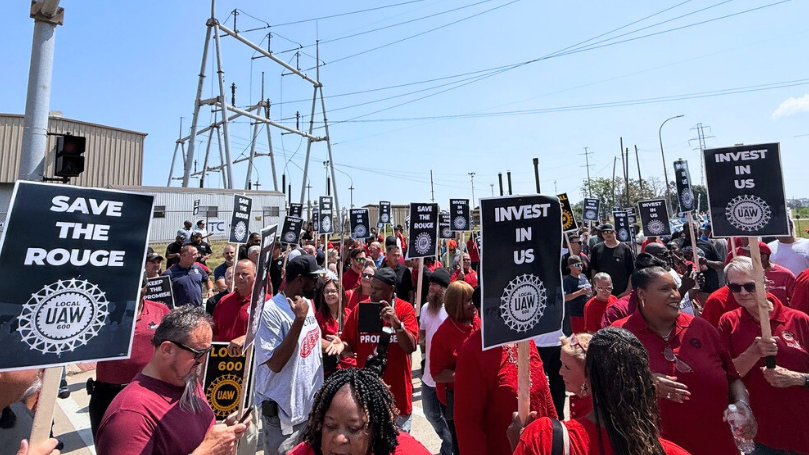
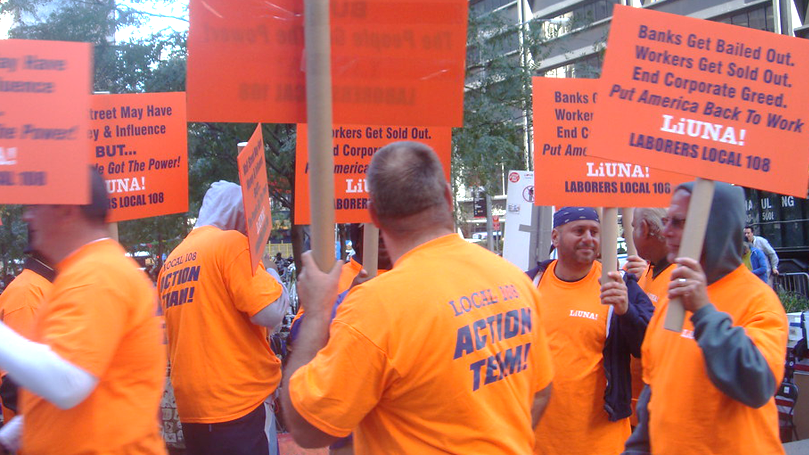
Images: United Auto Workers Local 600 demonstrate outside Steel mill in Detroit. People’s World; Laborers Local 108 demonstration. Creative Commons/Flickr; SEIU 32BJ demanding ICE OUT. SEIU on X; UE Local 197 in DC. United Electrical Workers; CBTU 54th International Convention. People’s World; WFTU demonstration in Paris. People’s World.
 Join Now