

The November 2026 midterm elections are rapidly approaching with the force of a hurricane. As Communist Party USA co-chair Joe Sims recently told the National Committee, “everything revolves around defeating the MAGA forces,” including labor rights, civil rights, women’s rights, LGBTQ rights, the environment, peace, and democracy itself. The fascist danger, the “whiff” from the Gus Hall period, is no longer a warning.
At the same time, a deep radicalization process is underway among the working class and its natural allies. Millions are rejecting the status quo and looking for real alternatives, including socialism and the Communist Party USA. Democratic Socialists of America candidates are winning Democratic primary victories around the country. The labor movement, previously hesitant to engage against Trumpism, is increasingly playing a role in the fightback, however uneven. The “socialist moment” is creating new possibilities for working-class politics that would have seemed unimaginable just a few years ago.
But this radicalization does not automatically translate into political power or strategic clarity. The question that has haunted the U.S. Left for generations remains: how do we break out of sectarian isolation without abandoning our revolutionary principles? How do we work where the masses of working people are while at the same time building toward independent working-class politics?
In 1959, CPUSA leader William Z. Foster grappled with these same questions in his Political Affairs article, “Work in the Two-Party System.” His insights, and his limitations, offer important lessons both for the Left and for the CPUSA’s orientation to the 2026 midterms and the broader struggle for democracy and socialism.
The CPUSA and the all people’s front
The CPUSA’s current approach to these questions is guided by a two-fold orientation: active participation inside the broad, democratic and progressive coalitions — including with the labor movement, civil rights organizations, faith communities, and neighborhood organizations — that are necessary to defeat MAGA, while simultaneously building outside the Democratic Party. In the first place, this entails strengthening the independent political capacity of the working class, which includes running Communist candidates under our own colors.
The Party’s role is to engage in and with the movement as an independent communist force in the all people’s front while building our own party and the broader infrastructure for independent working-class politics. This inside/outside approach is a strategic necessity rooted in the objective conditions of U.S. politics. The present structural barriers to independent working-class political action are immense and deliberately designed by capital to preserve the two-party duopoly.
For instance, ballot access laws in most states require thousands of signatures and prohibitively expensive filing fees to get a third party on the ballot. The Citizens United decision flooded the electoral system with unlimited corporate dark money and made it nearly impossible for working-class candidates to compete without access to billionaire-funded super PACs. Not to mention that the Electoral College systematically dilutes the votes of the working-class and people of color by design in order to protect elite, minority power.
These are the present features of a capitalist system built to limit, and at worst exclude, working-class political participation. Thus, operating both inside and outside the two-party system is not a contradiction but a clear response to these concrete conditions. For the CPUSA, it means using the spaces available inside the system to build up the necessary forces and power to transform it.
Meanwhile, the MAGA right is in the midst of a new anti-communist offensive, with hearings and investigations targeting the Left, including the CPUSA. This is a concrete effort to intimidate, disrupt, and criminalize the work of the working class, the Left, and progressive forces. The only immediate way to stop this offensive in its tracks is to defeat MAGA at the ballot box in November. We must deny them the political power to continue pursuing their fascist agenda.
The critique of sectarianism
Foster’s central contribution in his 1959 article was his critique of Left-opportunism and sectarianism. He understood that the Communist Party inherited from its forerunners a policy of “having no truck whatever with the two-party political system, regardless of the isolationist consequences.” This posture, he argued, produced “a serious split in the ranks of the working class, with almost the entire Left on the sectarian end of the split, and defending it with all sorts of so-called revolutionary arguments.”
The 1948 Progressive Party experiment exemplified this error, he argued. He called it “one of the most serious errors made by the Party during the entire period” — an “isolationist policy” that pulled members out of mass work, “broke up the Left-Center alliance in countless unions,” and left the Party weaker, not stronger. His critique was not of independent political action as such, but of premature splits that placed the Left in direct opposition to “the body of the workers who are still supporting the Democratic Party.”
As was the case then, still today the Communist Party cannot build a working class-led mass movement by standing apart from the people, especially during a time where the national debate remains centered around defeating the MAGA threat.
At its most recent National Committee meeting, the CPUSA reiterated the policy of struggling inside the broad movement, where millions of organized workers conduct political activity, to defeat the extreme right, saying that “standing aside is capitulating to fascism,” an echo of Georgi Dimitrov’s warning to the Communist International in 1935.
The two-party system
Importantly, Foster also understood that working within the two-party system could not mean surrendering to it. Progressives, he insisted, must “propagate their progressive program and line in the old parties,” build strong worker organization inside them, and “focus the attention of the masses on the eventual perspective of the Labor Party.”
This required a delicate balance for the Party. Communists must be engaged enough to reach the masses, yet independent enough to avoid being absorbed. Foster criticized the Party for failing to “theorize” this work and undertaking it “only half-heartedly.”
But Foster was writing in 1959, when the two-party system, while “closely controlled by the monopolists,” still operated within recognizably democratic norms. The Republican Party of Eisenhower is not the Republican Party of Donald Trump.
Thus, the task today is not just to “build worker organization inside the old parties while orienting toward an eventual Labor Party,” as Foster argued then — particularly since his framework, read literally, could be taken as an endorsement of working within the Republican Party as well. This approach is clearly untenable in the era of MAGA fascism. The task is to participate whole-heartedly inside the broad, democratic all people’s front to defeat MAGA, while simultaneously working outside it to build the independent political capacity of the working class and the Communist Party.
Moreover, defeating MAGA necessitates a struggle to transform the undemocratic electoral structures of the two-party system and bourgeois democracy. This means building support for and winning fundamental electoral reforms in the first place — including ending corporate domination of elections, securing proportional representation and ranked-choice voting, as well as an end to gerrymandering. Making it easier for workers to organize and bargain collectively — through the PRO Act for example — is also key to building a working-class counterweight to billionaire domination of the electoral sphere. These reforms are not ends in themselves, but they are essential preconditions for any serious working-class political challenge to the existing order.
Where Foster’s article remains most relevant is his emphasis on the labor movement as the backbone of any independent working-class politics. This remains true. “It is impossible to establish an effective Labor Party movement without a solid trade-union foundation,” he wrote, pointing to “several generations of effort to create the Labor Party” that foundered precisely on this weakness.
Today, while the labor movement is increasingly orienting itself towards political independence, including running its own election operations and putting forward its own candidates, much more needs to be done ideologically, politically and programmatically. The labor movement’s involvement in the general anti-MAGA fightback is still uneven. It is true that some center forces have moved, but the Left in labor remains a minority. Therefore, the primary task of the Left and the Communist Party remains to deepen these relationships, to help build the labor-led coalitions that can sustain the fight beyond November, and to ensure that the working-class stamp on the anti-fascist movement is not just symbolic, but programmatic.
The Party must engage with and help strengthen the trade unions politically. Unions have their own independent electoral operations, including get-out-the-vote mobilizations, mailing lists, phone banks, and independent candidate endorsement processes. As Sims noted in the recent National Committee keynote, “unions are armed with a ready-made form of political independence.”
Working with and within the trade union movement’s political operations, including reaching out to local unions and central labor councils to volunteer with their efforts, is working to build up the infrastructure for independent working-class politics as well as gain the skills and lay the groundwork for our own candidates in the future.

Political independence: the Leninist framework
What do we mean by “political independence” anyways? Here, Lenin’s formulation in Two Tactics of Social-Democracy in the Democratic Revolution is instructive. For Lenin, political independence was not a matter of declarations or slogans, but a question of class leadership — whether the working class could place its own stamp on the democratic revolution, or whether it would remain subordinate to other class forces.
Political independence, in this sense, means the ability of the working class to articulate its own interests, to build organization and unity, and to objectively lead the struggles for democracy and ultimately socialism. As Lenin said, the working class must “make its own class demands” and “not dissolve in the democratic bourgeoisie” — a warning that remains prescient today.
DSA and the socialist moment
The recent victories of DSA candidates around the country in Democratic primaries represents a new, qualitative development. There now exists a socialist movement operating inside one of the two main capitalist parties, while at the same time maintaining a more-or-less independent political identity outside of it.
For the Left, this creates both opportunities and challenges. On one hand, the DSA victories confirm that a deep radicalization is taking place in the working-class electorate. As noted, there is a great dissatisfaction with both the Democratic and GOP establishments. The response by the Democratic Party establishment to the DSA primary campaigns is actively creating an antagonism between the corporate wing of the party and the progressive wing, with many new activists getting involved in grassroots politics for the first time.
On the other hand, the DSA’s success within the Democratic Party raises the same question Lenin and Foster grappled with: how does the Left work where the masses are without being dissolved?
Foster warned that “reformists and opportunists of all shades have long since dabbled with political activity within the [Democratic Party],” and that “for the most part, however, they have immediately shed their previous radical pretensions.”
For the most part, the DSA’s ability to mostly maintain its democratic socialist identity while operating inside the Democratic Party is a phenomenon worthy of consideration. At the same time, the Communist Party cannot simply follow the lead of social democrats, lest our own independence is sacrificed. The Party’s role is not to tail developments, but to help shape them through the struggle process itself — including pushing beyond reforms and capitulation, and towards the development of truly independent working-class politics.
This brings us back to the CPUSA’s current electoral push: running Communist candidates under our own colors in tandem with the broader anti-fascist movement. Of course, the goal is not to isolate ourselves and run vanity campaigns, but to build visibility and leadership, organizational infrastructure, as well as to help push the entire political discourse to the Left, and create space for more ambitious demands and more socialist solutions.
The 2026 midterms
The most immediate political task this November is to end the MAGA control of Congress. In the first place, this requires the broadest possible unity in building the all people’s front. But unity does not mean surrendering the political independence of the working class or the Communist Party. The anti-fascist electoral work must be struggle-oriented in order to compel candidates to embrace working-class demands while always holding them accountable, and at the same time continuing to build independent political infrastructure that will outlast any single election.
Foster’s more strategic goal argued for in his essay — “the formation of the Labor-Negro-Farmer Party” — remains compelling, but the form it takes in 2026 may differ from what he envisioned. For one, the CPUSA program now calls for an independent party led by labor, not a “Labor Party” as such, but a party that places working-class interests at the center, that is independent of both bourgeois parties, and that can unite the multi-racial working class around an anti-fascist, anti-monopoly program.
Foster understood that the Communist Party had to work where the masses were — and that meant, in his time, engaging seriously with the Democratic Party base while never abandoning the strategic goal of independent working-class politics. He also understood that sectarianism was a dead end, that needless splits weakened the labor movement, and that without a solid trade-union foundation, any talk of an independent party remained just talk.
But the situation Foster analyzed is not the same situation we confront today, nor could it be. The Republican Party is on a trajectory now to become an active vehicle for fascist consolidation. In this context, the broad anti-fascist people’s front is not a tactical choice but an absolute necessity, and the Communist Party must be present in that front, visible and engaged, and not standing apart. Yet, merely being “present” is not enough. The Communist Party’s task is to remain an active part of the whole struggle process: to provide political clarity, strategic unity, and bring into being the necessary working class leadership and independence on the road to socialism.
The opinions of the author do not necessarily reflect the positions of the CPUSA.
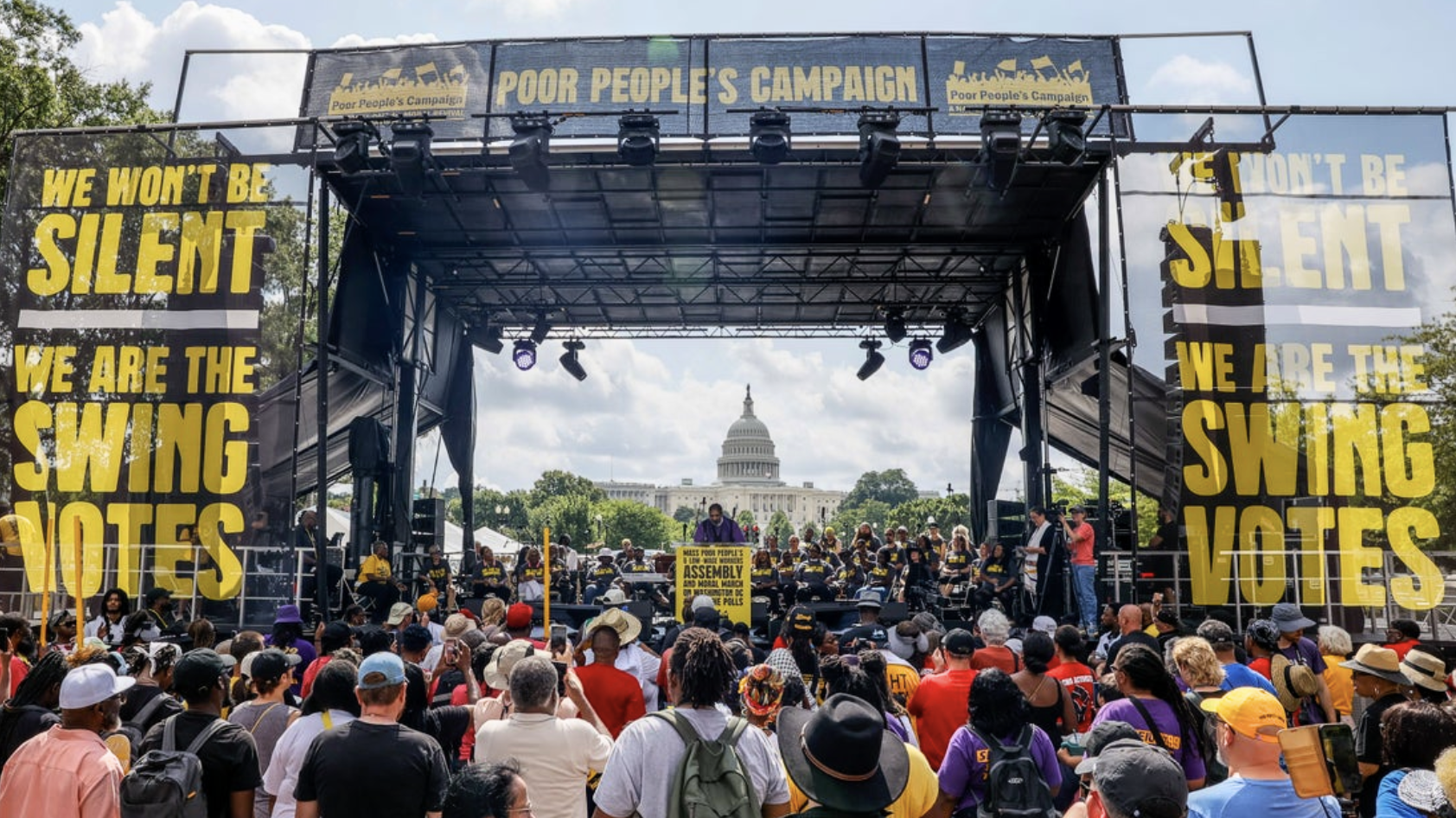
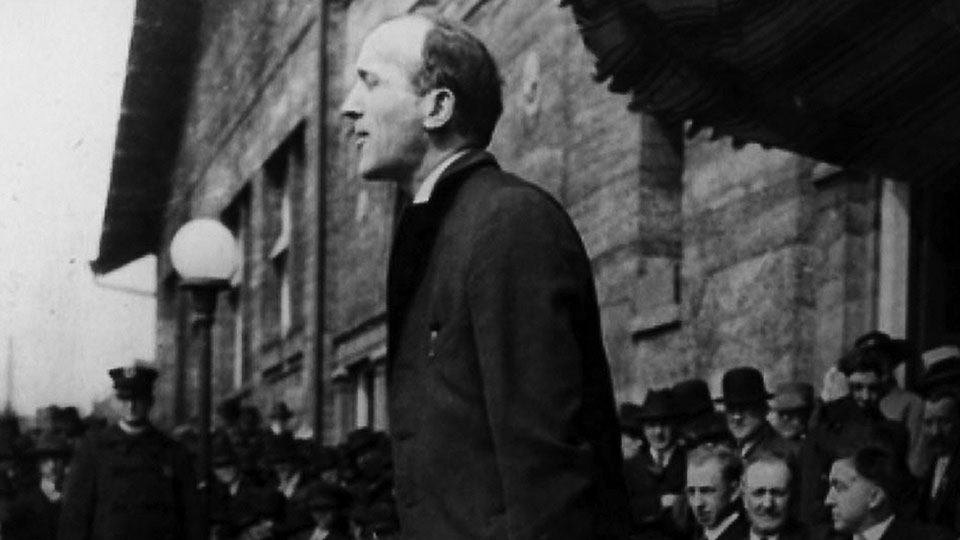
Images: Poor People’s Campaign Rally in DC. We are the swing votes! Repairers of the Breach; William Z. Foster, seen here during the Great Steel Strike of 1919. People’s World Archives; United Auto Workers members conduct door-to-door canvassing for 2026 midterms. UAW on Facebook.
Author

-
Cameron Harrison is a trade union activist and organizer for the CPUSA Labor Commission.
 Join Now